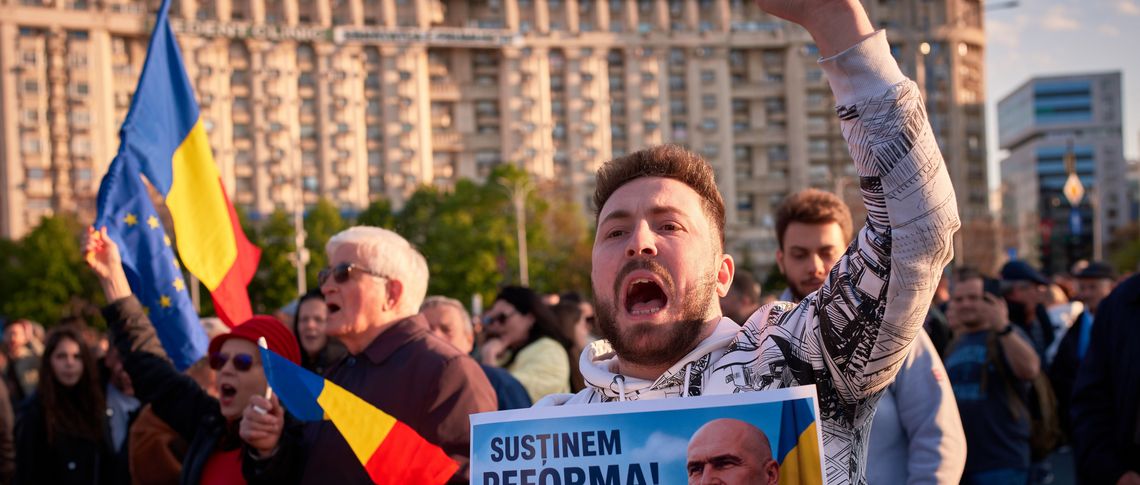
Romania is entering a new phase of political and economic turbulence at precisely the moment when stability matters most. The dismissal of Prime Minister Ilie Bolojan’s cabinet through a joint no-confidence motion initiated by the Social Democrats (PSD) together with the far-right Alliance for the Union of Romanians (AUR) exposed the growing fragility of Romania’s pro-European coalition. The move shocked the political establishment because PSD had formally been part of the governing coalition alongside the National Liberals (PNL), the reformist USR, and the Hungarian minority party UDMR. For months, PSD had insisted that any cooperation with AUR was out of the question. Yet political arithmetic and strategic calculation pushed the Social Democrats toward a risky course of action. But this current Romanian crisis is not merely a national story. It reflects a broader European dilemma.
Has the ‘Cordon Sanitaire’ fallen?
Many observers immediately described the vote as the collapse of the ‘cordon sanitaire’ around the far-right AUR. In reality, the taboo had already weakened years earlier. In 2021, the reformist USR itself attempted to bring down a national liberal, PNL-led government with the support of AUR – the sad irony is that now the same USR is backing up Ilie Bolojan against the Social Democrats. What makes the current episode significant is not simply parliamentary cooperation with extremists, but the political weight of the actor engaging in it. The social democratic PSD remains the country’s largest party and a central pillar of Romania’s political system. Its willingness to cooperate tactically with AUR contributes to the normalisation of nationalist rhetoric within mainstream politics.
The current pro-European coalition was never a coalition of conviction. It was a coalition born out of weakness and necessity after the turbulent elections of 2024. Both PSD and PNL suffered historically poor results, while the far right surged. The constitutional crisis triggered by the annulment of the presidential election after allegations surrounding the candidacy of sovereigntist outsider Călin Georgescu only deepened public distrust in institutions. Although Nicușor Dan’s eventual presidential victory over AUR leader George Simion created the conditions for a broad pro-European parliamentary majority, the coalition that followed remained fundamentally defensive in nature. Its primary objective was not political transformation, but containment: preventing sovereignist forces from gaining power.
Across Europe, pro-European governments increasingly define stability in narrowly fiscal and technocratic terms.
That logic has shaped the government ever since. Faced with mounting fiscal pressures, pressure from financial markets, and European demands for budgetary consolidation, the coalition embraced an increasingly aggressive programme of austerity. VAT increased from 19 to 21 per cent, social benefits were reduced, and reforms in healthcare and education disproportionately affected lower-income groups. Administrative restructuring targeted nearly 19000 public-sector jobs, while municipalities faced mandatory blanket spending cuts.
The Bolojan government presented these measures as necessary acts of responsibility designed to restore fiscal credibility and stabilize the state. Yet this is precisely where Romania’s crisis becomes part of a wider European problem. Across Europe, pro-European governments increasingly define stability in narrowly fiscal and technocratic terms. Economic discipline, deficit reduction, and rising defence expenditures are treated as unavoidable necessities that leave little room for redistributive policies or social investment. While such policies may reassure markets and European institutions in the short term, they often deepen political alienation among economically vulnerable groups.
At the centre of Romania’s conflict lies a fundamental disagreement over this model of governance. Bolojan and the liberal-conservative PNL advocate rapid fiscal stabilization through broad expenditure cuts across state institutions and administrative structures. In their view, Romania’s structural weaknesses stem primarily from inefficient spending, corruption, clientelist networks, and an oversized and wasteful bureaucracy.
The social democratic, PSD, by contrast, argues that Romania’s deeper problem is chronic underinvestment, weak public services, and unequal distribution of resources. The Social Democrats initially supported parts of the fiscal consolidation agenda, but increasingly warned that permanent austerity risked hollowing out the already fragile social state. PSD also remained the only major voice within the governing coalition insisting on policies such as increasing the minimum wage in order to offset some of the social costs of adjustment.
A strategic dilemma
This dispute reveals more than a tactical coalition conflict. It exposes the strategic dilemma now confronting many European social democratic parties. On the one hand, PSD faces pressure from European partners, financial markets, and the broader geopolitical climate to support fiscal discipline, budget consolidation, and higher defence spending. Romania’s commitments within NATO and the European Union leave limited space for expansive spending policies.
On the other hand, fully embracing permanent austerity risks undermining the very foundations of PSD’s political identity. Historically, the party has drawn support from pensioners, public-sector employees, low-income households, and economically weaker regions dependent on public investment and social protection. If social democratic parties fully internalize the logic of technocratic fiscal retrenchment, they risk losing the capacity to articulate a credible social alternative altogether.
This contradiction helps explain PSD’s increasingly ambivalent positioning. The party wants to remain a credible governing force within the pro-European consensus while simultaneously preventing, the far-right, AUR from monopolizing social discontent. The danger for the Social Democrats is that, by becoming too closely associated with austerity and budget orthodoxy, they may accelerate the erosion of their own electoral base while strengthening precisely the anti-system forces they seek to contain.
The more pro-European coalitions define politics primarily through fiscal discipline and emergency management, the easier it becomes for sovereignist actors to present themselves as defenders of ordinary citizens against detached elites.
The rise of AUR therefore cannot be understood solely through nationalism or cultural conservatism. Economic insecurity, distrust toward political elites, and frustration with technocratic governance are equally important. The more pro-European coalitions define politics primarily through fiscal discipline and emergency management, the easier it becomes for sovereignist actors to present themselves as defenders of ordinary citizens against detached elites.
Romanian politics increasingly resembles a form of brinkmanship without long-term strategy. Parties escalate risks precisely because they lack coherent political projects capable of rebuilding social trust. Coalitions are assembled defensively, governments survive through tactical compromises, and crises are managed reactively rather than being politically resolved. The objective is always immediate stabilization: reassuring markets, preserving parliamentary majorities, containing extremists, and satisfying European partners.
Yet little attention is devoted to addressing the structural problems that continue to erode democratic legitimacy: regional inequality, weak institutions, declining trust in political parties, demographic decline, and the inability of the state to provide effective public services. The danger now is not merely governmental instability. It is that repeated cycles of austerity, elite conflict, and technocratic crisis management will continue to fuel the growth of anti-system and sovereignist forces.
The irony is striking. Romania’s pro-European coalition was formed precisely to prevent such an outcome. Yet through its internal contradictions, strategic cynicism, and inability to articulate a convincing common social vision, it may ultimately contribute to the very forces it was designed to contain.