Once again, explosions can be seen and heard on television. Images of smoking buildings and rocket trails streaking across the night sky flicker across social media, accompanied by the familiar voice from the White House: boastful, sadistic, intoxicated with itself. This is precisely what Jesse Welles is currently singing about at his concerts. His song ‘Sometimes You Bomb Iran’ – written after the first bombings of Iranian nuclear facilities last summer – has regained a depressing relevance with the new escalation. What Trump’s administration presents as determination, Welles renders audible as a mixture of cynicism, recklessness and aggression, a symptom of the political brutalisation that pervades this presidency and its public tone.
For Trump, governing is a matter of quick-wittedness, both militarily and rhetorically. The escalation of the conflict with Iran is being conducted militarily and exaggerated linguistically. ‘We have destroyed nine Iranian warships, and soon the rest will be at the bottom of the sea. Otherwise, their navy is doing very well,’ he announced maliciously on Truth Social. Days later, Trump doubled down in one of his meandering speeches, calling them ‘very evil people.’ A veil of indifference has long since settled over this choice of words and Trump’s grotesque exaggerations. This shows how far the normalisation of Trump’s politics and language has already progressed. Where, then, has the resistance gone? Perhaps it is not on the streets, at least not on the same scale as before – but it can still be heard.
An art of mood
Welles’ refrain ‘Sometimes you get out your B-2s, and go bomb Iran’ sounds anything but dramatic; it comes across as a casual, almost offhand comment on the headlines. But that’s exactly what makes it so sharp. The line does not directly contradict the escalation, but rather dismantles the public echo chamber that normalises war and exploits it for cynical punchlines. The fact that Jesse Welles fills halls with a song that does not morally outdo this language, but rather laconically echoes it and thus exposes it, demonstrates the paradoxical political power of the new protest music.
If you want to understand why a genre as anachronistic as the protest song is making a comeback under Trump, you have to let go for a moment of the idea that politics is just a series of programmes and laws that you can support or criticise, depending on your convictions. Politics is also an art of mood. It regulates the volume of public debate, the frequency with which collective emotions circulate, and accustoms us to new forms of attention. The language of Trumpism does not consist merely of false claims. It creates an acoustic order that dominates the public space with threats, ridicule and the cultivation of enemy stereotypes. The new protest music responds to this with a different form of collective resonance that almost casually robs the authoritarian tone of its self-evidence.
Right-wing rhetoric cannot be ignored without consequences because it changes the conditions of speech itself.
This sound policy can be observed precisely in Trump’s easily imitable sentences: short, recurring phrases, always the same superlatives, loosely strung-together words, erratic capitalisation, exclamation marks. Nothing is inferred, but everything is immediately clear. Understanding then means simply nodding along to the beat of a string of refrains, in which one sentence slips almost word for word into the next. The beat of this populist parataxis grinds even the most scandalous things into monotonous normality.
Those who do not want to submit to this rhythm find themselves in a dilemma that is often underestimated. Right-wing rhetoric cannot be ignored without consequences because it changes the conditions of speech itself: it keeps the excitement going and demands from the dissenting voices precisely the cool composure that it systematically sabotages at the same time. Those who are outraged are considered hysterical; those who remain calm appear to agree. Under such circumstances, even the best arguments are of limited use. What is missing is a form of speaking, listening and feeling that not only refutes this permanently agitated tone, but interrupts it. This is precisely where the new wave of protest songs comes in — as a counter frequency in a public sphere whose sound is becoming increasingly authoritarian.
The loss of the personal
‘Iran’. An unlikely word in a song. It has been a long time since American music has referred so directly to geopolitical locations. When this word hits a guitar whose strumming sounds more comforting than combative, a peculiar contrast emerges. Welles relies on the laconic, sarcastic intonation familiar from Nina Simone’s setting of Langston Hughes’ ‘Backlash Blues’: ‘Raise my taxes / Freeze my wages / Send my son to Vietnam.’ He rhymes ‘Iran’ with ‘God’s plan’ – a dig at the missionary zeal and self-proclaimed sanctity of Trumpism, which constantly invokes a higher mission and yet pursues its fantasies of world domination in a strikingly haphazard manner.
Yes, Jesse Welles sings the news. But above all, he demystifies it. He replaces the alarmism of the headlines with an almost bored resignation, a musical shrug: Here we are again.
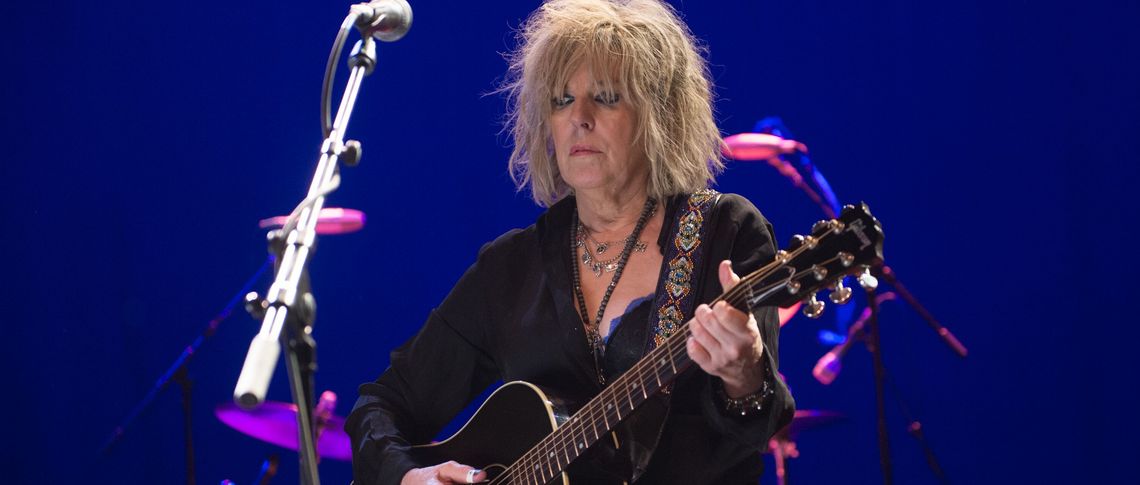
While Welles revives folk satire, Lucinda Williams occupies the space of silent witness with her current album World’s Gone Wrong. In elegiac assessments of loss that are far removed from the barricade sound of classic protest songs, she turns private pain into a diagnosis of social decay. Like Welles, Williams also dispenses with the glossy hymns of contemporary protest pop. Her songs are a conscious departure from danceable resistance, which often remains too commercially exploitable to really hurt. Williams thus ties in with an older folk tradition, as shaped by Woody Guthrie and Malvina Reynolds — a sparse aesthetic that emerged from poverty, precariousness and social vulnerability.
We tend to see political effectiveness only where masses take to the streets.
If there is a counterpart to the American protest song in Germany, it is most likely to be found in musical anti-fascism. But this music often thrives on volume and clear edges. When Die Ärzte sing against the right wing or young punk bands attack ‘Fortress Europe’, it is music for the streets, for collective rebellion. In such vehemence, however, the personal threatens to be lost. This is where the difference to Jesse Welles and Lucinda Williams lies. Both forego overwhelming effects in favour of reduction.
As different as the historical constellations in the US and Germany are, Trumpism and AfD language are rhetorically similar in one respect: both operate with martial pathos, a narrow repetition cycle and the constant invocation of a threatened people. Sarah Lesch shows in ‘Nie wieder’ (Never Again) that a political song does not have to respond with counter-noise. The song exposes the contradiction between a morally charged culture of remembrance and a present in which empathy is becoming increasingly scarce.
We tend to see political effectiveness only where masses take to the streets. But we should not forget that real change begins with the individual, long before it becomes visible. When a song keeps us awake at night or forces us to question our own comfort, that is already a form of political work.