


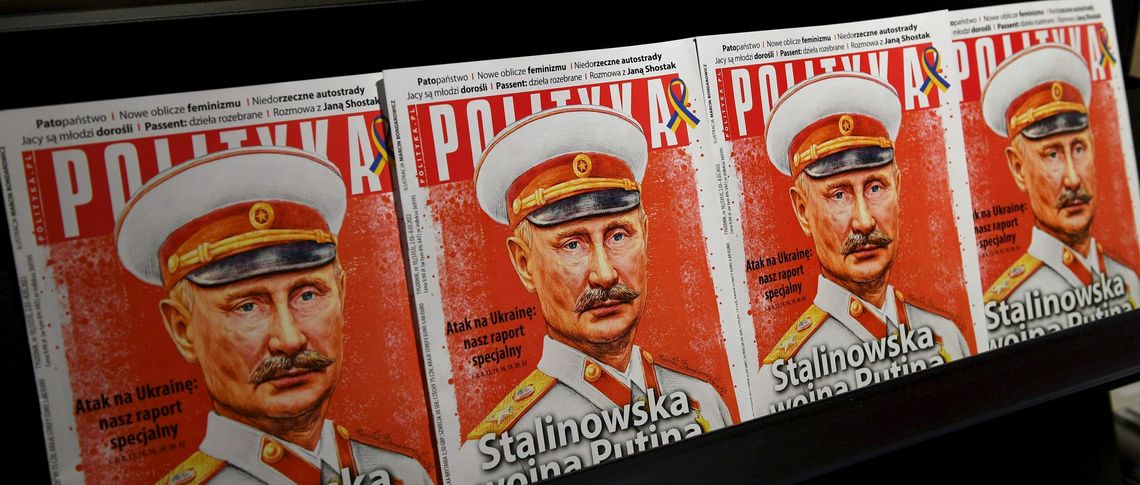
The following sentence is variously attributed to Politburo member Nikolai Bukharin or NKVD chief Nikolai Yezhov: ‘Comrade Stalin, there must be some terrible mistake!’ Both fell victim to Stalinist repression and were sentenced to death. The words have become emblematic in Russia of the desperate hope shared by many of the persecuted: if only one could prove loyalty to the leader, the machinery of repression might stop.
A similar tone has been heard recently. Kremlin-aligned political analyst and former Duma deputy Sergei Markov protested on his Telegram channel against being labelled a ‘foreign agent’. For 25 years, he has supported Vladimir Putin’s policies and is even under Canadian sanctions. Markov, a regular on propaganda talk shows and once Putin’s official campaign confidant in 2012, claimed that he had simply been slandered. The phrasing strikingly resembles the desperate appeals of victims of Stalinist repression. The irony is hard to miss: not long ago, Markov demanded that ‘foreign agents’ be dealt with more harshly and cut off from all information resources. Now he himself appears as number 1053 on that very list.
From loyalist to target
Opposition figures in Russia have long been under pressure, prosecuted or forced into exile. Since the start of the war of aggression against Ukraine, however, even declared war supporters and Z-patriots have increasingly been affected by repressive measures. As long as repression targeted ‘ideological opponents’, many applauded or at least remained silent, believing themselves to be on the ‘right’ side. Their error was obvious: the regime draws no reliable ideological line. Overnight, an ally can become a suspect. Liberal opponents of the system have largely been neutralised. Now, Sauron’s gaze falls on its own ranks. Neither office nor rank, neither old alliances nor networks, offers any guarantee of safety.
Since the beginning of last year, there has been a veritable wave of spectacular arrests and dismissals among high-ranking officials and major business figures previously considered loyal. In the fourth year of the war, this development resembles a structural overhaul under high pressure. According to research by the independent newspaper Novaya Gazeta, over 155 senior officials had been detained by October 2025 alone — including senators, Duma deputies, regional parliamentarians, ministers, governors and their deputies, as well as members of the defence sector. Judges, security officials and cultural figures have also come under the scrutiny of state investigations.
Even the closest proximity to power no longer protects one’s family.
Several deaths and alleged suicides among senior regional officials cast a particularly grim shadow over these developments. The probably greatest shock to the ruling elite came in July 2025 with the suicide of the Minister of Transport and former governor of the Kursk region, Roman Starovoit. Reports suggest his death was linked to bribery investigations and rumours of his imminent dismissal.
The wave of repression has not spared the judiciary or security apparatus. Regional leaders of security agencies have been arrested, senior investigators charged. Already this year, six senior employees of the Russian Investigative Committee were sentenced to long prison terms in a corruption case. The case is particularly revealing: one of the convicts, Sergei Romodanovsky, was sentenced to 19 years. He is the son of former head of the Federal Migration Service, Colonel-General Konstantin Romodanovsky, one of the defining security officials of the late Putin era. Romodanovsky senior died in autumn 2024; the circumstances of his death were not made public. That his death coincided with the high-profile trial of his son is widely read as a symbolic end to an era and simultaneously as a warning to the elites: even the closest proximity to power no longer protects one’s family.
At first glance, this development could be seen as a long-overdue anti-corruption drive. Yet a closer look at the pace, scale and regional spread of the cases reveals a different pattern: under the conditions of a prolonged war, the political reliability of the entire power vertical is being reassessed and more strictly monitored. The message to officials and top managers is unambiguous: no one is untouchable, the repressive apparatus remains ready for action at any time.
As recently as 2022, the Kremlin seemed to offer the economic and administrative elites a tacit deal: the West imposes sanctions, but in return new opportunities open up at home. Loyalty ensured continued earnings, promotion and influence. But these rules have evidently changed. The longer the war continues, the greater the pressure on the state leadership — without any clear guarantee of security. Sociologist Viktor Vakhstayn describes the mood in the upper echelons with the image of a submarine: everyone is in it, no one can get out. Formal procedures have been replaced, in effect, by a system of situational individual decisions. Political caution and even demonstrable loyalty provide no protection. Those without an influential patron remain vulnerable. Dense networks of personal relationships matter more than ideological proximity, though even that offers no guarantee anymore.
The mechanism of repression produces no lasting winners, only a climate of general insecurity.
Kremlin-aligned political scientist Yevgeny Minchenko speaks openly of massive uncertainty and even panicked reactions among the elite. There are no clear rules left to reliably prevent persecution or dispossession. The decisive question now is: ‘What must one do to avoid arrest and keep one’s property?’ Minchenko notes that both society and the upper echelons are characterised by fatigue and nervousness. Notably, the zone of risk extends beyond politics. Prominent figures in entertainment are also under pressure, even if they avoid political statements. This month, Nurlan Saburov, one of the country’s best-known stand-up comedians, a Kazakh national who lived in Moscow for years and deliberately presented himself as apolitical, was banned from entering Russia for 50 years — officially for ‘reasons of national security and the protection of traditional values’. Another comedian received a multi-year prison sentence after a failed stage joke. These episodes make clear that public visibility itself has become a risk. Prominence is equated with being difficult to control, and therefore dangerous.
Inevitably, the question arises: who actually benefits from this wave of repression? Formally, most cases originate from investigative and supervisory authorities. Political scientist Ekaterina Schulman once summarised the principle concisely: ‘It is always Comrade Major.’ Yet even within the security apparatus, there are no reliable safe spaces anymore. The cases against senior officials in the Ministry of Defence in the summer of 2024 illustrate this clearly. Senior officers from Sergei Shoigu’s closest circle were implicated, even though Shoigu had recently stepped down as minister. Shoigu has long been a close confidant of Vladimir Putin. Yet even this proximity was insufficient to protect his long-time associates from prosecution.
The mechanism of repression produces no lasting winners, only a climate of general insecurity. The system stabilises itself through ongoing deterrence. Yet therein lies its paradox: a power that for decades secured loyalty through privileged access to resources has now itself become a source of danger for its most faithful servants. The process of internal erosion is underway: control is maintained primarily through the constant threat to one’s own functionaries. There is no talk of an imminent collapse, however, as the regime still possesses considerable resources and remains operational for the foreseeable future. But the first cracks are visible. The system devours its own children — and in doing so becomes structurally vulnerable.


