As a new government takes office, Côte d’Ivoire has a rare opportunity to turn political transition into a catalyst for women’s leadership and inclusive growth. With legislative and presidential elections now concluded and a new government in place, the focus has shifted from campaigning to governing, from promises to delivery. This transition offers more than a reset of political priorities. It provides a strategic opening to address a persistent challenge: how to inspire and enable more women to take on leadership roles and shape public decision-making at all levels.
A woman from Bouaké captures a sentiment shared by many across the country: ‘My community has never been represented by a woman. Now I have the courage to be the first.’ Her words linger, not because they are exceptional, but because they should not have to be.
Why this matters now
Political transitions are rare windows, and the inclusion of women from the start sets strong foundations for the future. Côte d’Ivoire already has proof that progress is possible — and a clear sense of the untapped potential that remains. Women now hold strategic positions at the highest levels of the state. The appointment of Kaba Nialé as Minister of Foreign Affairs signals growing confidence in women’s leadership on the international stage. Equally significant is the leadership of the State Minister of the Civil Service and Modernization of the Administration, Anne Désirée Ouloto-Lamizana, a long-standing advocate for women’s advancement.
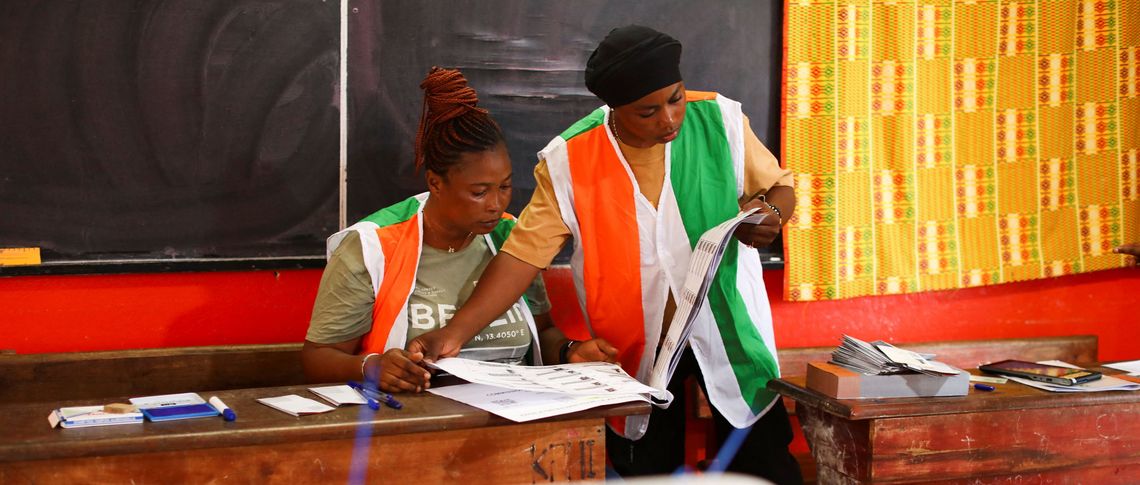
However, significant gaps remain. Despite recent gains, women are still markedly underrepresented. Following the 2025 legislative elections, women hold only 34 of the 253 parliamentary seats — not even 14 per cent. That falls far below the 30 per cent target set by Côte d’Ivoire’s own 2019 parity law.
Women’s leadership is not a matter of symbolism. When women participate meaningfully in decision-making, institutions perform better, public services are more inclusive, and societies become more resilient. Communities with women leaders invest more in education, health and social cohesion. Peace processes that include women last longer, and economies that reduce gender gaps grow faster. These patterns are well-evidenced across Africa and the world.
For Côte d’Ivoire to accelerate women’s access to leadership, confidence-building must be matched by deliberate institutional support, mentorship at scale, and systems that actively identify and promote women leaders.
The Ministry of Women, Family and Children, the United Nations Development Programme (UNDP) and the Embassy of Switzerland to Côte d’Ivoire are jointly tackling the structural barriers that keep women out of politics and public leadership. One flagship initiative is the Chrysalide Women’s Leadership Incubator, designed to help women move from civic engagement to political and institutional leadership. Through mentorship, leadership coaching, peer networks and campaign training, Chrysalide addresses one of the most critical gaps in women’s political participation: the transition from potential to power.
Scaling up similar initiatives is essential if the country is to meet its own legal commitments and build a sustainable pipeline of women leaders across regions and sectors. Participants in the programme consistently highlight the impact of confidence-building and support networks. Their stories reflect a broader reality. When women see their peers succeed – as mayors, senior civil servants, entrepreneurs or community leaders – leadership stops feeling exceptional and starts to feel attainable.
Drawing on her own experience, Minister Ouloto-Lamizana, a champion of the Chysalide programme, has spoken candidly about the obstacles women face in politics and public service: ‘I have been told many times that I did not belong. Each setback could have ended my journey. What made the difference was mentorship, resilience and institutions willing to open doors rather than close them.’
The message is clear: talent alone is not enough. For Côte d’Ivoire to accelerate women’s access to leadership, confidence-building must be matched by deliberate institutional support, mentorship at scale, and systems that actively identify and promote women leaders, rather than expecting them to succeed despite structural barriers. And those barriers are multiple and deeply entrenched.
What must change
Beyond social norms and the inherent harshness of political competition, one of the most persistent constraints on women’s accelerated emergence into political leadership is economic and financial in nature. This is not a question of insufficient public support – state mechanisms already exist – but rather the result of long-standing structural inequalities in access to economic opportunity. Historically, processes of wealth accumulation have favoured men, who have benefited disproportionately from educational, professional and business opportunities. As a result, women enter the political arena with fewer economic assets and weaker financial networks.
In the context of Côte d’Ivoire, pursuing a political career often requires securing substantial personal and relational financial funds, particularly during electoral campaigns. Yet women continue to lag behind in this domain. On average, women earn significantly less than men, are underrepresented in formal private-sector employment, and face more limited access to credit and capital. These economic disparities thus translate directly into political disadvantages, constraining women’s ability to finance campaigns, secure party nominations, access influential political networks and sustain long-term political engagement.
These economic barriers intersect with other well-documented challenges. Access to campaign financing, party nominations, political networks, transparency mechanisms and media visibility continues to disadvantage women. Heavy domestic and caregiving responsibilities further limit the time and resources available for political participation. Together, these constraints slow progress toward parity, despite the existence of strong legal and institutional frameworks.
The growing visibility of women in senior government and business positions is gradually reshaping social norms and public perceptions of leadership.
At the same time, opportunities for change are expanding. Côte d’Ivoire’s parity law provides a solid foundation for advancing women’s political representation. Leadership incubators and capacity-building initiatives have demonstrated tangible results. Women’s political and professional networks are becoming stronger and more coordinated. Digital tools are increasingly lowering barriers to mobilisation, communication and fundraising. Moreover, the growing visibility of women in senior government and business positions is gradually reshaping social norms and public perceptions of leadership.
It is in response to these structural economic constraints that, at the end of 2025, the Ministry of Women, Family and Children launched the Programme for the Development of Women’s Economic Initiatives and Capacities, aimed at strengthening women’s economic empowerment. The programme seeks to enable women with leadership potential – particularly in rural and semi-rural areas – to progressively acquire the economic and financial means necessary to support their political and professional ambitions.
The path forward is clear. What works must be scaled up. Political parties must move beyond formal commitments and actively identify, mentor and support women candidates. Local governance structures can serve as strategic entry points and pipelines for future women leaders. Public and private institutions can promote gender equality in senior decision-making roles. Innovative and gender-responsive financing mechanisms can reduce economic barriers, particularly those associated with electoral campaigns. Media organisations, for their part, can normalise women’s leadership by amplifying their stories and committing to balanced and fair political coverage. Taken together, these actions would move Côte d’Ivoire closer to its 30 per cent parity objective while strengthening governance, social cohesion and development outcomes.
Côte d’Ivoire has already made progress on the Human Development Index, and accelerating women’s leadership would further reinforce its position as a regional leader for inclusive growth and stability in West Africa. The country is not alone in its struggle. Across the region, women’s political representation continues to lag behind legal commitments.
With initiatives like Chrysalide, designed to be scalable and replicable, there is a real opportunity to demonstrate what effective, homegrown transformation looks like. As Minister Ouloto-Lamizana reminds us, ‘Leadership is not a gift — it is a responsibility.’ Côte d’Ivoire now has a historic opportunity to ensure that more women are empowered to assume that responsibility and help shape the nation’s future.