


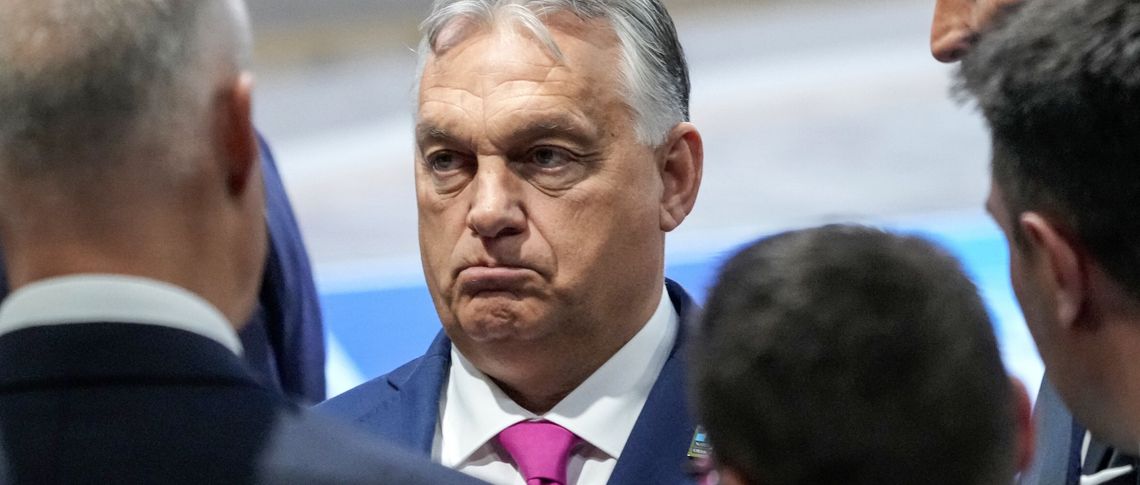
Earlier this week, US Vice President JD Vance visited Hungary. Scheduled only a few days before the parliamentary elections on 12 April, this represents something of a last-minute rescue mission. In most opinion polls, Fidesz, Viktor Orbán’s party, has fallen hopelessly behind its rival Tisza, a liberal-conservative anti-Fidesz movement. There is a palpable sense of a desire for political change in the air, especially in the cities.
There has always been some dissatisfaction with the ruling Fidesz in Hungary, but it has grown in recent years. It’s true that the party has been able to win four consecutive elections with an absolute majority, but this time things are different. The mood in the country has changed, and a new figurehead has emerged in the anti-Fidesz camp. Tisza’s strong support can be attributed to a variety of factors. After 16 uninterrupted years in government, a general fatigue with Fidesz and Orbán seems almost inevitable. Many Hungarians are taking an increasingly jaundiced view of this whole period. Most people see no progress, but rather stagnation and even deterioration in the main policy areas.
After four terms in office, Fidesz appears burned out and lacking in ideas.
Developments – or the lack of them – in health care, schools and public infrastructure are regarded as particularly problematic. After all, they affect most people on an everyday basis. Furthermore, the economy is stagnating because of the weakness of the German economy, with which Hungary’s is closely intertwined. Unemployment has reached a 10-year high. The high inflation experienced in recent years has undermined the purchasing power of the average household. In these circumstances, there is growing exasperation with the blatant nepotism and favouritism of the Fidesz regime, centred around a small circle of friends and relatives of the prime minister. Overall, after four terms in office, Fidesz appears burned out and lacking in ideas. The party seems unable to come up with an optimistic narrative about the future. The best they can offer is ‘business as usual’, which sounds ever more unconvincing.
By stark contrast, the Tisza movement of political shooting star Péter Magyar represents an authentic form of populism, surfing the wave of rising dissatisfaction. Magyar, formerly a middle-ranking Fidesz official and ex-husband of former Justice Minister Judit Varga, leapt onto the political stage almost out of nowhere in the run-up to the European elections in 2024. His Tisza party is basically a one-man show with strict lines of internal communication. Experienced politicians are pretty much persona non grata. If the opinion polls are anything to go by, however, this strategy appears to be a good one. Tisza draws its support from across the political spectrum, seemingly blithely indifferent to political sympathies and antipathies characteristic of the traditional party landscape.
Clear lead or neck and neck?
Fidesz has always been able to capitalise on people’s aversion to the ‘old parties’, not least the centre-left, which was held responsible for the socially and economically very destructive transition succeeding the change of system in 1990. Tisza’s cleverly crafted programme seeks above all to avoid charges of dilettantism and to ensure there are no psychological and political hurdles that might prevent voters from lending it their support. They are particularly keen on building bridges to dissatisfied Fidesz voters. This is evident above all in relation to the two issues on which Fidesz has contested not only earlier but also in the current election campaign, namely the war in Ukraine and migration. In relation to the latter, Tisza has promised to take an even harder line, ending the Orbán government’s guest worker programme. In relation to Ukraine, too, they are keeping their distance. Military support for Ukraine has been ruled out, and accelerated EU accession rejected. In general, European leaders should assume that even a future Tisza government will have to take domestic political sentiment into account on these two issues.
So far, this campaigning approach has been strikingly successful. Nevertheless, no one in the opposition camp is taking anything for granted. The reliability of polling on both sides has its limits. In previous elections, independent pollsters have seriously underestimated Fidesz support. Furthermore, they have found one of the party’s key constituencies – poor people in structurally weak rural areas, including many Roma – very hard to reach. A minority of Fidesz pollsters thus stubbornly claim that the party is in the lead or neck and neck. Many observers regard Fidesz’s attempt to frame Ukraine and its allegedly negative influence on Hungary’s future prospects as the main election issue as an act of desperation, because they don’t have anything else. But it does seem to be striking a chord. Volodymyr Zelenskyy is almost as unpopular in Hungary as Vladimir Putin.
Originally, the campaign was supposed to have a different focus. The idea was to contrast what ‘ordinary people’ could continue to count on under an Orbán government and the perilous leap in the dark under a Tisza-led administration. Fidesz’s campaign slogan is A biztos választás — the safe choice. But as the campaign failed to take off and the personal attacks on Magyar didn’t really get anywhere, Fidesz strategists decided to revert to their greatest hits, above all the invocation of an external enemy. In the past, cosmopolitan bogeyman George Soros, the US-Hungarian billionaire and political philanthropist, took pride of place. Today, he has been superseded by Zelenskyy and his ‘sponsors’ in Brussels, primarily Ursula von der Leyen and Manfred Weber. Some clumsy missteps by Ukraine – such as personal threats from Zelenskyy to Orbán and the shutdown of the Druzhba pipeline for Russian oil – have given the campaign new momentum in recent weeks. But even that has not been sufficient to regain ground lost to Tisza.
All in all, it appears too early to declare a winner in the Hungarian election. Nevertheless, the chances of a power shift in Budapest are much stronger this time. JD Vance’s visit will do little to help, about as little as the support expressed by Donald Trump himself, who recently called on Hungarians to ‘go out and vote for Viktor Orbán’, whom he described as a ‘true friend’. But this means nothing to most Hungarians, who are likely to have other concerns.


