


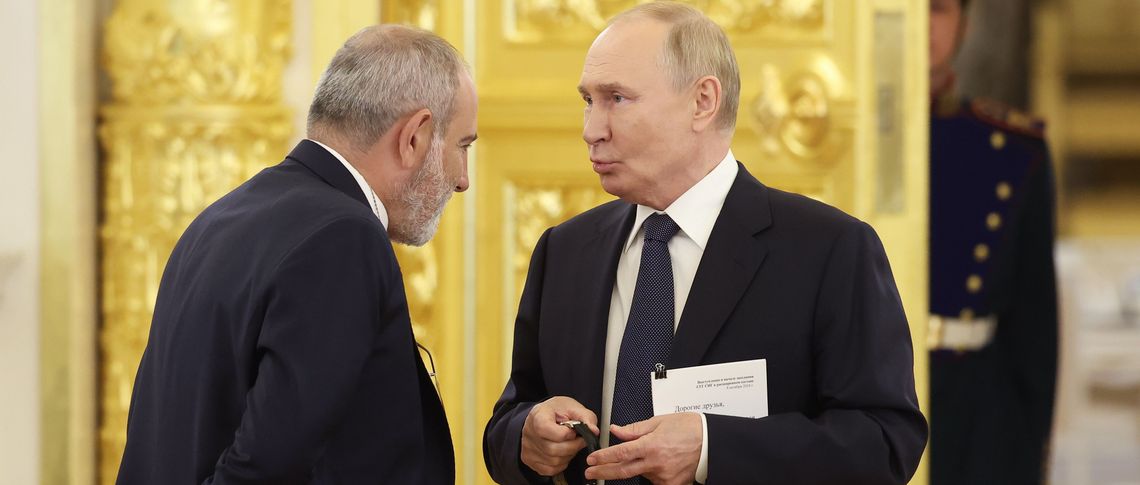
Russia’s growing pressure on Armenia has become the theme that has attracted most attention to the country’s election campaign. Officially, Moscow frames its criticism in response to Yerevan’s increasingly visible engagement with Europe. Yet the reality is more complex. As Armenians prepare to vote on 7 June, the country finds itself at the intersection of competing geopolitical interests, while Russia’s response reveals deeper concerns about Armenia’s gradual diversification away from its traditional dependence on Moscow.
It is therefore no surprise that the upcoming parliamentary elections have become heavily internationalised. Moscow has made little secret of its preference for opposition forces, while Donald Trump has publicly endorsed Prime Minister Nikol Pashinyan. Just weeks before the vote, Armenia hosted a high-profile EU-Armenia summit that was widely interpreted as an opportunity for the ruling Civil Contract party to showcase its growing international partnerships. Facing them is a fragmented but financially and media-powerful opposition, including Samvel Karapetyan’s Strong Armenia alliance and forces associated with the former presidents.
To understand the current security and political atmosphere surrounding the elections, it is necessary to look at the trajectory of Armenia’s foreign relations over the past several years.
A greater European threat
Following Armenia’s defeat in the 2020 Second Karabakh war, Azerbaijan’s military offensives against Armenia in 2022 and the ethnic cleansing of Armenians from Nagorno-Karabakh in 2023, Armenian-Russian relations entered their deepest crisis since independence. By 2025, however, signs of stabilisation began to emerge. Armenian leaders resumed more frequent visits to Moscow, mutual accusations became less confrontational, and Russia’s approval ratings among Armenians, which had collapsed after the events of 2023, stopped declining and began to stabilise.
At the same time, Armenia significantly deepened its relationship with the United States. A Comprehensive Strategic Partnership Charter, the Trump Route initiative, a US-mediated peace agreement, and a framework for nuclear cooperation followed in quick succession. Relations with the European Union also expanded. Brussels and Yerevan signed a Strategic Partnership Agenda, though neither side seriously discussed EU membership in the foreseeable future. Armenian officials consistently emphasised a more limited goal: expanding cooperation with Europe as far as both sides considered realistic.
Moscow has reacted more strongly to Armenia’s increasingly visible European engagement than to several developments in US-Armenian relations that arguably carry greater long-term strategic significance.
Initially, Moscow’s reaction remained relatively restrained. Armenian officials repeatedly reassured Russian counterparts that Armenia did not intend to leave the Russia-led Eurasian Economic Union (EAEU) and would not pursue policies directly aimed at undermining Russian interests. Only later did Russian concerns translate into the more visible campaign of discontent seen today.
Arguably, Armenia’s growing cooperation with the United States should have been of greater concern to the Kremlin. It carries more strategic substance and potentially more far-reaching consequences for Russian influence on the ground. Yet a longstanding feature of Armenian foreign policy once again worked to Yerevan’s advantage: the more manageable relations between Russia and the West become, the greater Armenia’s room for maneuver. Today, relations between Moscow and Washington differ significantly from Moscow’s relations with Brussels. This gives Armenia a differentiated geopolitical environment in which some forms of engagement with the United States provoke less – at least public – resistance than comparable engagement with Europe.
This dynamic helps explain one of the more striking features of recent Russian behaviour. Moscow has reacted more strongly to Armenia’s increasingly visible European engagement than to several developments in US-Armenian relations that arguably carry greater long-term strategic significance.
The contrast is particularly revealing. American initiatives have produced agreements with direct implications for energy, infrastructure, and other sectors where Russia has traditionally exercised influence. Yet the Kremlin’s public criticism has focused far more heavily on Armenia’s European trajectory. Officially, Russia has justified its pressure by pointing to concerns about Armenia’s possible future integration with Europe. In practice, however, the European dimension often appears to serve as a convenient framework through which Moscow can express broader frustrations about Armenia’s foreign-policy diversification.
The intensity of Russia’s reactions appears disproportionate to the actual likelihood of Armenian accession to the EU anytime soon.
The reality is that neither Brussels nor Yerevan seriously expects EU membership in the medium term. Nevertheless, Russia imposed restrictions on a wide range of Armenian imports, threatened to raise gas prices toward European market levels, and encouraged a collective position within the Eurasian Economic Union calling on Armenia to clarify its long-term orientation. The intensity of these reactions appears disproportionate to the actual likelihood of Armenian accession to the EU anytime soon.
The rhetoric of Armenia’s own leadership has also evolved in ways that help explain Russian concerns. When responding to Russian criticism, Armenian officials increasingly point to a distinction made by Pashinyan himself in conversations with Vladimir Putin. Rather than discussing whether Armenia’s commitments to the Eurasian Economic Union and deeper integration with Europe might one day become incompatible, Armenian leaders now increasingly speak about decisions that will need to be made when such incompatibility eventually emerges. Not if, but when.
This may seem like a subtle rhetorical shift, but it carries political significance. It moves the debate away from hypothetical scenarios and toward an assumption that Armenia’s strategic trajectory is already pointing in a particular direction, even if the timing remains uncertain.
Though this is an important change, the scale of Russia’s recent pressure on Armenia cannot be explained by rhetoric alone. There are at least four factors behind Moscow’s current approach.
Playing all the cards
First, there are the elections themselves. During a bilateral meeting with Pashinyan in April, Putin signalled a preference for more pro-Russian political forces. Russian pressure may be intended to weaken the ruling Civil Contract party by reinforcing opposition claims that another Pashinyan victory could lead to economic confrontation with Russia. Yet this strategy carries risks. Given the decline in Russia’s popularity among Armenian voters, overt pressure may instead mobilise support for the government. The stabilised ratings Russia had among Armenians started to decline again. With a Pashinyan victory remaining a realistic outcome, Moscow also has incentives to preserve working relations with whichever government emerges after the vote. This may help explain why Russian pressure, while significant, has remained within certain limits.
Second, the symbolism of Armenia’s growing engagement with Europe has created opportunities for political amplification. High-profile diplomatic events generated substantial media attention and allowed both Armenian and Russian actors to frame developments in broader geopolitical terms. Statements by foreign leaders attending events in Armenia further contributed to this atmosphere. In such an environment, relatively limited developments can quickly acquire outsized symbolic significance.
Third, public opinion matters. Repeated surveys show that more than 70 per cent of Armenians support eventual EU membership. At the same time, Russia’s recent pressure has once again damaged its image among Armenian society after a period of stabilisation. Armenian officials have generally responded in a measured manner, avoiding direct escalation. Yet the growing discussion of Europe may also have domestic electoral benefits. A clearly pro-European electorate has been gradually consolidating, and attracting some of those voters could prove electorally important for the ruling party. After elections, the rhetoric may toned down.
Diversification is likely to remain a central objective of Armenian policy.
Fourth, there is Russia’s frustration with Armenia’s expanding partnership with the United States. Interestingly, the strongest criticism against the American direction of Armenia’s policy rarely comes from senior Russian officials themselves. Much of it instead appears in state-aligned media and television programming. Moscow’s relative restraint at the highest political level likely reflects its particular approach to relations with Trump. Framing disputes primarily around Armenia’s European ambitions therefore serves a useful political purpose: it provides a publicly acceptable explanation while obscuring broader concerns about growing American influence in the South Caucasus.
Once the elections are over, tensions will likely ease. Yet the current episode once again highlights Armenia’s need to diversify its economic and trade relations. The sanctions and threats of recent months may ultimately strengthen the political case for reducing excessive dependence on any single external partner. Geography and structural realities mean that some dependencies will remain difficult to overcome in the medium term. But diversification is likely to remain a central objective of Armenian policy.
In that sense, the current crisis reflects a broader pattern in Russia’s approach to Armenia. Time and again, Moscow has attempted to preserve influence through pressure and coercion. Yet these efforts often produce the opposite effect, strengthening the very diversification they seek to prevent. If the latest round of pressure pushes Armenia to deepen alternative partnerships and reduce vulnerabilities, Russia may once again find that its attempts to pull Armenia closer have instead pushed it further away. When sticks have repeatedly failed, it might be wiser to switch to carrots.


