


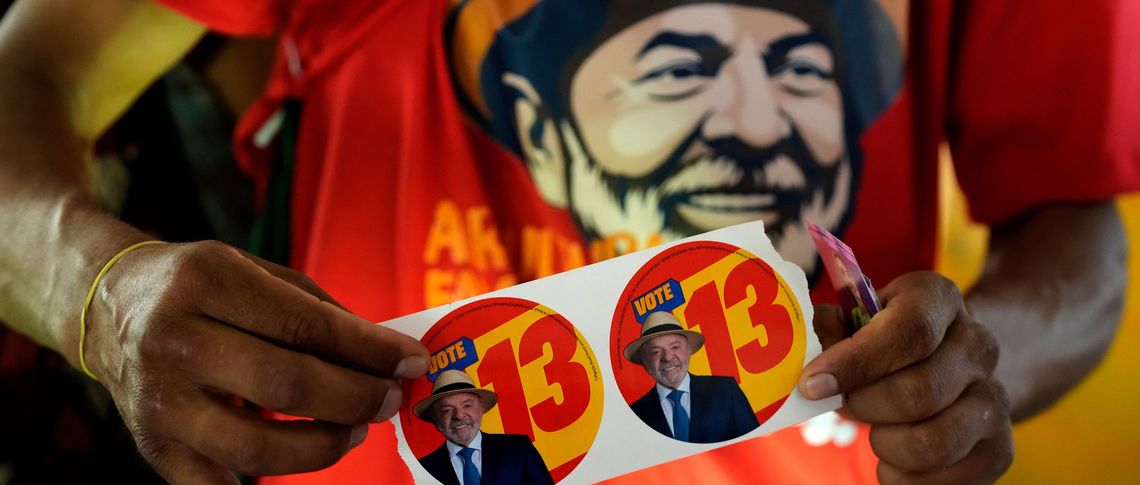
The 2026 presidential elections in Brazil will be the seventh in which Luiz Inácio Lula da Silva has run since he first became a candidate in 1989. Since taking office for the first time in 2003, Lula has initiated far-reaching changes in the economy and society – aiming to make Brazil a fairer place, to combat hunger and extreme poverty, and to provide equal opportunities for sections of the population that colonial structures have disadvantaged. Lula and his Workers’ Party (PT) have achieved considerable success in this regard, even though Brazil remains one of the countries with the highest levels of social inequality in the world.
But now these very successes are part of Lula’s problem. His policies have not only changed living conditions but also people’s expectations. For many, it is no longer simply a matter of overcoming poverty. They want to achieve prosperity and social recognition. The Workers’ Party (PT) has so far failed to find a convincing response to these aspirations.
Lula’s opponent is 45-year-old Flávio Bolsonaro, son of former President Jair Bolsonaro. He has been a professional politician since the age of 21, initially as a member of the state legislature in Rio de Janeiro, and since 2019 as a senator. Nevertheless, he has rarely attracted national attention; until his surprise announcement of his presidential candidacy in December 2025, he was not a prominent figure.
Forty-three per cent fear Lula’s re-election, whilst another 43 per cent fear a return to power of the Bolsonaro family.
The public support of his father, who had been convicted of the attempted coup d’état on 8 January 2023 and the attempt to violently overthrow the democratic order, and who had previously been barred from standing in any elections for eight years due to electoral offences, secured him the votes of the Bolsonaro camp’s core electorate. He thus quickly became the leading candidate of the right-wing camp and also won the support of those voters who do not belong to the Bolsonaro camp but define themselves primarily by their opposition to Lula and the PT.
Much of the population is dissatisfied with the candidates on offer. In polls, 47 per cent say they definitely do not want to vote for Lula, whilst another 47 per cent say the same about Bolsonaro. Fear is another key factor driving the election: 43 per cent fear Lula’s re-election, whilst another 43 per cent fear a return to power of the Bolsonaro family. The poll figures remain correspondingly stable: since March, Lula has been polling at 45 to 48 per cent in a potential run-off, whilst Bolsonaro has been at 43 to 46 per cent. Neither scandals nor government programmes and reforms have altered this situation so far.
The Lula political era is drawing to a close
Three groups are therefore particularly relevant to the election outcome: the relatively small group of non-polarised swing voters who have not yet made up their minds about the run-off, as well as undecided voters from the left and those from the right who, whilst they would not vote for the candidate from the other side, are considering abstaining. These groups often do not make up their minds until the final days before the election. It is likely to be decisive, then, what public sentiment and which issues dominate the final weeks leading up to the run-off.
There is a great deal of disappointment with Lula’s government, particularly amongst swing voters – a group that could well prove decisive in the election. Many had voted for him in 2022 with high expectations. Unlike during his first two terms in office, when many people experienced significant social and economic advancement, the current term has been marked by stagnation. At the same time, the aspirations of this section of the population have risen. Lula has thus, to some extent, become a victim of his own success: the goal is no longer merely to avoid poverty, but to achieve prosperity, comfort and social recognition. Everyday exposure to the success stories of wealth and self-reliance staged on social media clashes with a reality of precarious employment, high food prices and debt. The result is frustration and a desire for change. The PT can therefore no longer rely solely on its track record of social advancement, but must find answers to the changing expectations of its electorate.
Added to this is the tense security situation. Mobile phone thefts, carjackings, the presence of cartels and militias, as well as gender-based violence and femicides, characterise everyday life in many regions. Many people feel that the government has done nothing about this for years and has left them to cope with these problems on their own. Consequently, Bolsonaro’s radical proposals fall on fertile ground: the construction of mega-prisons, as seen in El Salvador under Bukele; the lowering of the age of criminal responsibility; and chemical castration for sex offenders do not address the structural causes of crime, but they give many people the impression that the government is at least doing something. Whilst the PT often fails to provide a convincing response here, Bolsonaro is able to score points with state-led activism.
Following the elections, the Senate and the Chamber of Deputies are likely to be even more right-wing than before.
Corruption also plays a significant role. The multi-billion-scale scandal surrounding the criminal financial dealings of Banco Master and the bribes paid to large sections of the political elite by its owner, Daniel Vorcaro, have dominated the election campaign. Flávio Bolsonaro is alleged to have received sums running into the millions; investigations are currently underway against him on charges of money laundering and corruption.
At the same time, Alexandre de Moraes, a judge at the Supreme Federal Court (STF), has found himself at the centre of the debate. Owing to his role in the conviction of Jair Bolsonaro, the latter’s son has long been calling for him to be impeached. After text messages between Vorcaro and Moraes came to light – in which Vorcaro is alleged to have asked for preferential treatment and referred to payments made to the law firm run by Moraes’s wife – public attention shifted from the allegations against Bolsonaro to Moraes. Bolsonaro is using the row to launch attacks on the government, the PT and the STF.
The ensuing internal disputes have intensified the politicisation of the court and created the impression amongst sections of the population that the entire political and institutional elite is corrupt. At the same time, they lend weight to Bolsonaro’s demand to curtail the court’s powers and remove unwelcome judges from office.
A two-thirds majority in the Senate is required to initiate impeachment proceedings against an STF judge. Following the elections, the Senate and the Chamber of Deputies are likely to be even more right-wing than before.
The central challenge of the coming years goes beyond the question of succession for the PT.
This would make governing even more difficult for Lula. Even during his current term in office, he has often failed to secure majorities in parliament.
Should Bolsonaro be elected and also secure a two-thirds majority in the Senate, he could attempt to remove unwelcome judges from the STF and weaken its oversight role. In the worst-case scenario, this could facilitate an illiberal restructuring of the state. Regardless of the election outcome, the PT – and with it the entire left-wing camp faces a period of renewal. The Lula political era is drawing to a close. Should he be re-elected as president, the conditions would be more favourable for an orderly process in which Lula could use his considerable political capital to foster cohesion amongst the numerous left-wing parties and to groom a successor as a leading figure. In the event of a defeat, the question of succession is likely to be more difficult to organise and could increase the risk of greater fragmentation within the left-wing camp. Furthermore, the stricter electoral threshold coming into force in 2030 is likely to cause difficulties for the smaller parties, the PSOL and the PSB, and could encourage alliances or mergers.
Lula’s preferred successor, Fernando Haddad, is not expected to win the gubernatorial election in the state of São Paulo, whilst other potential successors from the PT, such as Camilo Santana and Rui Costa, have so far lacked comparable national visibility. At the same time, key figures on the Brazilian left are outside the PT, such as Guilherme Boulos and Erika Hilton (PSOL) and João Campos (PSB). Yet the central challenge of the coming years goes beyond the question of succession. The PT and its partners must not only produce a new generation of political leadership capable of holding the left-wing camp together beyond Lula. They must also find answers to the changing expectations of those sections of the population whose social advancement is one of Lula’s greatest achievements. For today’s aspiration is no longer merely to overcome poverty, but to achieve prosperity. As long as the Left fails to provide a convincing response to this, the Right can step into this gap with the promise of state intervention.


