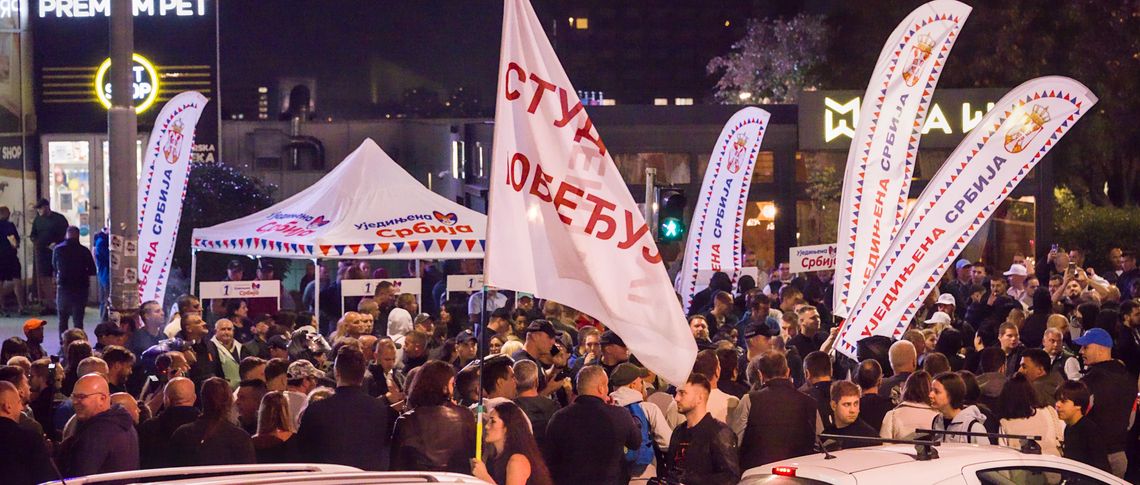
On the evening of 25 October, Serbia could find itself in a situation for which almost no one is prepared: two political camps, each convinced it has won, each with supporters ready to take to the streets. This is perhaps the greatest risk of the upcoming parliamentary elections, even greater than the question of who will win them. The outcome is uncertain, but more important than pre-election forecasts is whether there is a plan for a contested result and whether the European Union, which has so far mostly watched events, will react in time.
Aleksandar Vučić called early elections on 9 September, and on 27 September resigned as President of Serbia in order to lead the electoral list as candidate for prime minister. The Constitution bars him from a third consecutive presidential term, so he is trying to remain at the centre of power by changing his office. His populist Serbian Progressive Party (SNS) has dominated Serbian politics since 2012, but it now faces the most serious challenge to its rule so far: the Student List, which emerged from a protest movement that grew out of the tragedy in Novi Sad in November 2024, when the canopy collapsed at the railway station and 16 people were killed. Protests against corruption, impunity and captured institutions grew into a mass social revolt, and then into a political movement that wants to remove the government.
Public opinion polls show how uncertain the outcome is. According to differing surveys the support for the SNS ranges from 35.7 to 47.2 per cent, and for the Student List from 31.5 to 44.9 per cent. The differences are large and they show the difficulty of predicting the winner.
Democracy under pressure
One should not expect a level playing field either. International observers assessed the previous parliamentary elections, in December 2023, as marred by serious irregularities. And current conditions do not inspire confidence. Voter intimidation, abuse of institutions and violence during the campaign were already documented. From 21 to 27 September, representatives of the government received 75 per cent of the time devoted to political actors on national television, and the opposition only 25 per cent. Vučić himself received more space than the entire opposition.
In its interim report of 9 October, the OSCE observation mission pointed also to an unusually high number of registered voters in some municipalities, which further undermines confidence in the integrity of the electoral process. That observation mission (ODIHR) described the campaign as deeply polarised, with heightened street tensions and isolated acts of violence.
The student movement responded with referendum logic: for or against the regime. Most of the opposition supported this approach. Still, part of the pro-European opposition remained in the electoral race, claiming that it is fighting the government and not the students. Supporters of the Student List accuse them of splitting the anti-regime vote. According to official data on the proclaimed lists, 18 electoral lists are running, including nine minority lists.
The Student List brings together people of different political convictions, from liberals and pro-European citizens to nationalists.
The Student List is not without a political programme. Its eleven-point plan envisages freeing the judiciary and media from political control, fighting corruption, depoliticising the public sector, education reform and measures in the areas of labour rights, housing and health care. However, the common denominator of the broad movement remains regime change, while on ideologically and foreign-policy sensitive questions it mostly avoids clear positions.
This is at once its strength and its weakness. The Student List brings together people of different political convictions, from liberals and pro-European citizens to nationalists. Such a strategy makes it possible to gather a broad electorate, but leaves open the question of how these differences would be reconciled after a possible victory.
This is where the real test lies. In 2000, when Slobodan Milošević was toppled, the opposition coalition DOS, the student movement Otpor and independent media shared an organisation, and had contacts inside parts of the security apparatus, that could turn an electoral victory into a transfer of power. Today it is not publicly known whether the opposition or Student List has a comparable plan for a disputed result. The question is not whether anyone is planning violence, but whether anyone is prepared: what happens if both sides declare victory, and who protects peaceful protesters if the authorities respond with force? Responsibility is not symmetrical, since the government controls the police. But those who call on citizens to defend the vote should also be expected to have a plan.
The need for EU involvement
Keeping all this in mind, what kind of government can emerge after the elections? Three outcomes are possible.
In the first, the ruling party stays in power and Vučić returns as prime minister. The system continues, probably with increased pressure on those who tried to remove it.
In the second, the Student List wins a parliamentary majority and gets the chance to form a government. Its immediate priorities would be the renewal of institutions, the fight against corruption and freeing the state from party control. But such a government would inherit institutions shaped by 14 years of one-party dominance. It would have to ensure the functioning of the state, carry out reforms and manage political differences within its own broad movement at the same time.
In the third scenario there is no clear winner: results are contested, the formation of a parliamentary majority becomes uncertain, and two opposing claims to political legitimacy stand against each other. This is the most dangerous scenario, especially in a society in which trust in institutions and the willingness of political opponents to compromise are seriously damaged.
The European Union for now mostly stands aside. One reason is uncertainty about the political profile of the Student List. The movement brings together pro-European forces but also nationalists, and some of its representatives oppose the introduction of sanctions on Russia. Such EU uncertainty is understandable. Still, uncertainty about the future program of possible winners must not be an excuse for passivity in the face of threats to the democratic process. All the more so because the rule of law, which the Student List also insists on, is one of the fundamental values of the European Union.
Elections in a hybrid regime are never only the counting of votes.
For the European Union, which in the Western Balkans has for too long given priority to the stability of existing governments, this is a test of whether stability really implies the rule of law.
Brussels and European capitals do not have to choose a side in the Serbian electoral contest. They must, however, clearly side with free elections and with the right of citizens to express their will peacefully. An invitation to the European Parliament to send a delegation arrived only at the last moment, after the procedural deadline had already expired. MEP Vladimir Prebilič confirmed that the delegation is coming after all, while the opposition accuses the government of deliberately delaying the invitation. To this should be added insistence on transparent determination of results and an unambiguous message that violence against peaceful demonstrators and electoral manipulation cannot remain without political consequences.
The greatest responsibility remains with those who today control the state and its institutions.
Elections in a hybrid regime are never only the counting of votes. They are also a question of whether institutions can determine a result that citizens will believe, and whether those who lose will accept a peaceful change of government.
In Serbia, for now, there are not enough reasons for such trust.
Europe’s chance to help prevent a crisis is now, not on the night of 25 October.