


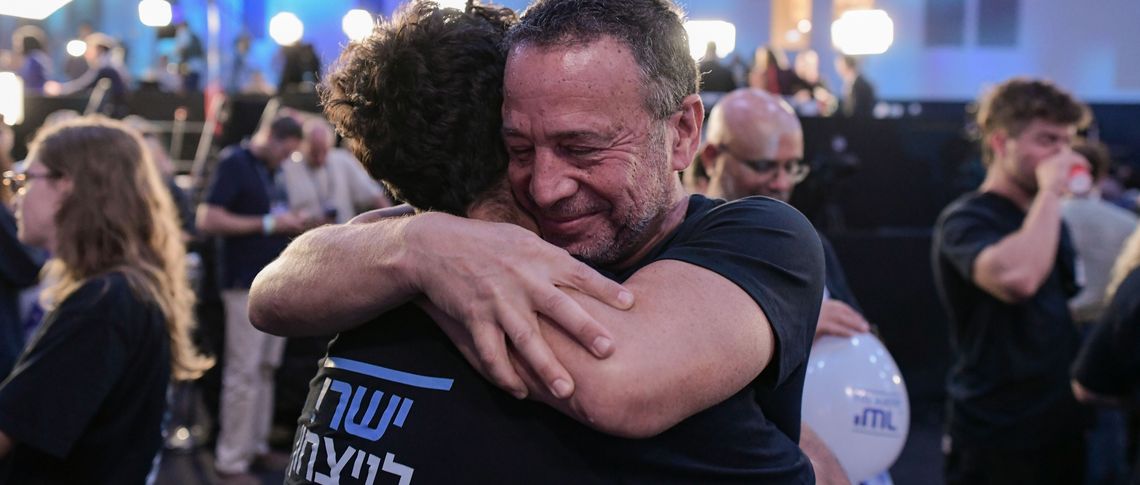
When the first figures appeared on screen at 10.00 pm sharp, just after the polling stations had closed, cheers erupted at the party organised by the social-democratic party HaDemokratim (The Democrats). Yet even at that moment, it was becoming clear that the Likud party of the incumbent Prime Minister Benjamin Netanyahu would likely form the largest parliamentary group, and that the predicted nine to 10 seats for their own party would, at best, represent a mediocre result. The exuberant atmosphere had something of the self-suggestion and a continuation of the election campaign after the vote: Party supporters, MPs and numerous young activists were celebrating simply because they wanted to, and because the enormous tension of the past few months had to be released somehow. Time and again they chanted ‘Bibi HaBaita’ (‘Bibi, go home’), and cries of ‘Demokratim – Demokratim’ alternated with chants such as ‘We’ll fix it – with joy’.
Their message is a return to democratic values, the rule of law, responsible governance and a fair distribution of state resources. In other words: an end to the ‘politics of chaos’ – as Israeli constitutional lawyer Suzie Navot calls it – pursued by Netanyahu and his far-right and ultra-Orthodox coalition partners over the past four years.
An unclear fresh start
When party leader and lead candidate Yair Golan took to the microphones shortly before midnight, he spoke of hope and the birth of a ‘new, liberal and democratic movement’. He called for people to seize the opportunity for a government of change. Gadi Eisenkot’s initial statements also focused heavily on change. The leader of the new Yashar party, which had been ahead of Likud in most polls in the months leading up to the election, called on Netanyahu to resign and declared his intention to form a government.
The only question is: how? After all, Eisenkot is one of those opposition politicians who have spoken out against the Arab Ra’am party joining the government. Yet even with Ra’am, the opposition would not achieve the required majority of 61 Knesset seats. Moreover, as the night progressed, the figures continued to shift further in favour of Netanyahu and his coalition partners. Their camp has since overtaken the opposition bloc, though it too lacks a majority. With 94 per cent of the votes counted, the Democrats now hold only eight seats.
It therefore remains entirely unclear whether and when a fresh political start will be achieved and whether the measures announced by the former opposition can be implemented in relation to three key issues: the repeal of the laws passed as part of the so-called ‘judicial reform’, the passing of a law making ultra-Orthodox Jews and Arabs liable for military or civilian service respectively; and the long-overdue establishment of an independent state commission of inquiry to investigate the failures and misjudgements in the run-up to the disaster of 7 October 2023. For whilst ‘Bibi’ and his allies may have lost their majority, they are by no means defeated.
Netanyahu circulated an AI-generated image showing a nuclear explosion over Tel Aviv and apparently attempted to persuade the US President to launch a fresh attack on Iran.
On the contrary: President Isaac ‘Bougie’ Herzog now has two weeks to task a Knesset member with forming a government. As things stand, that could initially be Netanyahu. In the weeks leading up to the election, Netanyahu had become increasingly panicked in the face of persistently poor poll ratings. Among other things, he put pressure on candidates from several smaller right-wing parties not to stand for election. He circulated an AI-generated image showing a nuclear explosion over Tel Aviv and apparently attempted to persuade the US President to launch a fresh attack on Iran. Furthermore, it is said that only a veto by Chief of the General Staff Eyal Zamir prevented him from carrying out an unspecified military operation against Iran. This might have provoked a massive counter-strike, which in turn could have provided Netanyahu with a pretext for postponing the election.
It is hard to imagine that Netanyahu will shy away in future from once again delving deep into his extensive bag of tricks to remain in office. His fear-mongering campaign and his portrayal of himself as ‘Mr Security’ have, despite all the facts, once again proved effective, and he has succeeded in mobilising his supporters.
At just under 78 per cent, voter turnout was around 7 per cent higher than in 2022.
On 27 October, around 7.3 million Israelis were called upon to determine the composition of the 26th Knesset. The country constituted a single constituency with over 12 000 polling stations. As Israeli citizens living abroad are only permitted to vote from there in exceptional cases – such as diplomats, security personnel or seafarers – a record number of an estimated 70 000 Israelis travelled specifically to cast their votes this time. At just under 78 per cent, voter turnout was around seven per cent higher than in 2022. It was particularly high – at 80 per cent – amongst the Arab-Israeli population. This contributed to a historically unprecedented success for the two Arab parties and party alliances, which are expected to win 19 seats. This is all the more remarkable given that, as feared, problems arose at some polling stations in Arab and mixed cities. For instance, some eligible voters could not find their names on the electoral rolls; in other places, security forces made access to polling stations difficult; and, at least initially, there was a shortage of bilingual ballot papers.
Following a heated election campaign characterised by threats and smear campaigns from far-right politicians and Netanyahu’s ‘smear machine’, election day itself passed largely peacefully. However, there were isolated incidents of physical attacks on Democratic campaigners. In addition, a man armed with a knife apparently attempted to approach Yair Golan. The circumstances surrounding this incident remain unclear, including whether the previous smear campaigns labelling Golan a ‘traitor’ played a part.
Admittedly, there are likely to be slight shifts in the distribution of seats, and the official final result will not be known for a few days.
In the run-up to the election, the vote on 27 October had frequently – and quite rightly – been described as a make-or-break election, perhaps the last realistic chance to restore democratic principles before their erosion becomes the norm. Admittedly, there are likely to be slight shifts in the distribution of seats, and the official final result will not be known for a few days. However, given the high expectations and the significance of this election far beyond Israel’s borders, its outcome is sobering.
This also makes it highly doubtful whether there will be a change in policy regarding the humanitarian crisis in the Gaza Strip and the diplomatic deadlock over the implementation of the 20-point plan. The same applies to the ongoing violence by militant Jewish settlers in the West Bank, the volatile security situation across the entire region and the Israeli-Palestinian conflict. ‘I see no other option but to strive for two states for two nations,’ Yair Golan declared during the election campaign. He was the only Jewish-Israeli party leader to state this openly.


