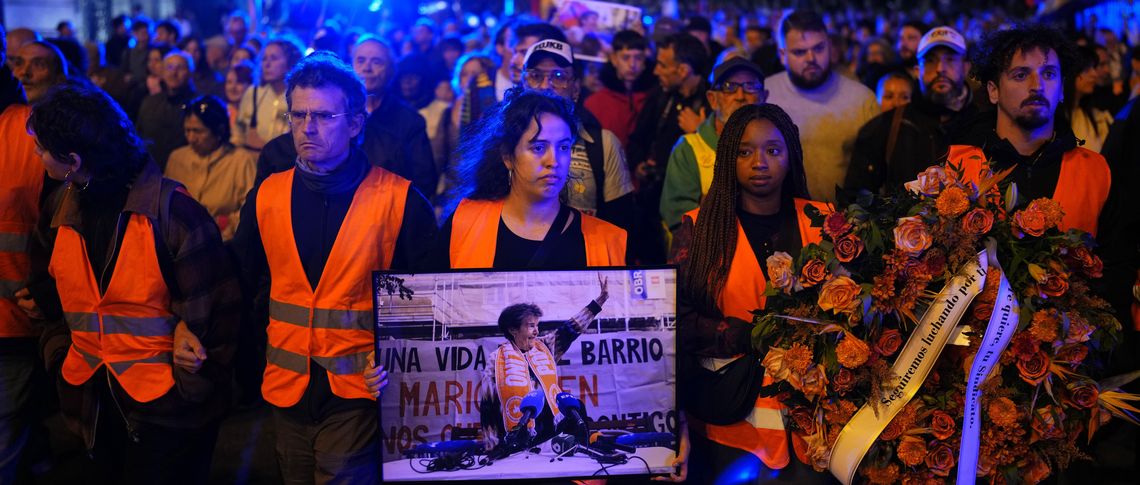
Abascal, who was living in poverty, has died. Aged 87, she did not die at home, as she had wished, but in the Madrid hospital to which she was taken following the forced eviction from her home. A flat in which she had lived for 70 years and whose rent she was no longer able to pay following extreme increases. Following the eviction, a large-scale protest sprang up spontaneously, with a tent camp set up in Madrid’s central Puerta del Sol square; other cities followed suit. The image of the frail woman being carried out of her flat on a stretcher on 23 September became a symbol of a dehumanised housing market, in which housing is now merely a business and no longer a social right. Nevertheless, her fate has not only sparked a protest movement but has also fundamentally altered the political landscape in Spain. The housing crisis could now present an unexpected political opportunity for Pedro Sánchez.
Maricarmen would certainly never have imagined the chain of political events that her eviction would set in motion. A few days after her eviction, the government tabled two bills in Parliament which, amongst other things, provided for a moratorium on evictions in cases of hardship, as well as further measures to alleviate the simmering housing crisis. To secure a majority in Parliament, the minority government led by Pedro Sánchez was reliant on the votes of smaller parties, including the right-wing Catalan pro-independence party Junts per Catalunya. Despite participating in the negotiations on the so-called ‘Maricarmen Decrees’, the party decided at the last minute – and to the surprise of many – to vote against them, as did the conservative Partido Popular (PP) and the far-right VOX. As a result, both bills failed.
Consequently, on 5 October, Sánchez called a snap general election, which will now take place on 29 November. Calls from the opposition for a snap general election, due to the lack of a parliamentary majority, had been a feature of Sánchez’s time in office for months. These calls were further fuelled by several allegations of corruption, in particular the investigations into former Prime Minister José Luis Rodríguez Zapatero, which Sánchez supported unconditionally. The government’s much-criticised handling of the crisis in Ceuta – when tens of thousands of refugees swam into the Spanish exclave at the end of July – also weighed heavily in the balance. Sánchez, however, had consistently emphasised, in a friendly yet unwavering manner, his intention to see out his term of office, pointing to his government’s positive track record. In doing so, he highlighted in particular the strong economic growth, job creation and Spain’s international role under his government as a bulwark against the rise of right-wing populism worldwide. But now Sánchez appears to see an unexpected political opportunity in the housing crisis.
A desperate need to be addressed
For the Partido Socialista Obrero Español (PSOE), these snap elections may be less a matter of winning over new voters than of mobilising its former supporters. The momentum surrounding the issue of affordable housing, sparked by Maricarmen’s eviction, offers both the PSOE and its potential left-wing coalition partners the chance to win back those voters who had cast their ballots for progressive parties in 2023 but have since turned away in disappointment and now threaten to stay at home in the next election. In other words: the gap between the PSOE and the parties to its left and the PP and VOX can therefore be explained less by a shift of voters to the right and more by the threat of abstention from disappointed left-wing voters. Already in 2023, the mobilisation of non-voters from the progressive camp led to the PSOE performing significantly better than any polls had predicted.
According to polls, just under 50 per cent of the population regard the availability of affordable housing as the most pressing issue.
By championing the cause of affordable housing, Sánchez has now found an issue with which he could turn the election campaign back in his favour, despite unfavourable poll ratings. One reason for this is the issue itself. According to polls, just under 50 per cent of the population regard the availability of affordable housing as the most pressing issue. Some are already comparing the current protest movement with the so-called ‘Indignados’ (‘the Outraged’) movement of 2011, which brought about lasting changes to the Spanish party system. And indeed, even back then there were calls for affordable housing for young people.
The trade unions are also backing the cause and have called for a general strike on 11 November – 18 days before the elections – under the slogan ‘Salarios – Vivienda – Precios’ (‘Wages – Housing – Prices’). The focus on a single issue – for which Sánchez offers concrete solutions – has, incidentally, been a tried-and-tested formula for success in his previous election campaigns. And by highlighting the right-wing parties’ rejection of the decrees, Sánchez can clearly identify those responsible for blocking a solution and who have thus voted against the interests of a large section of the population. Conversely, this could even lead to conservative voters staying away from the polls in protest. It is also speculated that Sánchez has factored in the US mid-term elections as an additional source of momentum for mobilisation. A clear defeat for the Republicans in early November could possibly give a progressive government a new boost in Spain as well.
In recent years, Pedro Sánchez has become a key figure for progressive forces in Europe.
Within the progressive camp, there is confidence that Sánchez, with his grasp of the issue, his charisma and his campaign experience, can still stage a spectacular comeback against Alberto Núñez Feijóo, the rather lacklustre PP candidate. The situation is more problematic, however, when it comes to the PSOE’s required coalition partners, all of whom are on the left of the political spectrum. On the one hand, according to the polls, they are struggling even more than the PSOE to cope with the disappointment of their former voters. On the other hand, they are facing the snap election rather unprepared. With the 2027 election in mind, the electoral alliance Sumar – which had united up to 20 parties on its list in the last elections in 2023 – was planning to re-establish itself this autumn under a new name, Frente Amplio (‘Broad Front’), and, as part of this, to select a lead candidate. The Podemos party, which emerged at the time from the so-called Indignados movement, is also still in the midst of deliberations regarding personnel and campaign tactics.
In recent years, Pedro Sánchez has become a key figure for progressive forces in Europe. On 29 November, it will become clear whether he and his PSOE, as well as the other left-wing parties, have succeeded in channelling the outrage over the housing crisis into political support. The key will be whether they can convincingly convey to those who mobilised spontaneously in response to the images of Maricarmen that the path to a progressive housing policy does not end at the Puerta del Sol, but leads via the ballot box.
If they succeed in winning back disillusioned voters with concrete solutions to the housing crisis, this could also serve as a model for progressive parties in other European countries.