


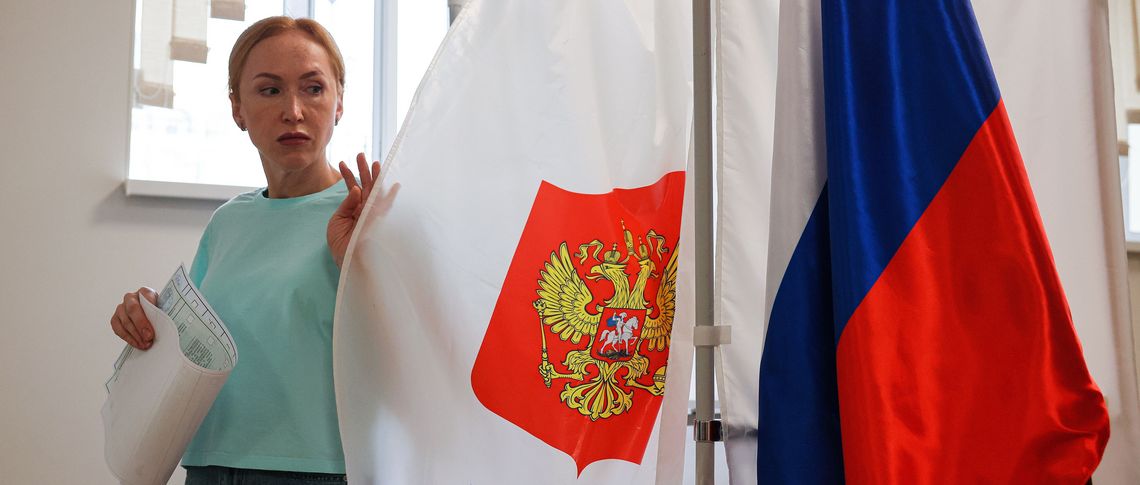
The State Duma election held from 18 to 20 September 2026, the first since the start of the full-scale invasion, unsurprisingly produced the result the Kremlin wanted. What is surprising, though, is the complete absence of any surprise. Despite more than four years of war, growing repression and the militarisation of society, the Kremlin has refrained from fundamentally restructuring its political system. The election thus demonstrates two things: the regime’s continued ability to control political outcomes — and its remarkable aversion to change.
The election took place against the backdrop of a largely frozen front line: Russia’s summer offensive has brought no fundamental change, while the drone-dominated ‘kill zone’ makes large-scale operations extremely manpower-intensive. The strategic air war, by contrast, is escalating: Ukraine is targeting refineries, storage facilities and transport routes with long-range drones, while Russia is carrying out mass strikes against energy, port and logistics infrastructure.
A remarkable level of control
State Duma elections are organisationally more complex and less centrally controllable than presidential elections because of the large number of regional actors, single-member constituencies and candidates. The fact that the Kremlin did not postpone the election and was able to produce the desired result demonstrates the system’s continued organisational and steering capacity. Putin and pro-regime commentators portray the vote as a kind of renewed nationwide plebiscite on the president and his ‘special operation’ — and present it externally as evidence that Russia remains stable and capable of action despite the war, sanctions and Ukrainian attacks.
The official result illustrates the artificial nature of party pluralism: The ruling party United Russia won just under 58 per cent. The actual extent of manipulation is difficult to determine. Independent analyses show clear statistical irregularities; at the same time, there is little to suggest that United Russia would not have remained the strongest force even without manipulation.
What is apparent is conditional loyalty to the system, not a stable majority for a costly and open-ended continuation of the war.
This is precisely where a systemic dilemma lies: the election is supposed to demonstrate strength and popular support, while also providing the centre with information about the performance of governors, regional administrations and party officials. The more heavily the vote is manipulated, the less the Kremlin learns about the country it governs.
With 355 seats, United Russia achieved its best result to date and once again holds a comfortable constitutional majority. It is unclear what such a majority would still be needed for. The far-reaching constitutional amendments strengthening the president were already adopted in 2020. The significance of the new Duma is therefore primarily symbolic and temporal: it will continue to provide the legal basis for the war economy, conscription and repression, and could become institutionally relevant again in the event of a reorganisation of the regime’s succession. After all, deputies have been elected until 2031, beyond the next scheduled presidential election in 2030.
The result is not, however, a useful measure of actual support for the war. Independent polling projects record high levels of support for the armed forces, but also a clear majority in favour of negotiations. They also show that willingness to continue the war declines when mobilisation or personal costs are involved, and that only a small group remains that consistently supports the war. What is apparent is conditional loyalty to the system, not a stable majority for a costly and open-ended continuation of the war.
An even stronger aversion to risk
Even more striking than the control the regime has demonstrated is the system’s political risk aversion. The Kremlin has refrained from any discernible modernisation of its controlled party system. The Communist Party of the Russian Federation (KPRF) remains the most important permitted opposition force, while the only institutionally visible anti-war platform, Yabloko, had already been decisively weakened before the election. A restructuring of the party system for the post-war period or a possible succession to Putin, which had been anticipated for a time, failed to materialise.
The political integration of veterans of the war against Ukraine has also fallen short of initial ambitions. Kremlin-aligned experts had at times expected a large influx of front-line veterans into the Duma. United Russia reports only 49 elected deputies with combat experience following the election. Compared with Putin’s repeated promise of a ‘new, true elite’, the result above all shows how cautiously the apparatus is treating veterans: it is only prepared to displace established politicians to a limited extent and to allow a larger, less controllable bloc of veterans to emerge.
In this election, power was never at stake. Competition had already been largely eliminated before election day. Compared with 2021, around a quarter fewer party lists and constituency candidates stood for election, while challengers in single-member constituencies were removed from the race through extremism and discreditation procedures. State-owned companies, housing management firms and educational institutions appointed supervisors from middle management to monitor the voting of small groups of employees, preferably through electronic remote voting, with participation to be documented by screenshot in company chats. Cases have been documented of teachers being required to report on whether parents had voted, threats of dismissal, ballot stuffing and fraudulent electronic voting. On the first day alone, around 1 500 observers from the KPRF and Yabloko were prevented from entering polling stations.
Unlike in previous attempts at rapprochement, the Kremlin could this time offer Washington something itself in light of the pressures of the war in Iran: mediation with Tehran, which remains closely aligned with Moscow.
The occupied Ukrainian territories are a particular issue. Their inclusion in the vote provides a largely uncontrollable reservoir of votes while also framing any negotiated territorial settlement as a constitutional issue that the Kremlin can reject by referring to ‘voters’ and ‘deputies’. For Putin himself, who is known for his legalistic fixation on procedures and formalities, the parliamentary election in the annexed territories is a kind of final step in their ‘integration’: legally speaking, they now participate on an equal footing in determining the balance of power within the Russian Federation.
There will be no further regular nationwide election before the presidential election in 2030. There is therefore no longer any need to postpone difficult decisions out of concern about their impact on elections. The decisive factors, however, remain the situation at the front and manpower requirements. Much speaks against a new mass mobilisation: it would be extremely unpopular, undermine the functioning monetary recruitment system because coercion and high bonuses are mutually incompatible, and a simple infantry offensive would have no clearly attainable operational objective given the transparent battlefield and the broad ‘kill zone’.
Any expansion of recruitment would therefore not have to resemble the ‘mobilisation from the streets’ of 2022. The digital military register allows for individual, less conspicuous summonses and sanctions. Additional manpower could be recruited more gradually, regionally and through repression, via higher bonuses, regional targets, reservists or recruitment for specific branches of the armed forces, without a single public mobilisation drive.
A further escalation of the air war appears more likely, particularly against civilian Ukrainian infrastructure before and during the winter, combined with speculation that European willingness to provide aid will wane and that President Volodymyr Zelenskyy’s domestic political fragility will grow. At the same time, Moscow could seek to make use of a new negotiating initiative from Trump before the US midterms. Unlike in previous attempts at rapprochement, the Kremlin could this time offer Washington something itself in light of the pressures of the war in Iran: mediation with Tehran, which remains closely aligned with Moscow. Moscow could hope, in return, to secure US pressure on Kyiv to make concessions on its negotiating position.
The State Duma election thus gave the Kremlin exactly what it needed from it: not political renewal, but confirmed control. After more than four years of war, the system has emerged not more dynamic, but more ossified. Even the new elite of war veterans invoked by Putin is allowed to alter the existing balance of power only in measured doses. This risk aversion should not, however, be mistaken for weakness. Precisely because the Kremlin is prioritising continuity at home, it can concentrate its resources even more strongly on continuing the war. The real question after this election is therefore not whether Russia’s political system has changed — but what Putin will do with the room for manoeuvre he has gained.


