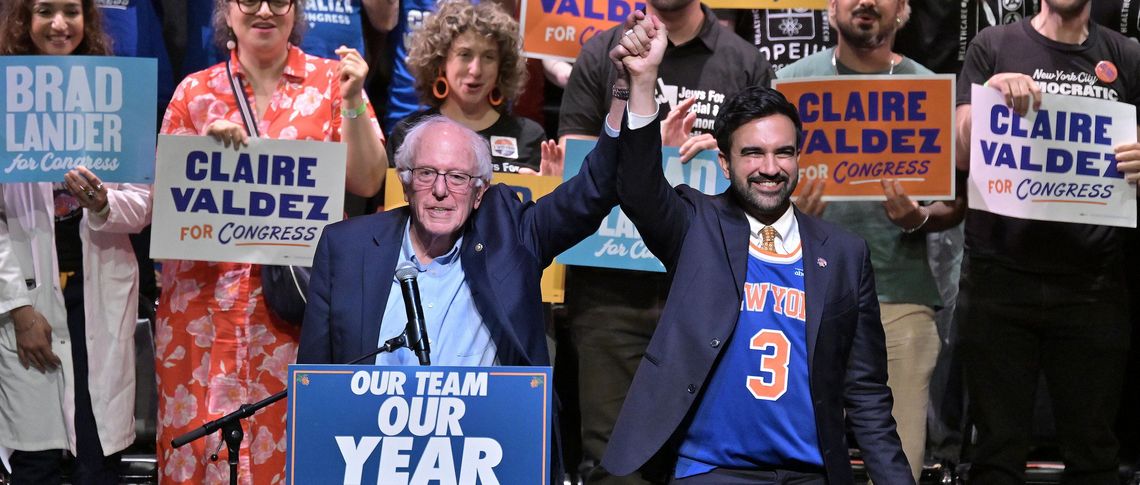
Between inflation, the backlash to Donald Trump’s deportation policy, and the unpopular war against Iran, Democrats appear poised to retake Congress in the November midterm elections. And yet, they struggle to project the unity they briefly feigned last winter under the banner of ‘affordability.’ Fierce primary battles to take on Republican incumbents or retain seats held by retiring Democrats have reignited the larger conflict between a defensive liberal establishment and a reinvigorated left, revealing fault lines that their shared antipathy for Trump can no longer paper over.
Although left-wing challengers have not succeeded in every intraparty contest, the left’s momentum is undeniable following several upset victories this summer. The reasons are fairly self-evident: Grassroots frustration with the Democratic leadership’s anaemic response to Donald Trump’s overreach, as well as insurgents’ more compelling economic message, have created an opportunity for the left to set the terms of debate that few thought existed in the aftermath of Trump’s 2024 election. Back then, the party’s losses were partly blamed on the excesses of progressive identity politics.
Still, the left faces a defining test in the upcoming elections, one that will determine its power to steer the party’s course in 2028. Left-wing candidates are attempting to export a model once limited to progressive coastal cities to traditional working-class districts, where Democrats lost significant ground since the so-called Trump realignment. That gambit will reveal whether the current left, considerably more social-democratic than its ‘woke’ iteration, has the blueprint to build a majority coalition or if it still needs to confront the ideological baggage that contributed to Democratic setbacks across the country.
A gap between reality and ambition
To be clear — the left has not reinvented itself. Reenergised by Zohran Mamdani’s triumph in New York City’s mayoral election last November, the left has hardly abandoned identity politics. Following Mamdani’s lead, however, it has significantly recalibrated its focus, returning to the economic populism that animated Bernie Sanders’ first insurgent campaign for president. Combined with new social media strategies, the left is betting that its simplified trifecta of issues - living costs, corruption, and war - is mobilising voters whom mainstream Democrats have repeatedly failed to reach.
Critics insist this strategy is fatally flawed so long as progressives fail to account for their unwitting role in Trump’s comeback. The left has merely sidestepped how its policy advocacy on matters of gender, immigration, climate change, and criminal justice alienated voters who had previously backed Democrats. Yet the effort to discredit the left from within the Democratic establishment clearly has its own ideological impetus rooted in opposition to major economic reform.
Democrats have not yet regained ground in districts in which past generations proudly displayed portraits of presidents Franklin Roosevelt and John F. Kennedy.
It also smacks of desperation. Threatened by the left’s newfound confidence and anti-establishment rhetoric, centrists contend that the confrontational approach of candidates like Michigan’s Abdul El-Sayed, particularly regarding Israel and American foreign policy, could cost Democrats a winnable election. But whatever alleged risks left-wing populists have courted, the centrist case does not offer a positive contrast. It is instead, as insurgents have retorted, an appeal to fear, pitched to anxious Democratic voters torn between their hunger for sweeping change and a desire to simply win elections.
Unfortunately, the gap between the left’s ambitions and political reality has no straightforward solution. In fact, whether progressive or moderate, Democrats are still confined to ‘superstar’ cities, college towns, and their other, mostly coastal enclaves. If they have, for the time being, stopped the defections of Latinos and young black men to the right, Democrats have not yet regained ground in districts in which past generations proudly displayed portraits of presidents Franklin Roosevelt and John F. Kennedy.
This weak record is primarily a threat to the party establishment, which has, in the last decade, often failed to pick viable contenders in regions and states that are culturally conservative and more ambivalent about a strong regulatory state. Yet the establishment’s lost credibility does not automatically validate the latest theory of change au courant on the left — that if progressives just hammer living costs, once-sceptical voters will set aside their reservations and carry them to victory.
Even if this were true, and it is doubtful, the left is hindered by the fact that it has only belatedly thought to repair the local party infrastructure that Democratic elites largely abandoned in their pursuit of more affluent and educated voters. That is a monumental task unlikely to be completed in one or two election cycles. Democrats’ reputation in most rural and Rust Belt regions is so bankrupt that several Republicans who should be vulnerable will keep their seats in November.
The left is emboldened by its growing ability to ‘punch above its weight’ in select races — an ability often attributable to the plain inferiority of centrist opponents.
Both wings bear responsibility for this dilemma. Barack Obama mounted a fairly populist campaign in 2008, raising hopes that Democrats’ support for neoliberal prescriptions had come to an end. But in the Trump era the party elite has repeatedly sabotaged the construction of a ‘big tent’ motivated by economic populism. Faced with abundant proof that less-educated voters were deserting the party, it instead indulged the very cultural battles it has lately accused the left of propagating, embodying the ‘limousine liberal’ epithet to dire effect.
The left of the late 2010s failed to question this trend, wasting precious political capital on elitist preoccupations. On top of past disappointments, that costly diversion cemented the impression among many workers that Democrats were disengaged from (and even scornful of) their concerns. Responding to former Democratic operatives now critical of the left, progressive trailblazers such as Alexandria Ocasio-Cortez have essentially rejected this claim while acknowledging Democrats need to move on from the rhetoric that defined opposition to Trump’s first administration. So far that seems to be the left’s preferred course. Today’s insurgents deflect from addressing how the left went astray, on the premise that the establishment, despite vowing to vanquish Trumpism, is far guiltier of spoiling Democratic chances in Middle America.
The establishment’s disrepute certainly offers progressive populists a fresh opening to shift the axis of political conflict. But the recent defeat in Wisconsin’s primary of gubernatorial candidate Francesca Hong, a notably ‘woke’ Democratic Socialist who fumbled her chances, suggests the imperative to connect with patriotic voters has yet to fully sink in. The left is emboldened by its growing ability to ‘punch above its weight’ in select races — an ability often attributable to the plain inferiority of centrist opponents. That has led it to downplay the liabilities of candidates who lack Mamdani’s charisma, a tendency that reinforces the perception left-wing campaigns are run by novices and dogmatists.
To rebut its critics, the left will have to set a higher bar for talent and discipline. Individual leaders such as Mamdani have credibly assumed Sanders’ populist mantle, refashioning New Deal-style politics for Millennials and Gen Z. But the broader left must prove it can transpose his model to contests where the MAGA right has aggressively filled the vacuum created by globalisation, the decline of trade unions, and inept liberals. In races won at the margins, that unavoidably requires assuring reluctant voters that Democrats will strictly prioritise their economic well-being and not reprise the politics of ‘peak woke.’ As Sanders himself has counselled, transformational reform depends on convincing ordinary Americans that a better future is actually on the horizon.