


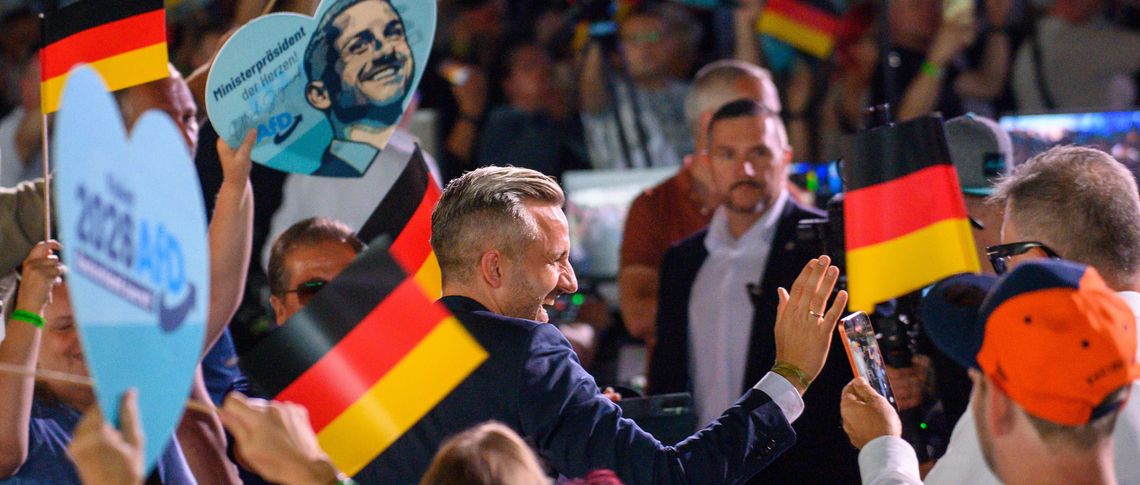
The AfD has won the state election in Saxony-Anhalt by a clear margin. 43.8 per cent of voters cast their ballots for the party, more than twice as many as for the CDU. A result that would have seemed almost unimaginable just a few years ago. How did the AfD become so strong? And above all: how can this rise be halted?
Germany is far from alone in this. In France, the Rassemblement National is stronger than ever before; in the UK, Reform UK has shattered the previous two-party system; and in the US, voters have sent Donald Trump to the White House for the second time.
There is certainly no shortage of explanations for the success of the far right. Disinformation and attempts at foreign influence are often cited, as are economic uncertainty and geopolitical crises, social polarisation and the increasing radicalisation of the electorate. Right-wing populists, it is said, are particularly adept at stoking fears and exploiting people’s discontent for their own ends. All of this may well play a part. Yet one obvious explanation is surprisingly overlooked: perhaps right-wing populists are so strong precisely because their political opponents are so weak.
A widening representation gap
A look beyond Germany’s borders supports this view. In the US, Joe Biden initially stood for re-election in 2024 despite dismal poll ratings. Inflation had eroded the purchasing power of many Americans, whilst illegal migration across the southern border had become a perennial political issue. At the same time, doubts about Biden’s ability to serve another term were growing ever stronger. His party nevertheless stood by him until, following a disastrous TV debate, it was no longer tenable. Kamala Harris took his place within a very short space of time – and we all know how that turned out.
In France, the situation is hardly any better. The economy is faltering, the mountain of debt is growing, and for years the political system has been preoccupied primarily with itself. Since taking office in 2017, Emmanuel Macron has gone through seven prime ministers. Many French people are likely now to be asking themselves: might you perhaps get back to tackling the country’s problems at some point? In any case, the ongoing political chaos has not harmed Marine Le Pen’s anti-immigration Rassemblement National: it has long since become the country’s strongest political force.
Three-quarters of Germans are now dissatisfied with Friedrich Merz’s performance.
The UK has tried a number of things over the past ten years. Prime Ministers, in particular. The 2016 Brexit vote was already a massive wake-up call for the political establishment: it was followed by years of political chaos, at the end of which the Conservatives were dealt a crushing defeat. But Labour, too, managed to squander the enormous trust placed in it in a very short space of time. Keir Starmer had become so unpopular that he resigned as Prime Minister after less than two years in office. Meanwhile, little has changed on one of the major issues of contention since Brexit: migration. The British view the consequences of immigration even worse today than they did in 2016, whilst the number of people crossing the English Channel in small boats has risen dramatically. Reform UK has benefited from this more than anyone else.
Three countries, three different political systems – and yet a strikingly similar pattern. The established parties are losing public trust, key issues remain unaddressed, and competition from the right is growing ever stronger. This is by no means just about migration. The economy is faltering, and the cost of living is rising. At the same time, confidence is waning in a state that fewer and fewer people believe is capable of fulfilling its fundamental duties.
Now back to Germany. The result in Saxony-Anhalt is less an exception than the most dramatic manifestation to date of a nationwide trend. The ‘traffic light’ coalition wore itself out in endless squabbles and collapsed before the end of the legislative term. Then came Friedrich Merz, determined to do everything better. Yet his government is even more unpopular than the ‘traffic light’ coalition. Three-quarters of Germans are now dissatisfied with Friedrich Merz’s performance.
A common explanation for the rise of the AfD is that people have simply shifted to the right. However, this would imply that Germany must have undergone a massive ideological shift within just a few years. Another explanation is that it is not the voters who have changed so drastically, but rather that a gap has emerged between their views and those of the established parties. This is particularly evident when it comes to migration. Political scientist Laurenz Guenther speaks of a representation gap: on social and cultural issues, above all migration, the established parties sometimes hold different positions to large sections of the population. The AfD is tapping into precisely this gap. A recent study by a team led by sociologist Martin Schröder shows that it is not economic disadvantage or fears of social decline that primarily explain the AfD’s success. Far more decisive is the concern about immigration.
Politics must deliver
So perhaps the problem lies, at least in part, elsewhere entirely: the political centre and the social centre are not automatically one and the same. If a particular demand is not championed by any of the established parties, that is by no means to say that it is also a fringe view amongst the general public. Over the years, a section of the population has thus come to feel that their views and concerns carry less and less weight in politics. This makes the reaction of parts of the political centre to this loss of trust all the more surprising. Instead of taking a critical look at their own track record, they are quick to shift the blame onto others. After all, many of today’s problems did not simply fall from the sky. They are also the result of political decisions and misjudgements made in recent years.
The debate surrounding so-called ‘deliverism’ provides a fine example of this. People are now warning against viewing democracy as a fast-food restaurant, where citizens order a political service and then wait impatiently for it to be delivered. Seriously? Of course politics must deliver. What else is it for? People vote for parties because they expect them to solve problems. And in most cases, this isn’t about miracles at all. Bridges shouldn’t collapse, trains should run more or less on time, and schools should teach their pupils to read and do arithmetic. Energy should be affordable, migration should be managed, and the state should ensure security. Anyone who considers even that to be excessive is setting the bar awfully low.
It gets even stranger when journalists ask themselves whether overly harsh criticism of the government might play into the hands of right-wing populists. Of course, the media should not blow every blunder out of proportion into a national crisis. But their democratic role is not, either, to shield centrist parties from the consequences of their own policies. If a government is performing poorly, this must be reported. Those who play down obvious problems for fear of helping the wrong people politically are likely to achieve one thing above all else in the end: trust in the media will decline even further. None of this means that there should be no limits when dealing with a radical party. However, as a political response to approval ratings of nearly 30 per cent, ‘firewalls’ and debates on banning the party are not enough. Above all, they fail to answer the crucial question: why do so many people now want to vote for this party?
Nor is Burnham shying away from the issue of migration: he is determined to significantly reduce the number of people crossing the English Channel in small boats.
For years, the political centre has been searching for explanations for the rise of its opponents – and has found a surprising number. Ironically, it is a country that, politically speaking, has recently offered little cause for emulation that is showing things could be done differently. It is still far too early to pass judgement on the new British Prime Minister, Andy Burnham. Yet his start, at the very least, is making people sit up and take notice. On only his second day in office, he announced plans to abolish VAT on domestic electricity. His government aims to give people ‘breathing space’ again and make life more affordable. Nor is Burnham shying away from the issue of migration: he is determined to significantly reduce the number of people crossing the English Channel in small boats.
And the public? So far, they are grateful to him. Since the end of the Starmer government, Labour has made significant gains in the polls and is now once again ahead of Reform UK in several surveys. This highlights something that is easily forgotten in the debate on right-wing populism: voters who have drifted away are not lost forever. Political trust can be squandered quickly. Those who take people’s problems seriously and deliver solutions can also win it back. The AfD, Reform UK and the Rassemblement National are not forces of nature. Their strength is, above all, the result of their opponents’ weakness.


