


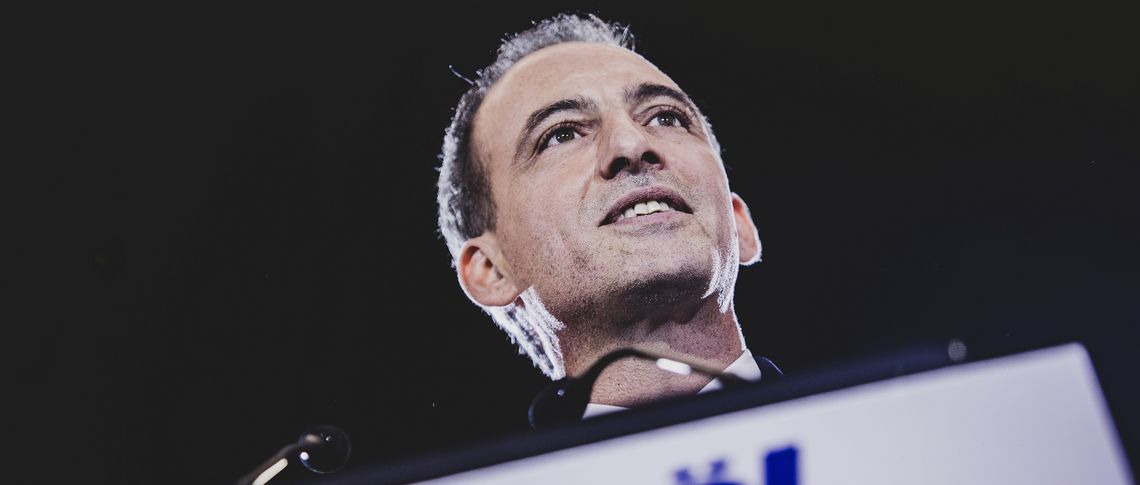
It was a bittersweet moment for the French Socialists. A sense of victory for some. Deep disappointment for the supporters of party leader Olivier Faure. In the primaries to select a presidential candidate, members of the Parti socialiste (PS) and the wider public voted by an overwhelming majority for a man who is not even a party member: Raphaël Glucksmann. At 66 per cent, the result was so clear-cut that the 14 per cent for Faure amounted to a slap in the face.
Glucksmann’s election has now – and this is a good thing – settled the very issue that has deeply divided the Socialist Party for the past two years: namely, the question of an alliance with La France Insoumise (LFI), the radical-left party led by the polarising figure Jean-Luc Mélenchon. Glucksmann, co-chair of the small social-democratic party Place Publique, categorically rejects a strategic alliance with LFI. Olivier Faure, on the other hand, has consistently advocated a pragmatic openness towards the Insoumises and the idea of a united left spanning all camps.
The fact that Glucksmann describes himself as a social democrat therefore says it all. For in France, social democracy represents a political alternative to the thoroughly successful left-wing populism of the LFI. France’s socially progressive, pro-European and moderate left now wants, with Glucksmann at its helm, to return to the political centre. And this could actually work. Nevertheless, it does not shield them from the predictable disappointment of the left-wing electorate, the so-called ‘peuple de gauche’, who are increasingly yearning for a fundamental social break and radical changes that promise a fairer future.
Still alarmingly little to offer
To many on the French left, social democracy sounds more like ‘social liberalism’, as embodied by Emmanuel Macron or as Tony Blair once championed with his Third Way. For the left – in a rare show of unanimity – Macron and ‘Macronism’ have long been synonymous with a betrayal of social achievements and the piecemeal dismantling of the welfare state.
Raphaël Glucksmann is now taking the daring gamble of entering the presidential election campaign under this banner. The challenge he faces is the difficult task of filling this term with concrete political substance and convincing people that it will not be a rehash of a softer form of Macronism with an intellectual and slightly more ecological veneer.
If one were to summarise Glucksmann’s positions in a pithy way, his brand of social democracy would be the vision of a society based on fair compromises.
The result, however low the turnout may have been, lends the political newcomer a legitimacy that he had previously lacked. As co-chairman of a small party, he has been a Member of the European Parliament since 2019. He is the son of the well-known French philosopher André Glucksmann, used to make documentary films and served as a special adviser to the Georgian President Mikheil Saakashvili. Now he is standing for the most powerful presidential office in Europe.
If one were to summarise Glucksmann’s positions and the ideas from his new book Nous avons encore envie (We Still Have the Desire) in a pithy way, his brand of social democracy would be the vision of a society based on fair compromises. Politics should be less hierarchical and operate more on an equal footing, in order to adapt the French way of life to social, geo-economic and environmental requirements.
His critics, particularly within the PS itself, acknowledge that he has a clear foreign policy profile: he supports unrestricted aid to Ukraine, the expansion of European arms production and the strategic strengthening of Europe vis-à-vis the US, whilst at the same time advocating transatlantic cooperation and sanctions against Israel’s leadership. Yet sceptics point out that, on the domestic front, merely rejecting left-wing populism and the coarsening of politics does not in itself constitute a presidential project or an election manifesto. Glucksmann still has alarmingly little to offer to win back centrist voters disillusioned with Macron.
There is therefore a justified fear amongst the Socialists that the PS’ ‘man of the centre’ will ultimately leave behind an empty election campaign fund and a party further diminished by this ‘centre’ experiment. Some leading Socialists have already made it clear that they will not support this candidate, even though Glucksmann largely represents the PS’s positions. Olivier Faure himself has pledged his support to his rival. The vote for Glucksmann is particularly bitter, however, for the Young Socialists, who unanimously and vociferously support Olivier Faure.
The first real-world test for the newly appointed minister is the current protest movement by secondary school pupils, which is causing sleepless nights and days filled with police violence across France.
Even Glucksmann’s supporters know that his policy platform is still rather thin. On several issues of the utmost urgency and sensitivity, Glucksmann has so far taken a lukewarm stance. Firstly, there is France’s now-critical financial situation and the rapidly growing mountain of debt. His plan involves taxing large fortunes and raising inheritance tax, though the expected revenue from these measures will fall far short of what is needed to balance the deeply in the red public finances. On the highly emotive issue of pensions, he confines himself to calling for a return to the standard retirement age of 62 and for greater consideration to be given to the physical strain of hard labour – without explaining how this might be financed.
Glucksmann’s supporters speculate that his two rivals in the race for the centre are burdened by a heavy legacy: Gabriel Attal and the widely regarded and highly respected Édouard Philippe – both former prime ministers under Macron. Together, they represent a failed movement that is now frowned upon or even hated across the political spectrum in France.
The first real-world test for the newly appointed minister is the current protest movement by secondary school pupils, which is causing sleepless nights and days filled with police violence across France. Glucksmann has expressed his solidarity with the non-violent demonstrators, whose demands he considers legitimate. However, anyone hoping for concrete proposals from him to resolve the crisis will probably have to wait a little longer. He has not yet been seen at the sites of the school blockades. Instead, he stated that ‘it is not a politician’s job to go and demonstrate’. LFI leaders take a very different view. Numerous Insoumises politicians are getting involved, mediating between the police and demonstrators, and discussing matters with teachers and pupils. If the centrist politician is unlucky, he may well have ceded the ground for a new, powerful, cross-class social movement to the very same left-wing populists.


