
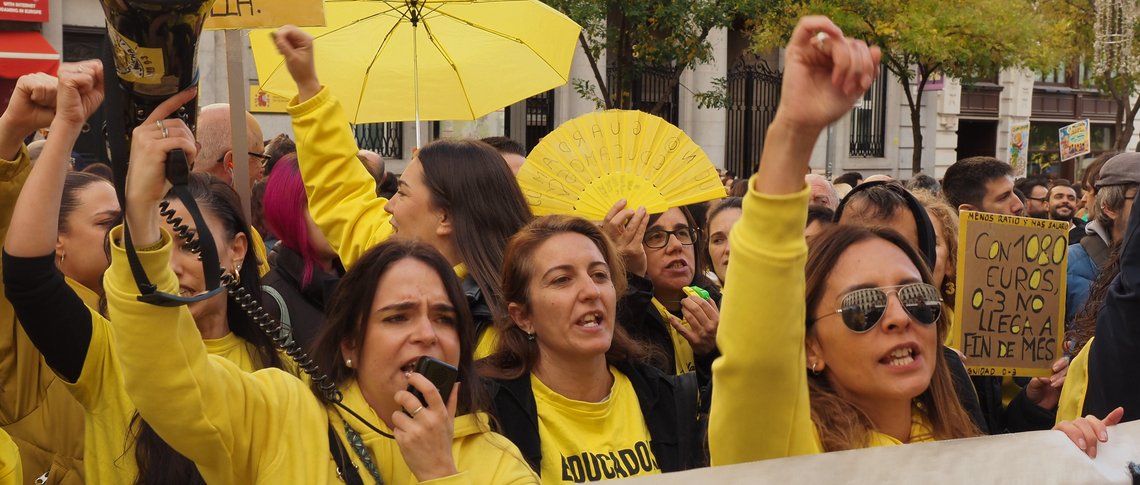
Images of the unrest that has gripped Europe for weeks — from Paris to Rome, Brussels to Madrid, and Lisbon to Berlin, Tirana and now Prague — have left no one indifferent. The mass demonstrations, largely peaceful though punctuated by sporadic outbreaks of violence, have been met with curfews, large-scale police deployments and thousands of arrests, and, in Italy’s major cities, even by soldiers on the streets.
Although each country has its own points of contention (education and the cost of living in France; housing in Spain, Portugal and Germany; low wages and the ‘war economy’ in Italy; pensions and social spending cuts in Belgium; the independence of public media in Czechia), there are common elements that invite reflection on what lies beneath them all. In virtually every case, the same conflicts keep appearing: the young versus established generations, tenants versus large property owners, citizens versus political elites, peripheries versus centres, social spending versus rearmament budgets. In a nutshell, these are revolts aimed at opening up access to what everyone needs across the different spheres of society.
When one family in Madrid, Lisbon or Berlin can hardly afford € 800 in rent, another already owns its flat, and yet another, through an investment fund, controls a portfolio of more than a thousand flats, this is more than simple inequality.
Although these protests are often understood as a revolt against ‘inequality’, this concept is becoming increasingly inadequate to capture what is going on. A situation like that of the schools in Créteil, on the outskirts of Paris, which are unable to fill their teaching posts while those in the city centre run normally and an elite private school functions as an oasis for educating the country’s future leaders, can be described as unequal. This is also the case when one family in Madrid, Lisbon or Berlin can hardly afford € 800 in rent, another already owns its flat, and yet another, through an investment fund, controls a portfolio of more than a thousand flats. The same applies to political voice: one citizen writes a letter to the editor, a group of citizens founds a small independent newspaper, and a government — as protesters in Prague fear — seeks to bring public broadcasters under its control.
All these situations can indeed be described as unequal. And yet we all know that, while the gap between the school in Créteil and the one in central Paris, or between a reader’s letter and a small independent newspaper, is a difference of degree, elite schools, the ownership of hundreds or thousands of homes or the control over public media can no longer be fully captured by that label.
What these cases have in common has a name: ‘concentration’. This term goes back to Karl Marx, for whom it described a basic tendency of capitalism: wealth does not spread out but gathers in fewer and fewer hands, as the big players absorb the small ones. Building on Marx, but extending his idea beyond the economy, I would argue that the same logic now reaches into every sphere of society. Think of what we all need: homes, good schools, decent incomes, medical care, a voice in public debate. Concentration means that access to all these goods ends up in the hands of a small group, while the majority is partly or entirely left out. The problem, then, is not only that some have more than others, but that a few come to control what everyone else depends on, in whatever sphere: the elite school, the fund with its thousand flats, a government taking over public media. In Alexandre Dumas’s classic novel, the Three Musketeers swore ‘all for one, and one for all’, a pledge of mutual solidarity. Concentration keeps only the first half, and takes it literally: what all of us need goes predominantly to one — an extremely small minority. A minority that not only enjoys its privileges but, consciously or not, keeps seeking to reproduce them indefinitely.
Your solutions are our problems
This dynamic of concentration is no abstraction: most people experience first-hand what it means to be partly or entirely excluded from the benefits of social prosperity. In the economy, this has translated into precarity — people are unable to ‘make ends meet’ — while ‘at the top’ there are resources to spare for wasteful spending; in housing, it means facing unaffordable rents in the very city where one works, while entire buildings change hands in a single transaction; in public life, it means being shut out of the debates and decisions that shape society, while still having to live with their consequences (as murals across Berlin put it: ‘Your “solutions” are our problems’). It is, in short, an experience of dispossession rooted in everyday life, which at some point becomes intolerable.
It is no coincidence, then, that protest movements against concentration have proliferated over the past fifteen years: from the Occupy movement, whose ‘We are the 99 per cent’ reached Frankfurt in 2011, through the gilets jaunes in France — who demanded the reinstatement of the wealth tax — and the crowds who filled Prague’s Letná Plain in 2019 against the concentration of political and economic power in the person of Prime Minister Andrej Babiš, to Berlin’s 2021 referendum in favour of expropriating the large property companies. All these movements were, in essence, struggles against the concentration of what everyone depends on — wealth, housing, political power — in the hands of a few.
In France, the wealth of the country’s 500 largest fortunes has grown more than sixfold in some two decades, according to Challenges magazine — fifteen times faster than prices.
Thus, amid the current wave of protests, it is worth looking at what lies beneath them. Without rushing to definitive answers, we can consider concentration, if not as the main driving force, then at least as the background to the discontent sweeping through Europe’s streets. The protesters’ own demands point in this direction — against large landlords and investment funds in Madrid, Lisbon or Berlin, against a government seeking control over public broadcasters in Prague — and so do the data.
At the continental level, according to the World Inequality Report 2026, the richest 10 per cent receive 36 per cent of total income — almost twice the share of the poorest 50 per cent. In France, the wealth of the country’s 500 largest fortunes has grown more than sixfold in some two decades, according to Challenges magazine — fifteen times faster than prices. In Spain, data from the Ministry of Consumer Affairs show that homes owned by large landlords have more than quadrupled since 2008, while in Berlin a handful of companies own more than 200 000 homes. Finally, in education, where this wave began, OECD data show that across European countries more than two in three young adults with at least one university-educated parent obtain a degree, compared with barely one in five of those whose parents did not complete secondary school.
It is not my intention to offer a definitive answer about what is happening in the present wave of protests across Europe. What does need to be acknowledged, however, is that no short-term policy aimed at offering ‘a little more money’ here or there will solve a problem whose roots run far deeper than any photograph or video of the protests can capture. For Europe to address the problem of concentration through a redistributive policy that is not merely economic but extends to every sphere of society seems as necessary as it is unlikely. I hope I am wrong.