


It is not every day that a red multimillionaire knocks on the door of a social democratic party and says: ‘I want in. I’ll be your leader if you want me.’
That is exactly what happened to Austria’s Social Democratic Party (SPÖ) at the end of September. The man knocking on the door was Gerhard Zeiler, 71, a media executive also well known in Germany (RTL) who has served on the board of WarnerMedia in the United States since 2012.
But with Zeiler, the past also came knocking. He stands for the ‘Third Way’, the move towards market logic and globalisation that was in vogue among social democrats in the 1990s. Gerhard Schröder in Germany, Tony Blair in Britain, Bill Clinton in Washington and the ill-fated Viktor Klima in Austria had no qualms about being called ‘comrades of the bosses’. Zeiler began his career as a press spokesman in the Austrian chancellery. He chose Austria’s largest tabloid to announce his ambitions — the Kronen Zeitung. In the 1990s, after all, all you needed to govern was ‘Bild, BamS and the box’ (mass-market tabloid media and television), as then German SPD leader Gerhard Schröder once put it.
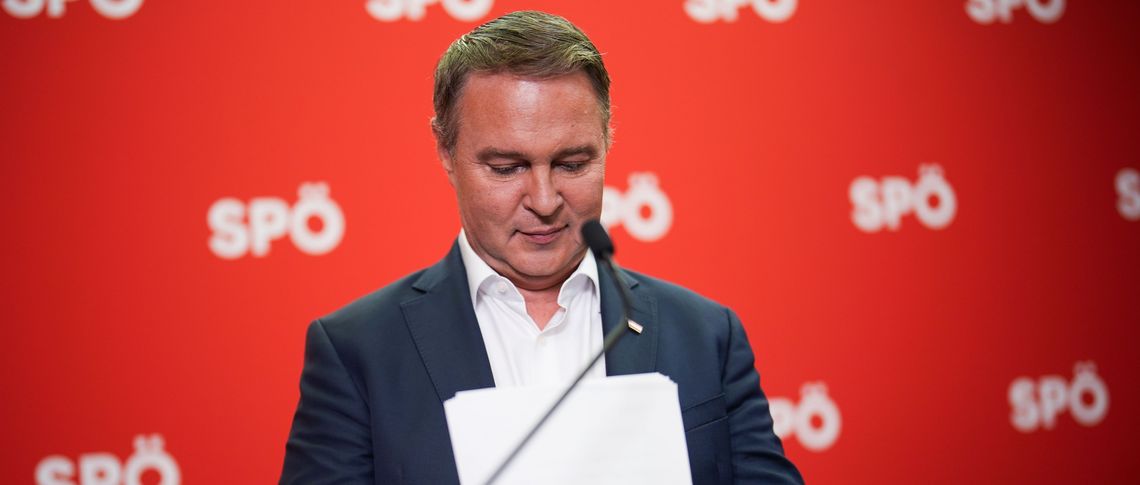
In the end, Zeiler did not take over the SPÖ. But his announcement alone prompted the party’s leading officials to meet spontaneously on the first weekend of October and decide that the current party leader, Andreas Babler, would have to step down gradually.
Who is the SPÖ?
This dismantling was a unique event in the history of Austrian social democracy. But behind the leadership crisis lies a much more fundamental crisis of direction. In the Sunday poll, the party is at around 15 per cent, and it now governs in only three of Austria’s nine federal states.
Babler is on his way out. The only compromise candidate to succeed him is Finance Minister Markus Marterbauer. He is the most popular member of the government. But the economist, a supporter of Thomas Piketty, has been diagnosed with lymphoma and must complete his chemotherapy by the end of the year. Only then will he take on the party and government leadership — provided he has recovered. Marterbauer is supposed to remain finance minister until early 2027 and then become vice-chancellor. Until then, two younger politicians from the red leadership team are to support Babler as party leader: Philip Kucher, parliamentary club chairman, and Eva Holzleitner, minister for women, science and research. A party conference in the spring will make everything official.
Can a party that takes refuge in a four-person leadership team for months really make this work? The personnel solution devised in Vienna emerged out of necessity and clearly shows that the SPÖ lacks people to fill the top job. No one could be found to succeed Babler immediately — apart from Zeiler, the outsider.
The Austrian Social Democrats provide a good illustration of how fatal it can be for a party on the centre-left when it fails to find a clear answer to the question of what it stands for and who should lead it. The personnel question alone will not solve its crisis.
This applies to all parties, of course, but to social democracy in particular. For a long time, it was used to govern or be part of government — which meant there was no need to ask what it stood for. We are in power, we are part of the republic, that must be enough. This self-image has made the party complacent.
All nine SPÖ state party leaders are men.
The SPÖ has therefore allowed the far-right Freedom Party (FPÖ) to poach its base, the working class, as an electorate since the 1990s. By now, Austrian workers have been voting blue rather than red for two or three generations.
There are structural reasons for this, of course. In 1970, around half of all employees worked in industry and manufacturing; in 2025, the figure was just under a quarter. They are also less likely to be unionised. Only 20 per cent of employees are now members of a trade union. This increases the influence of the Chamber of Labour (AK) within the SPÖ, as it benefits from compulsory membership in Austria. Finance Minister Marterbauer was chief economist at the AK before entering government.
The working class has not only shrunk, it has also become much more migrant. But many migrants do not have Austrian citizenship and are therefore not allowed to vote. In Vienna alone, the SPÖ’s stronghold, one third of the population is not eligible to vote. This makes it even harder for the SPÖ to mobilise them.
Then there is the fact that the remaining, predominantly older, traditional red electorate is latently hostile to foreigners. Since 2015, an SPÖ that advocates for the rights of migrants has struggled to gain traction. The FPÖ dominates the cultural debate, polling at around 37 per cent. ‘Austria first’ is also what many red voters want.
These structural problems are compounded by internal challenges, to put it politely. The party has already been criticised for failing to nurture new talent. It also missed the digitalisation boat: the party’s social media accounts lack reach, and its own media channels were established far too late.
Most damaging are the internal divisions that have paralysed the party for the past decade. If Marterbauer takes over the party in early 2027, he will be its fifth leader in 10 years. The party has experienced factional disputes, contested votes marked by Excel mishaps and personal feuds. Babler himself emerged from a power struggle between two rival camps as the unexpected third man who ultimately came out on top. Uniting the party is therefore difficult. Most recently, leading state politicians simply boycotted the party’s key bodies. A party could hardly be more dysfunctional. It is fitting, then, that the share of women at the top of the party is zero. All nine state party leaders are men.
At least one question of direction has been answered by Babler’s removal. No, Austrian social democracy does not need a more hard-line left-of-centre course. What matters is not how left-wing its policies are, but how credibly it represents them.
A failed balancing act
That is precisely what Babler stood for. In his fiery speeches, he repeatedly harked back to the 1970s and the promise of social mobility. It suited his own biography as the son of workers whose parents toiled at the Semperit tyre factory. During the election campaign, he mobilised many young voters with these romantic retro vibes. The ‘Bableristas’, as the media dubbed his followers, had momentum.
But Babler’s slogans – wealth taxes, a basic child allowance, free lunches for every child – could not be implemented in the three-party coalition with the Austrian People’s Party (ÖVP) as the senior partner and the liberal NEOS as the small but crucial provider of a majority. A study by the University of Graz shows that during the three years of government, the SPÖ managed to get the fewest of its demands through of the three coalition partners. This is hardly surprising when it finds itself caught between two parties that tend towards market liberalism.
The SPÖ will return to its traditional course, back to where Austrian social democracy has always been most at home: in the pragmatic centre.
As vice-chancellor, Babler proved surprisingly pragmatic — at least internally. In public, he continued to present himself as a red revolutionary. But the balancing act did not work. The Bableristas were disappointed, while he failed to connect with the wider public. In a digitalised media democracy, personal authenticity matters more than ever: political image and political record must match.
His successor, Markus Marterbauer, will find this easier. He is an Austro-Keynesian through and through and is therefore politically just as left of centre as Babler. But he has a softer manner. As finance minister, Marterbauer has skilfully fashioned his role as that of an explainer and expert. During his time at the Chamber of Labour, he learned how to explain complex issues in very accessible language. This has earned him a great deal of sympathy.
Marterbauer would of course also like to introduce wealth taxes, but unfortunately this is not politically possible in the current coalition. If he could, he would introduce a basic child allowance, but the budget must first be put back on a sound footing; otherwise Austria’s debt burden would become crushing and leave the country unable to act.
Multimillionaire Zeiler stood for the Third Way. Workers’ leader Babler stood for left-wing populism. With the economist Marterbauer, the SPÖ will return to its traditional course, back to where Austrian social democracy has always been most at home: in the pragmatic centre, with a social conscience but without the scare-the-middle-class rhetoric. Its political convictions do not need to change fundamentally. What needs to change is the way they are represented.


