


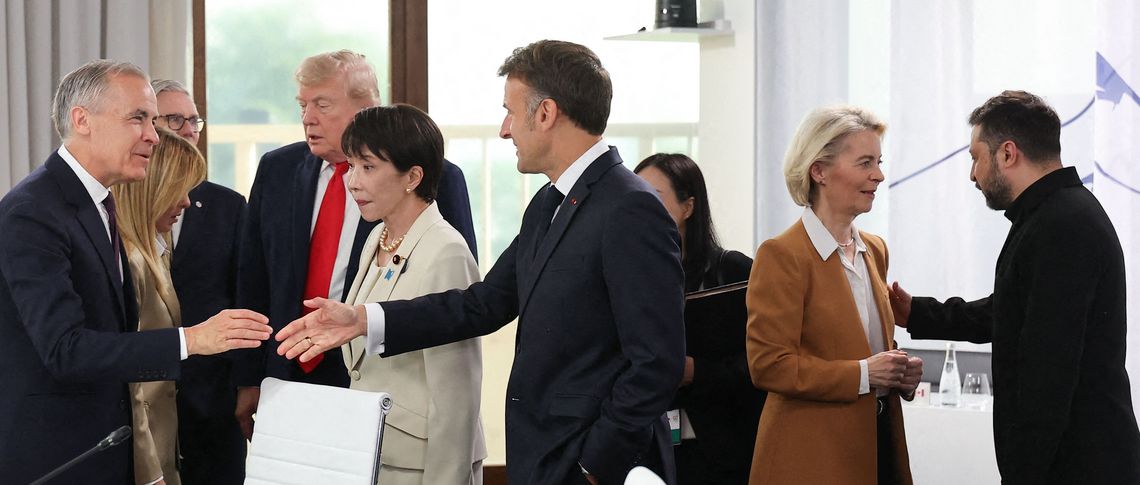
Fires caused by shelling in Kyiv and Moscow, with a summit of Western leaders taking place between them. It seems that this picture will retain their symbolic significance in the coming months.
While Ukraine is critically dependent on the decisions taken by its partners, those partners are also dependent on Ukraine’s successes or failures in countering Russian aggression. From the very outset, the Russian-Ukrainian war has been closely interwoven with the global struggle for the redistribution of influence and over the specific rules on which the next version of the international order will be based. It is impossible to understand its logic and dynamics in isolation from this context. The US, China and Europe are playing their own games, seeking to minimise risks, build influence and prepare for future conflicts. Ukraine, like Russia, plays a significant role in these manoeuvres. The war is shaping expectations, assessments of the balance of power, perceptions of threats and the choice of instruments. For many reasons, it is fateful for the West – both for what remains of American leadership and for Europe’s definition of its geopolitical role, along with the price it must pay. President Zelenskyy’s meetings at the summit in Évian-les-Bains were aimed at integrating Ukraine into a holistic vision of European security and finding something akin to a new common strategy, adapted to the changing realities of war. On the whole, this was achieved.
Changing circumstances
Of course, one must take into account the specific nature of the G7 summits. They rarely prove to be decisive: their decisions are largely symbolic, and the group’s share of the global economy is diminishing over time, along with its global influence. Yet the forum remains a mirror reflecting the concerns, solidarity and disagreements of Western nations in a changing world. Last year, for instance, this mirror revealed a lack of consensus on the issue of the Russia-Ukraine war.
Now, however, the situation has changed, and the West needs a more consolidated position. It is unlikely that ‘off-the-shelf’ strategies can be expected, but even the fact that the parties have found common ground regarding further support for Ukraine, and have specified its key elements, can be regarded as a diplomatic success.
Timing is crucial this year. The summit coincided with significant developments in both the Russia-Ukraine conflict and the Israeli-American conflict with Iran. Both wars pose a challenge to the West’s geopolitical positions, of which the Group of Seven is the embodiment. In both cases, the stakes are high, and the outcome is far from what is desired. However, recent events have brought news that is forcing the West to act.
Trump now needs Europe more, Russia less, and is in desperate need of a geopolitical success, or at least something resembling one.
Trump lost – or, as is often the case in asymmetric wars, failed to win – the war in Iran, whilst Ukraine has achieved limited successes in countering Russian aggression, which optimists might well regard as a turning point or a seizure of the initiative. This is significant because the greater Kyiv’s chances of continuing to successfully contain Russia, the more justified Europe’s investment in Ukrainian security becomes, right up to negotiations on EU membership – which, in any case, promise to be protracted, difficult and with little guarantee of success.
The uncertain outcome of the war against Iran, from the US perspective, has also altered the situation in its own way. Trump took a risk, decided to go to war contrary to his own pre-election rhetoric — and lost. The failure in Iran has reduced the scope for new geopolitical experiments and increased the value of existing alliances. Washington can no longer afford another geopolitical defeat and is seeking a more promising strategy in the Russian-Ukrainian war. Trump’s risky and ill-prepared attempt to act as a mediator last year failed to yield results. It turns out that Biden was not so far off the mark when he based his strategy on measured pressure on Moscow, continued support for Kyiv and rhetoric of solidarity with Ukraine.
These developments have meant, firstly, that the Ukrainian issue has returned to the G7 agenda, and secondly, that Trump has been forced to change his stance. He now needs Europe more, Russia less, and is in desperate need of a geopolitical success, or at least something resembling one. Ukraine has shown him the path to such success, which involves investing in the Ukrainian resistance rather than exerting pressure on Kyiv through mediation; this requires, however, a rethink of the ‘default assumptions’ that Kyiv holds no cards and that Moscow is bound to win. The US’ own experience in Iran should have convinced Trump that victory for the nominally stronger side is not the only possible outcome. Betting on Ukraine, however modestly, looks more attractive today than it did a year ago.
Cautious optimism
Europe, too, has undergone a complex and at times contradictory process of re-evaluating current realities over the past year. The recognition that Ukraine’s survival and security are key to Europe’s own security has gradually come to dominate the political landscape from Lisbon to Warsaw. However high the cost of supporting Ukraine in a war that may drag on for a long time, Europe is now prepared to pay it.
It is important to us that these changes took place in the run-up to the G7 summit and shaped its outcomes, which Zelenskyy described as significant. These include an increase in air defence supplies, the possible granting of licences to manufacture missiles on Ukrainian territory, increased pressure on the Russian economy, and assistance to Ukraine in preparing for the coming winter. It is unlikely that the West could have promised more.
That said, as under Biden, the definition of victory remains vague. No one knows what that will look like.
However, there is little cause for euphoria as yet — more likely, there is reason for cautious optimism. To begin with, the summit’s decisions are declarations of intent; the actual volumes, conditions and measures will be the subject of further discussions. Secondly, if all this is put into practice, we will effectively return to the 2022–2024 model, with a redistribution of expenditure between Europe and the US. Under this framework, instead of security guarantees and allied commitments, Ukraine received controlled supplies of money and weapons, which, of course, became critical for deterring Russia, but were insufficient for victory.
It seems that confining the war to this framework now satisfies both Europe and the US. Trump’s strategy of seeking a rapid improvement in relations with Moscow, even at the expense of Ukraine’s interests, has largely lost its purpose following the war with Iran. In the Russian-Ukrainian war, it is important for the US to be on the side of the victor — and even better if Ukraine emerges as the victor. That said, as under Biden, the definition of victory remains vague. No one knows what that will look like. But this is a level of uncertainty the West can live with. The aim is to ensure Ukraine’s long-term ability to resist, to help plug the most vulnerable gaps, and to constantly raise the cost of the war for Russia.
This does not mean that such an approach will remain unchanged. Trump himself may well change his mind under the pressure of the realities of war. A series of elections lies ahead in European countries, and the line-up for the next G7 summit could be quite different. However, as the years of the Russian-Ukrainian war have shown, strategic guidelines often prove more resilient than the political parties in power. The strategy on which the West is banking does not guarantee us victory, but it is the best of the realistic options available to us today.


