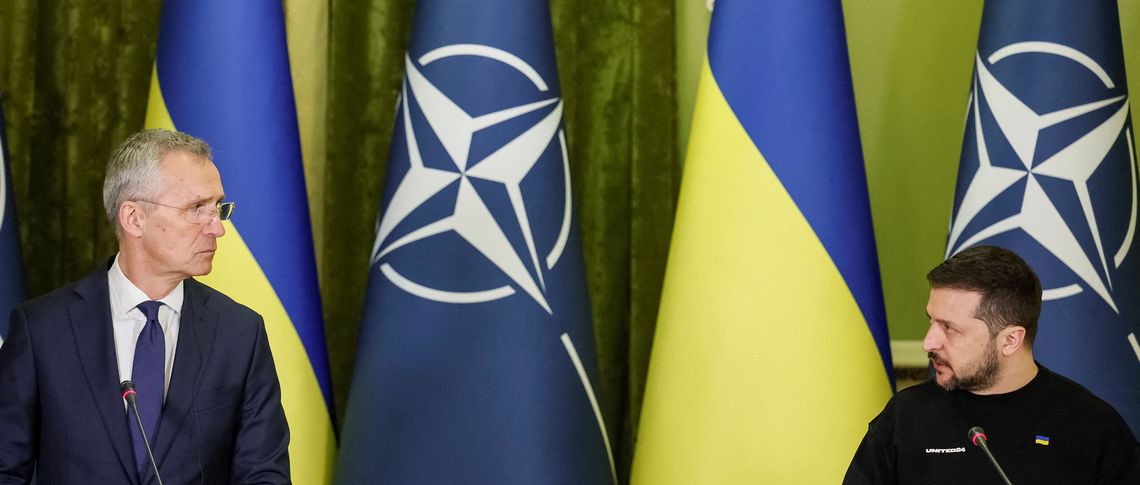
Ukraine has been fighting off Moscow's illegal aggression, defending the internationally agreed-upon rules-based order for more than 500 days. It hopes that this will be the last time. For this wish to come true, Kyiv has applied for NATO membership, the Western military alliance, to be included in the mutual defence system with big players such as the United States and the United Kingdom, France and Germany.
In a letter signed by their presidents, nine Eastern flank allies immediately said that they ‘firmly stand behind the decision’ that Ukraine will become a member of NATO. Other members have met Ukraine's application with deafening silences, while weapons deliveries continue. ‘Our focus now is on providing immediate support as Ukraine defends itself against Russian aggression,’ NATO Secretary-General Jens Stoltenberg declared.
But it is this week that the time has come for the leaders of the 31 nations united under NATO to answer Ukraine's call and stop the decisional vacuum, as they meet in Vilnius, Lithuania.
Now is NATO’s chance to prove its commitment to Ukraine’s membership – albeit distant – in an unbreakable way to show Russia that it has lost, at least on the political scene, and that NATO is ready to protect Ukraine for ‘as long as it takes’. The difficult question to answer is how and when Ukraine could eventually count itself among the NATO members.
Will promises become more concrete?
Technically, Ukraine already got the promise to join the alliance 15 years ago — in Bucharest, back in 2008, when the allies ‘agreed that [Ukraine] will become [a] member of NATO’. But not much has happened since, with Ukraine first hesitating between the West and Russia and then the war breaking out in 2014.
‘Ukraine's rightful place is within NATO’, the alliance's Secretary-General Jens Stoltenberg said back in May. To prove they're committed to Ukraine, the alliance's members have established a NATO-Ukraine summit, which they say ‘upgrades’ Kyiv's relationship status. The only other country with a Council is Russia.
However, putting Kyiv on a ‘pathway’ to membership is also not as easy as it sounds.
Surely, this new bureaucratic format will have a concrete impact, as Kyiv will have better access to working groups and intelligence, and will have the right to call discussions when it deems necessary. But it falls short of what Kyiv really wants: a concrete assurance, more than just another promise, that it will join the Western military alliance and benefit from the mutual defence clause of Article V.
‘In summer in Vilnius at the NATO summit, a clear invitation from members to Ukraine is needed,’ Ukraine President Volodymyr Zelensky said last month. An ‘invitation’ though is unlikely as long as the war is still raging, as it would automatically start the membership ratification process in all capitals. This could only happen if all 31 nations would agree that Ukraine is ready to join the military alliance.
However, putting Kyiv on a ‘pathway’ to membership is also not as easy as it sounds. ‘All the discussions between the allies are about the terms, the modalities, the conditions under which this accession could take place,’ an Élysée source said ahead of the meeting.
Defining the process
The most fervent supporters of Ukraine can be grouped into ‘the Easterners’, minus Hungary. Estonia, Latvia, Lithuania, Poland, Czech Republic, Slovakia, Romania and Bulgaria are maximalists: according to them, the path should be as closely defined as possible, and irreversible, with a decision remaining in the hands only of the political decision-makers.
Under this scenario, Ukraine would still have to go through reforms before joining. Membership would happen ‘when conditions are met’. But the spelling out and the assessment of such reforms would remain a political decision.
While the US-Germany Club looks for a stricter process, if any at all. Under this configuration, the benchmarks and timelines would be more clearly defined. Assessment would be in the hands of NATO or national authorities, much like the European Union accession process.
‘There are standards that the Alliance sets for all members, and US President [Joe Biden] made clear that Ukraine would need to make those reforms,’ Amanda Sloat, Special Assistant to Biden and National Security Council Senior Director for Europe said. For instance, all NATO members must be in control of their territory, respect the rule of law, have armed forces and equipment which is compatible with that of other allies’
This way would create an additional step in the accession process.
Notwithstanding the differences in perspectives, it is unclear which process would eventually be faster, diplomats from both schools of thought confess behind closed doors. At the end of the day, it's a matter of principles, and who's got the control.
The accession process, as those of Sweden and Finland have shown, is highly political. The two Nordic countries have been left in NATO's waiting room for months, as Turkey and Hungary kept postponing green lighting the processes. And Sweden still is.
A distant prospect
Conditioning Ukraine's accession to the military alliance is unavoidable. Despite the commonly agreed rule: no accession for a country at war.
‘I don’t think there is unanimity in NATO about whether or not to bring Ukraine into the NATO family now, at this moment, in the middle of a war,’ Biden said in an interview with CNN. ‘If you did that, [while] the war is going on, then we’re all in war. We’re at war with Russia.’
Conditioning membership to the end of the war or a peace scenario, which could take years to arrive, would postpone accession to an unknown time.
Be that as it may, if the rule is that Kyiv will only join after the war, it would also give Putin a good reason to never let arms fall silent, the Easterners Club would claim. After all, the closer Ukraine comes to NATO accession, the clearer it is that Ukraine will not return to Moscow's arms, which saw NATO’s expansion to the East as one of the reasons behind invading Ukraine last year. Plus, a negotiated settlement of the conflict seems like a rather far-off perspective.
Conditioning membership to the end of the war or a peace scenario, which could take years to arrive, would postpone accession to an unknown time.
Whichever shape the military alliance gives to Ukraine’s accession process in the Lithuanian capital this week, it is important to remember Kyiv joining NATO will take time. Meanwhile, Ukraine and its Western allies will craft other types of security commitments to hopefully deter from any future attack. They'll include long-term military support, economic assistance, non-lethal aid and more because if Russia wins, there will be no Ukraine to let in the alliance.