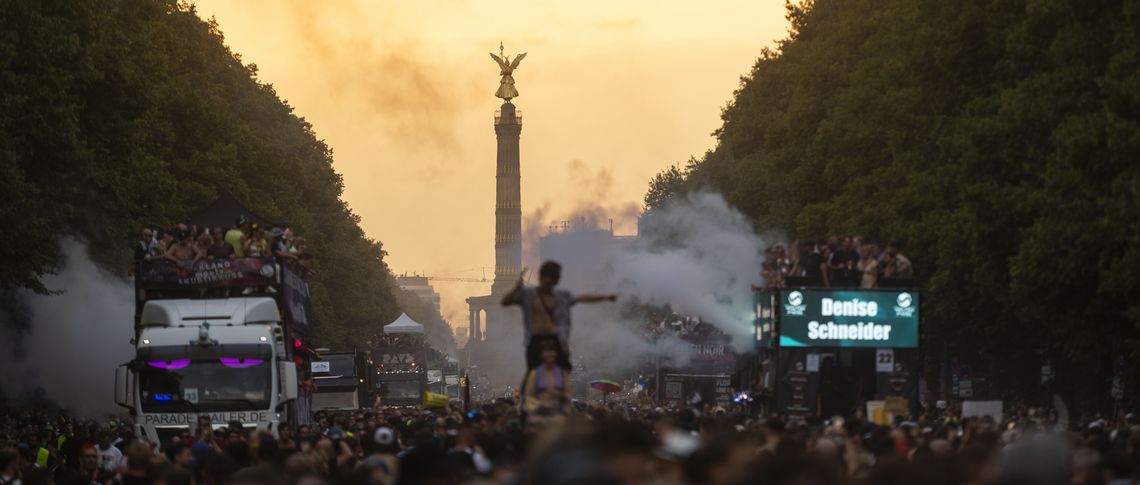
A month ago, the attack on the Berlin CSD caused a stir in political circles. The debate unfolded along familiar lines. Whilst some emphasised the dangers of Islamism and its trivialisation by left-wing figures, others pointed to the shared responsibility of right-wing figures, who they claimed had paved the way for such an act. In the public eye, the attack was primarily linked to anti-queer sentiment.
In times of digital ideological conflict, the interpretation of political events is heavily influenced by emotions. Even in response to acts of terrorism, all sides are quick to establish their own narratives, which reflect their perceived truths. It is therefore worth taking a step back to examine the certainties that have emerged surrounding the attack – including its classification as an act of anti-queer hostility. Can they stand up to sober scrutiny?
This is more than just a matter of correct classification. How an attack is interpreted also determines what political consequences are drawn from it. On top of that, the battles over interpretation can further exacerbate existing social conflicts – and thus become part of the attack’s impact in their own right. For, as is a truism in terrorism research, terrorism targets not only its immediate victims, but also aims to provoke political and social reactions. According to Peter Waldmann, it is a ‘communication strategy’; the victims are a means to an end.
One interpretation of the attack stands out in particular, namely that it stems from the same ideological evil that the political right also stands for: hostility towards queer people. Accordingly, following the attack, there was discussion of the right-wing camp’s shared responsibility, particularly that of the far right.
But does this interpretation do justice to the nature of the attack? Was the attack even anti-queer in the first place? The question may seem perplexing – after all, the target was clearly a queer event. Yet it is precisely the obvious that warrants a second look. For the crucial question is whether the CSD became a target because of its queer character, or as a particularly visible symbol of an open, pluralistic and secular – that is, Western – way of life.
The need to see the bigger picture
Terrorist attacks are quickly interpreted through one’s own political worldview. Particularly when perpetrator profiles are contradictory, each side picks out what fits their own narrative – including the appropriate attribution of blame. For instance, in the case of Islamist attacks, the right regularly assigns partial blame to the left. On the left, in turn, the accusation that the right-wing exploits such attacks to fuel anti-Muslim hate speech has often dominated. Consequently, the Islamist background has so far been downplayed or, at the very least, kept in check in public discourse.
In the case of the attack on the CSD, this pattern has now shifted, as the target of the attack suggests that the act could be interpreted as anti-queer, thus opening up other interpretations. Whilst for some on the left it provides a bridge to address the issue of Islamism – now free from any suspicion of being part of the far-right agenda – for others it helps them to jump straight to the shared responsibility of the right and even conservatives, rather than merely warning against right-wing instrumentalisation.
Muslims are said to be marginalised and thereby driven into the arms of Islamists or into jihad. Yet this interpretation is selective. It views the Berlin attack in isolation, rather than placing it within the series of IS-linked attacks of recent years, which have been on the rise again since 2023. As Peter R. Neumann points out, these are often directed against people who, from the perpetrators’ perspective, are simply regarded as ‘infidels’ or ‘enemies of Islam’. Jewish targets also play a particular role.
The targets of the attacks are therefore quite varied, but they have one thing in common: they represent the Western way of life.
The attacks repeatedly target public gatherings: the Bataclan and Stade de France in Paris, the French National Day celebrations in Nice, the music festival in Ansbach, the Christmas markets at Berlin’s Breitscheidplatz and in Strasbourg, the Ariana Grande concert in Manchester, the town festival in Solingen – and now the Berlin CSD. The targets of the attacks are therefore quite varied, but they have one thing in common: they represent the Western way of life. And the CSD also stands for this – particularly from the perspective of Islamists.
The queer community has been directly affected by the recent attack. Accordingly, their reactions are entirely understandable. From a security policy perspective, however, queer life is ‘merely’ a subset of a larger target category, just as Christians, visitors to a national holiday, and metal, football or pop fans were previously. Especially as the CSD has long since become more than just an event organised by LGBTQIA+ people.
The CSD is an open, hedonistic mass event, a symbol of progressive culture in particular and the Western way of life in general. Just how crucial the latter category is is illustrated by a thought experiment: had the perpetrator attacked Berlin’s ‘Zug der Liebe’ a few weeks later, the act would have fitted seamlessly into the pattern of IS-linked attacks. The ensuing debate about queerphobia and the political right’s shared responsibility, by contrast, would scarcely have gained traction.
That does not mean that queerphobia plays no role. Such acts are frequently carried out by ‘lone wolves’. Sometimes they have contact with IS and receive some instruction; at other times, the perpetrators act autonomously and, like Abdul B., identify themselves as part of the group. When choosing a target for an attack, individual motives such as hostility towards the queer community may therefore well play a role. Nevertheless, this aspect remains secondary if the attack is not viewed in isolation but as part of a series of attacks.
The ‘yin and yang of terror’
In the context of the series of attacks, however, the strategic dimension is crucial. The individual perpetrators do not usually think strategically themselves. They are often unstable, act out of a vague sense of hatred, are fascinated by IS, or are seeking a kind of redemption. Their actions nevertheless form part of IS’ strategy, which motivates such attacks. Its aim is to exacerbate social tensions – and also to provoke anti-Muslim hatred.
As once set out in Dabiq magazine, IS aims to ‘eradicate the grey area’: Muslims are to be marginalised and thereby driven into the arms of Islamists or into jihad. Accordingly, anti-Muslim agitators on the right act as accomplices to this radicalisation strategy – whilst Islamists act as a catalyst for such incitement. Ten years ago, this interplay was already described as the ‘yin and yang of terror’.
From a jihadist perspective, the CSD was therefore the perfect target. However, this was merely a theoretical deduction drawn from the IS strategy mentioned. Whether this actually works and leads to further radicalisation is another matter. To date, it cannot be said that anti-Muslim reactions to attacks have intensified Islamist terrorism. What is crucial here, however, is something else: the dynamics of the conflict following an attack are by no means limited to the interplay between Islamists and the (far) right.
From a jihadist perspective, the CSD was therefore the perfect target: the attack not only struck at a symbol of the Western way of life, but also triggered the well-rehearsed reflexes of political polarisation to a particularly marked degree.
Rather, we are dealing with a triangular constellation: jihadists want to fuel hatred against Muslims, far-right extremists want to incite hatred against Muslims, whilst sections of the left, in turn, seek to hold the right-wing camp responsible. So it is not only the right that attempts to exploit the attack for domestic political gain. The left does so too. It goes round in circles.
The focus on anti-queer sentiment may satisfy emotional needs, but above all it serves to instrumentalise the attack for the fight against the right. And that has far-reaching consequences. For it obscures the transnational, anti-Western nature of such attacks. Anyone who draws primarily queer-political conclusions from this is missing the heart of the problem. That would have been of little help to the Ariana Grande fans in Manchester or the visitors to Christmas markets.
From a jihadist perspective, the CSD was therefore the perfect target: the attack not only struck at a symbol of the Western way of life, but also triggered the well-rehearsed reflexes of political polarisation to a particularly marked degree. Islamists, the far right and the far left each follow their own playbook. The ‘yin and yang of terror’ thus becomes a triad of polarisation.
Islamists also welcome left-wing reactions. Not because they are anti-racist, but because they deepen the rifts within Western societies. Anyone who immediately categorises an Islamist attack within the framework of political factionalism may themselves be contributing to the very polarisation that terrorism is intended to create.
The least misleading way of putting it is therefore: it was an attack on the Western way of life (‘on all of us’). Queer lives are part of this. Focusing on Islamism as a shared threat (including to moderate Muslims) could have kept bridges open between the camps. At the same time, genuinely racist and anti-queer positions would have become more clearly recognisable as such.
But by shifting responsibility along the familiar dividing lines, the rift between the camps is further deepened. And this means that people are increasingly forced to choose between them. This, too, amounts to the erasure of the grey area.