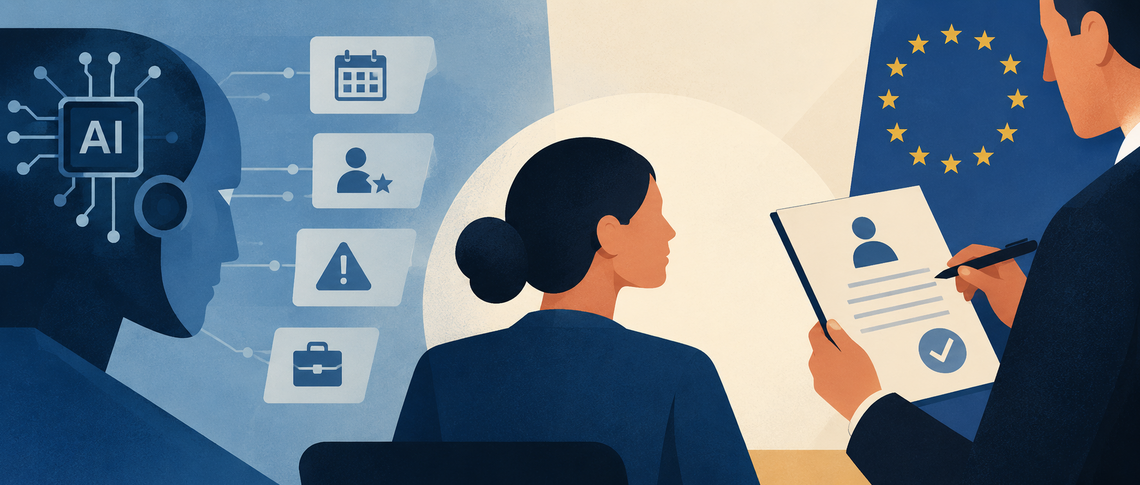
Europe’s new AI transparency rules answer an important question: when should people be told that they are dealing with a machine or encountering synthetic content? They do not, however, fully answer a much harder question: what can an employee do when an algorithm helps decide their shift, promotion, disciplinary warning or even whether they get hired in the first place?
That gap matters because algorithmic management has quietly become the norm in many workplaces. An OECD survey found that such tools are used by an average of 79 per cent of firms in France, Germany, Italy and Spain. This number is even higher in the United States, where 90 per cent of managers say their firms have adopted at least one tool to allocate work, monitor performance, set targets or support personnel decisions. The same research found that worker consultation can reduce risks and improve engagement with new tools.
Europe should therefore treat transparency only as the beginning of accountability, not its endpoint. A label is useful. But disclosure without a practical right to challenge the result is little more than a notice pinned to a locked door.
The power imbalance behind the label
If a chatbot gives bad advice, you can close the browser or choose a human service instead. Workers rarely have that luxury. They usually cannot walk away from the system that assigns shifts, scores calls or recommends who receives training. The employer controls the tool, the data and the consequences. The employee may not know which input mattered, who approved the decision or whether a human reviewed it at all.
This imbalance changes what meaningful transparency requires. Telling an employee that ‘AI was used’ does little if the employee must still guess how to raise an error, fears retaliation for objecting or waits weeks while the disputed decision remains in force.
Technology alone won’t determine the future of work. Institutions, policies and social dialogue matter just as much. That principle should guide the implementation of Europe’s AI rules. What is needed, therefore, are three basic guarantees: transparency, human responsibility and meaningful remedy.
First, transparency must mean more than simply telling workers that AI is involved. They should know, in plain language, what role the system played, whether it made a recommendation or effectively determined the outcome, and what categories of information it used. A generic sentence in a privacy policy is not enough. Workers also need a clear route to challenge an error without specialised legal knowledge or being sent back through the same manager who relied on the tool.
Secondly, responsibility means putting a named human behind every AI-assisted employment process. That person must have authority to examine the evidence, change the outcome and pause the system if a pattern of errors appears. ‘The algorithm decided’ cannot be the end of the conversation.
A social market economy cannot rely on disclosure alone when one side controls the system, and the other side lives with its mistakes.
Lastly, remedy matters because algorithmic decisions can quickly become income losses. In 2020, the Bologna Labour Court found Deliveroo’s rider-ranking system discriminatory: riders who cancelled booked sessions too late could lose ranking and, with it, access to the best future work slots — even when the absence involved protected reasons such as illness or strike action. The point is larger than one platform. A meaningful appeal should protect a worker from serious harm while review takes place, keep a record of corrections so recurring failures become visible, and bring workers, works councils and unions into system reviews before problems harden into routine.
The debate over workplace AI is often framed as innovation versus regulation. That is too narrow. The real question is how productivity gains, decision power and correction costs are distributed. An automated scheduling system can save managers hours while pushing unpredictable working hours onto employees. A performance model may standardise evaluation while concealing a poor proxy for quality. A recruitment tool may accelerate screening while placing the burden of proving an error on applicants who never learn why they were rejected.
These are questions of voice and bargaining power. A social market economy cannot rely on disclosure alone when one side controls the system, and the other side lives with its mistakes.
A worker appeal right would also help responsible employers. Managers often receive AI recommendations without enough context to judge them. A formal review process creates better evidence, exposes weak inputs and permits managers to reject outputs instead of deferring to a system that appears objective. Consultation can also improve adoption because employees are more likely to use tools they understand and can challenge.
From national patchwork to European floor
The Commission wants transparency rules to work the same way across Europe. Workplace appeal rights deserve the same common standard. If protection depends entirely on national enforcement capacity or the generosity of individual employers, workers doing similar jobs will have very different rights across the single market.
To achieve this, Europe does not need one rigid procedure for every workplace. A hospital, warehouse, bank and delivery platform face different risks. But the floor should be common: notice, a human owner, an accessible challenge, protection during review, a correction record and worker participation.
That floor would make transparency credible. It would turn the label from a warning into a doorway.
Europe is right to require people to know when AI is involved. The next step is to ensure that workers can do something meaningful with that knowledge. When an automated recommendation shapes a person’s livelihood, the right to see the machine must be matched by the right to reach a human.