A bonus of €300 000 — per employee, per year. That is the profit-sharing payment won by employees of the South Korean conglomerate Samsung at the end of May. The approximately 78 000 employees in the semiconductor division had threatened to strike unless the company distributed part of its exorbitant profits to the workforce. The background: Samsung manufactures so-called memory chips. Due to the AI boom in the United States, demand for these chips has exploded in recent times. Samsung’s share price had increased eightfold within just a few months. However, employees had so far seen little benefit from this.
Exactly how large a productivity boost artificial intelligence will trigger over the coming years is not yet entirely clear. More conservative estimates assume additional annual GDP growth of around four per cent. Other studies, such as ‘Could Advanced AI Drive Explosive Economic Growth?’ by Open Philanthropy, put the boom in highly developed economies such as the United States or China at up to 30 per cent per year. Yet even if factory output were to increase by only three per cent, it would amount to a massive stimulus programme for the global economy. It is comparable to a second Industrial Revolution — both in its positive and its negative effects.
Expect exponential growth
The commercial deployment of the steam engine in 1776 marked the beginning of industrialisation in Great Britain. From then on, it was no longer people who powered the looms, but machines. This increased textile output many times over. Steam-powered pumps made coal and iron extraction easier, which in turn further accelerated the construction and operation of steam engines. This, in turn, enabled the construction of the railway, which transported goods more quickly and cheaply. In 1760, Great Britain imported 1 130 tonnes of cotton for textile production. By 1830, that figure had risen to 119 300 tonnes — a hundredfold increase. Exports rose from £0.7 million in 1760 to £31 million in 1830. Exponential growth took hold, transforming the United Kingdom within just a few decades from an insignificant island kingdom on the edge of Europe into the largest empire in world history. At its peak in the 1920s, the British Empire controlled around 25 per cent of the Earth’s landmass and approximately 20 per cent of the world’s population.
No one today would seriously claim that the Industrial Revolution was a negative development for humanity. It increased global living standards many times over — even if the problem of distributing this wealth was severe in the first decades. This was evident both nationally and globally. Because Europe’s industrialised societies needed markets for their production, colonialism gathered real momentum. With its cheaply produced textiles, the United Kingdom destroyed India’s economy. One of the richest regions in the world became, within a few decades, a byword for poverty. At the same time, however, it is also true that the Industrial Revolution made the world richer overall, not poorer.
Annual economic growth of 30 per cent would mean that the world would develop from a society of scarcity into a society of abundance. In such a scenario, there would no longer be shortages of food, housing, energy or medical care — prices would tend towards zero. Millions of jobs would become redundant or be replaced by robots. Studies by the European Central Bank and other institutes assume that a quarter of all jobs in EU countries will be directly affected, with a further 30 per cent affected indirectly. These are primarily white-collar jobs, such as administrative and office work. The world would therefore become richer, but unemployment would initially rise.
This does not mean that we will all lose our jobs. Work is more than simply an activity for earning money. Work means identity, social interaction and self-worth. Every person needs work. However, if the material necessity to work diminishes, we can devote more of our time to the activities that fulfil us.
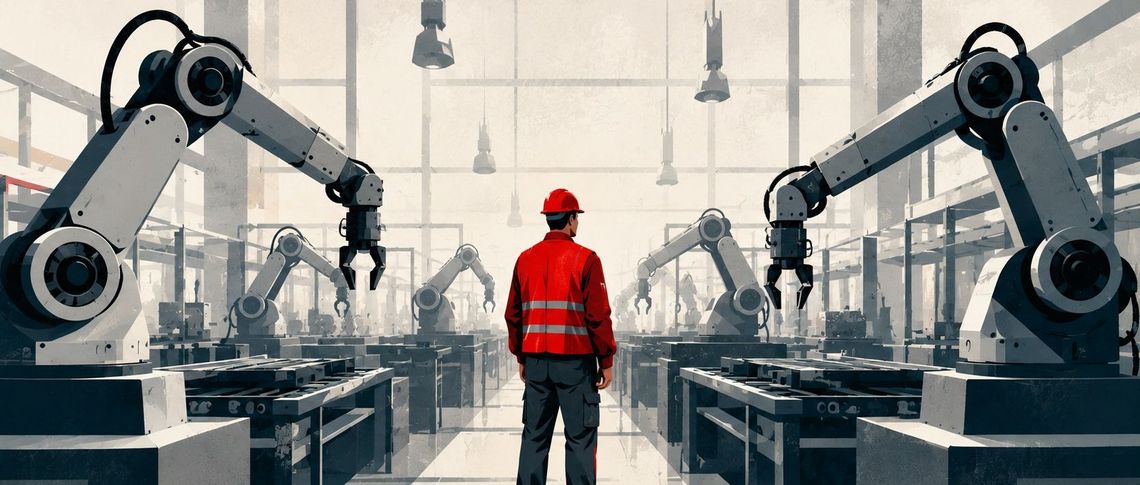
The AI revolution threatens to create a new proletariat, much as industrialisation did in the nineteenth century.
Moreover, there are numerous tasks that we will not hand over entirely, or only partially, to robots. Most people would rather have their hair cut by a human being and prefer a restaurant staffed by people. These professions are therefore likely to be better paid in the future than they are today.
Nevertheless, the path towards this brave new AI world is likely to be a bumpy one. The first signs are already visible. Job cuts are already occurring across an increasing number of industries. In the first quarter of 2026 alone, the banking sector in the United States eliminated 15 000 positions. The trend is even more dramatic in the IT and technology sector: in the first months of the year alone, more than 90 000 people have already lost their jobs.
The AI revolution, therefore, also threatens to create a new proletariat, much as industrialisation did in the nineteenth century. Some people became very wealthy at the time, while others fell into destitution. Only after decades of revolts, revolutions and political compromises was it possible to distribute the newly created wealth more effectively. This problem is real and will lead to considerable social unrest. However, the AI revolution can no more be stopped than the Industrial Revolution could 200 years ago. The machine-breakers and Luddites remained a historical sideshow.
The challenge, therefore, is to solve the problem of distribution creatively. There are already proposals for doing so. Bernie Sanders, for example, recently called for a one-off levy of 50 per cent on AI companies, while others advocate a form of windfall tax. The problem with all these approaches is that they could hamper growth.
Ideas are therefore also emerging from Silicon Valley itself. Sam Altman of OpenAI recently floated the idea of a public wealth fund into which AI companies could contribute equity. The returns or shareholdings would then benefit the American population. Anthropic founder Dario Amodei has also been grappling with similar ideas. Both OpenAI and Anthropic are likely to go public later this year and achieve gigantic valuations. Amodei has already announced that he intends to give away at least 80 per cent of his shares.
There has been discussion of an investment account containing $1 000, which every American child would receive at birth.
President Trump picked up on this idea and spoke of giving parts of AI companies ‘to the American public’. In the most likely scenario, this would not involve a traditional nationalisation, but rather voluntary small equity contributions from companies, possibly led by OpenAI. These could be distributed through investment accounts for children or via a sovereign wealth fund.
More specifically, there has been discussion of an investment account containing $1 000, which every American child would receive at birth. At first glance, this sounds like hyper-capitalism. Yet the idea is not a bad one. Unlike higher taxes, a universal basic income or welfare payments, it makes people co-owners and thereby promotes personal responsibility.
The issue is now also being discussed politically in South Korea. The €300 000 profit-sharing payment for employees in Samsung’s chip division was merely a foretaste of a much larger debate. The South Korean labour minister is calling for the introduction of an AI dividend that would be paid into a national fund.
And the idea is not as unrealistic as it may seem. Norway, for example, pursues a similar model with its sovereign wealth fund, which is financed through oil revenues. Alaska does something similar with its oil income. This may not be the classic social-democratic approach. But it would be one way of ensuring broader participation in the new prosperity.
Social democracy did not prevent industrialisation; it ensured that its prosperity was distributed more broadly. Today, it once again faces the same task.