‘The international order, which was based on rights and rules,’ German Chancellor Merz warned last week at the Munich Security Conference, ‘no longer exists’. Already in 2022, Russia’s war on Ukraine prompted Germany’s then-Chancellor Olaf Scholz to declare the Zeitenwende – a historic turning point – and initiate the country’s rearmament. But it has been the recent rejection of the rules-based international order by the Trump administration that calls for a more fundamental re-evaluation of Germany’s foreign policy strategy. In short, only by leveraging the great powers against one another can Germany survive the looming inter-imperial competition.
Under Donald Trump, the US has launched unprecedented trade wars against its main partners, torpedoed international institutions, threatened to annex Canada and Greenland, vowed support for nationalist-populist forces throughout Europe and abducted the president of Venezuela, while declaring the whole of the Western Hemisphere its imperial playground. Europe’s military and technological dependence on the United States has become a deeply unsettling vulnerability, exposing Europe to potentially continuous blackmail.
Where does that leave Germany? One strategy has become a non-starter. That is the idea, enunciated by Chancellor Friedrich Merz in January 2025, of a world neatly divided between liberal, rules-based democracies and revisionist autocracies bent on undermining international order. This view mistakes our current situation for a second, bipolar Cold War. Instead, we see an increasingly multicentric competition between imperial powers. To survive in a world of inter-imperial competition, Germany needs to embrace a new pragmatism in its relations with the imperial powers.
‘Winning’ the game of inter-imperial competition
In this new era, the system of formally sovereign states has been overlaid by a system of competing imperial centres that exploit asymmetric interdependence to exact tribute from others. While Russia uses military and covert action to dominate its neighbours, the US and China are engaged in a global rivalry over military predominance, transnational value chains and access to natural resources. To maintain their autonomy, middle powers like Germany will need to find ways to leverage the imperial powers against one another.
‘Winning’ the game of inter-imperial competition means developing an autonomous position buoyed by deeper European cooperation and a regional leadership role for Germany. Moreover, to reduce critical dependencies and create economies of scale, Germany should build on its core advantages, strengthen European autonomy, and diversify its foreign relations. The alternative is ‘to go along to get along’ and become one of the peripheries that the imperial centres compete over to expand their spheres of influence.
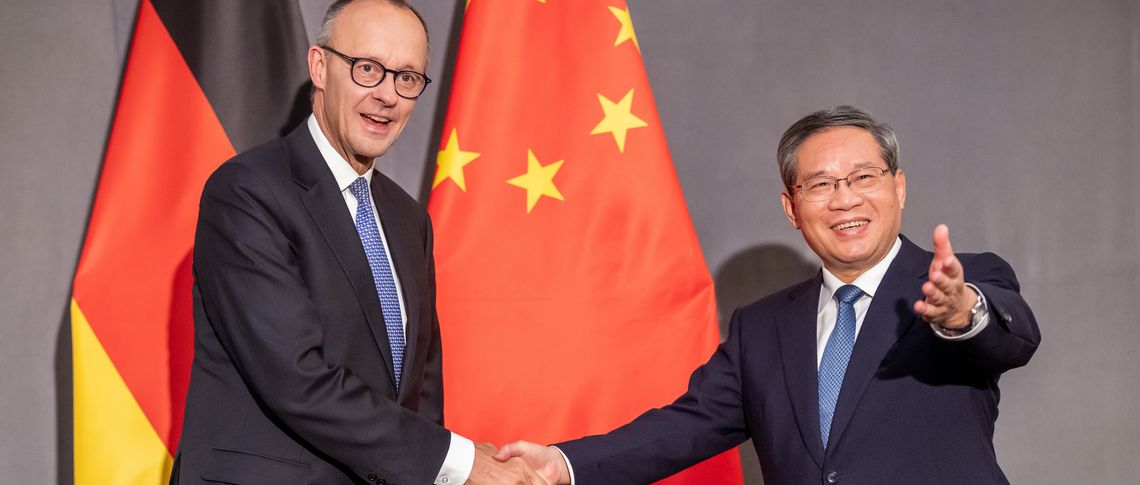
How Germany navigates ties with China will be critical for this balancing act. The recent visits to Beijing by Canada’s Mark Carney and Britain’s Keir Starmer reflect an instinctive grasp of the idea that, in a world of competing empires, middle powers cannot be beholden to a single power centre. Merz himself is currently preparing his inaugural visit to China at the end of this month. Yet an equitable relationship with China – not to mention the US or Russia – will only be possible if Germany has its own house in order. As an exclusionary policy is no longer viable, German and European policymakers will need to carefully balance longstanding economic and moral concerns, such as industrial competitiveness and human rights, with strategic ones.
Pragmatic and interest-based engagement with China could help to reduce American economic leverage.
In military and diplomatic terms there is much to commend in the current government’s policy, but it needs to go further. Germany has more than tripled its annual military spending since 2022, and these sizeable investments in the armed forces are necessary to alleviate the dependence on the US for security and deterrence. The initiative to harmonise policy-making in a new National Security Council may speed up a traditionally sluggish foreign policy bureaucracy. Yet gains from these changes will be limited unless there are corresponding moves at the European level. Procurement coordination, concrete steps to securing greater unity in foreign affairs and other such measures must take precedence over European unanimity rules. In terms of cooperation with China, the resulting ‘multi-speed’ Europe needs to focus on risk management and clear diplomatic signalling.
Another immediate concern is to reduce dependence on US information technology and foster European alternatives. Germany has only taken limited steps through its Sovereign Tech Agency and lags behind France in reducing dependence. A failure to act decisively will leave Europeans exposed to the world’s most sophisticated tools of information warfare. In this arena, Germany should only seek cooperation with China where there are ironclad safeguards.
The economic domain will be decisive for Europe’s long-term viability. Germany and Europe desperately need to modernise their digital and physical infrastructure while investing in education and social cohesion. In this situation, there is no room for fiscal conservatism or playing off defence and social welfare, as some in Germany have attempted. International tax cooperation is critical to reduce tax competition, and domestic reforms are needed to ensure that the wealthy pay their fair share. If the top 10 per cent of households (who own 60 per cent of national wealth) fail to share this responsibility, the outcome may well be a far-right government at the head of the country with ‘the strongest conventional army in Europe’. This would undermine Germany’s credibility in Europe in the same way that the Trump-MAGA administration has undermined American legitimacy in the world.
Pragmatic and interest-based engagement with China could help to reduce American economic leverage. At the same time, it needs to be carefully managed to reduce new dependencies emerging from China’s rapid ascent up the value chain. Access to Europe’s markets should be leveraged to this effect. The European Union remains China’s largest trading partner, and Europe provides critical technology and capital goods that China cannot easily substitute. Openness to China should be both a tool to force European manufacturers to innovate and to discipline Chinese competition.
While China is clearly no ideological ally for Germany and Europe, a simplistic ‘Autocracy vs. Democracy’ frame is an outdated and counterproductive approach
Regarding international institutions and multilateralism, China may yet turn out to be more of a partner than an opponent. While the US is undermining international law and taking a wrecking ball to the multilateral system, China has discovered a newfound appetite for global governance. China has worked together with European countries to keep the WTO on life support in the face of American sabotage and become a critical UN donor, with the US now starving the United Nations of funding. Only by engaging with Chinese proposals like the ‘Global Governance, Security and Development Initiatives’ do Germany and Europe stand a chance in shaping the trajectory of multilateralism.
Another dimension is ideational. While China is clearly no ideological ally for Germany and Europe, a simplistic ‘Autocracy vs. Democracy’ frame is an outdated and counterproductive approach for a world of hybrid regimes, democratic backsliding and imperial spheres of influence. Entering a ‘systems competition’ with China while appeasing an increasingly nationalist US would be a grave mistake. Germany should by no means abandon its principles-first foreign policy, but there might be advantage in recognising the real ideological differences that exist between Europe and the United States. Europe offers a much more attractive model than the US, rooted both in freedom and solidarity, individualism and social responsibility. Thus, Germany should use its influence in Europe to foster this model and challenge trojan horses such as Orbán’s Hungary that reject it. Overall, ideational autonomy from the United States will help to navigate the ideological aspect of inter-imperial competition. European advantages in this domain should not be underestimated.
China under Xi Jinping is both a challenge to Germany and an important counterweight to other imperial centres. German foreign policy should thus engage with China to navigate this imperial system and enhance Germany’s autonomy. The greatest risk is that China uses its leverage to play European countries off against one another. But if Germany is able to foster European unity, strength and autonomy, China, Russia and the US will have no choice but to treat it as an equal.