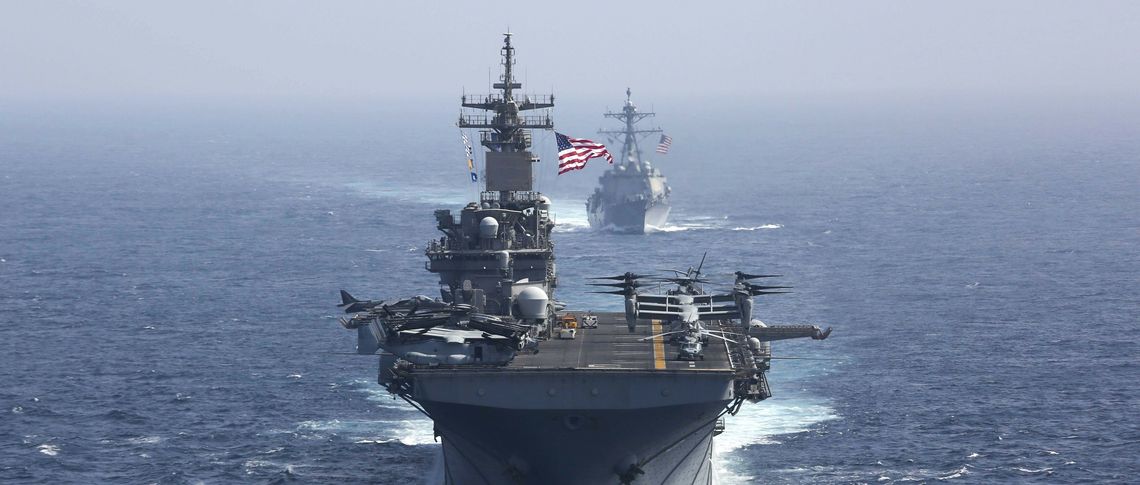
The Middle East is on the brink of a new war — possibly the most far-reaching military conflict since 7 October 2023. The United States and Iran are hurtling towards each another like two express trains. Exactly when they will collide is something we will know within hours, days or weeks at most. The odds are stacked against this ‘big bang’ being averted.
Yet this war is entirely unnecessary. From America’s perspective, it is almost a ‘war of choice’. Iran is not under attack because it is so dangerous. On the contrary: the Islamic Republic has never been weaker than it is today. The aim is to hunt down the injured animal, Washington’s and Tel Aviv’s arch-enemy for decades and the boldest challenger of the American world order. The war is a high-risk gamble on a geopolitical shift in the heart of Eurasia. The collapse of the Islamic Republic would be the biggest geopolitical turning point for the Middle East since the end of the Soviet Union.
Brave new world
Legality barely plays a role anymore. International law is a thing of the past. While the Israelis at least gave their June attack the semblance of a semi-legal pre-emptive strike, Washington is not making even the slightest effort to come up with any kind of legalistic sleight of hand. This gives us a taster of the brave new dog-eat-dog world. The strong do what they can, and the weak suffer what they must. The message to the international community is: Don’t mess with the big powers! And if you do, make sure you organise a nuclear survival guarantee in good time. Hardly anyone will be willing to tolerate a 30-year nuclear stalemate like the one with Tehran in the future.
But the Americans are also driven by their own agenda. The threat they have created – the world power’s largest deployment of troops since the 2003 Iraq War – is so enormous that even the highly erratic Trump would be hard pushed to back down now. In the ongoing negotiations, Washington is effectively demanding that Iran capitulate on security policy. The regime is politically capable, but not prepared to surrender its security interests. According to the prevailing mindset in Tehran, concessions lead to increasingly far-reaching demands. What America is offering is death by a thousand cuts. Iran would rather have the big bang.
Contrary to the stereotype of the crazy mullahs, Iran’s actions over the last two and a half years have been highly calculated. Perhaps too calculated. Towards Israel, Tehran has been careful to de-escalate the situation. The fire had to be stoked, the Israelis kept busy, but preferably avoiding an uncontrollable conflagration. Retaliatory strikes were meticulously choreographed performances, telegraphed to the enemy in advance to prevent too many casualties. Iran was saving face while simultaneously dismantling its own doctrine of deterrence. Optimists called it ‘strategic patience’, while the enemy saw it as fear and incompetence.
The Islamic Republic remains a highly ideological enterprise at its core, even now in the fifth decade of its existence.
At least the signals are different this time. The regime believes it is fighting for its own existence. The security forces are on high alert, and concrete scenarios, including succession arrangements, are being simulated. Supreme Leader Ali Khamenei himself is preparing for martyrdom. Unlike the de-ideologised farcical Arab kleptocracies, the Islamic Republic remains a highly ideological enterprise at its core, even now in the fifth decade of its existence.
Instead of choreography, the focus this time is on maximum escalation. The fact that this is not just flowery Persian rhetoric but a genuinely serious situation is perhaps also evidenced by the targeted killings of protesters. This time, no one was arrested. Well over 30 000 were killed, at least according to the maximum estimates of some human rights activists. A number as high as this can only be explained if the goal was not merely intimidation but mass murder. The social contract has thus been irrevocably broken. A return to the status quo ante is now impossible.
For the regime, all this is playing with fire — even if, from their perspective, there increasingly appears to be no other option. Militarily, the situation is almost grotesquely unbalanced. If things go badly, Tehran is likely to have little more than one or two waves of retaliatory strikes left after the opening salvo from the American side. That said, wars do not usually go as expected. And as Washington should know only too well, they are not decided solely by military means but also politically, socially and psychologically.
America’s Achilles heel is that it has an army that can do almost anything — except endure losses. And this gives Tehran an opportunity: America’s pain threshold is so much lower than its own. Every American death is blamed on its erratic leader, who has not even bothered to try and explain the supposed need for this war to his own people. Why are Americans even dying here? According to polls, around 70 per cent of US voters are against the war. Even experts are unsure what Washington actually wants: the nuclear programme, which has supposedly already been obliterated, ballistic missiles or regime change after all?
As a reminder, Trump actually positioned himself as a critic of the Iraq War during his run for office, claiming that he would end the ‘forever wars’ and the regime change fantasies. There was much talk about a pivot to Asia and a focus on the Western Hemisphere. The recently published National Security Strategy advocates non-interventionism. The guiding principle seems to be more of a lack of principles — an ideological will-o’-the-wisp where anything is possible as long as it seems politically expedient.
Fears of a new hegemon
However, America’s high-risk gamble has found few supporters in the region. The complex geopolitical situation has undergone an almost 180-degree turn. The Saudi crown prince is up in arms about what is now an almost inevitable confrontation. The region sees itself as the main victim, paying the highest price in almost every scenario.
On the one hand, there is the problem of escalation. The four ‘Hs’: Hormoz, Houthis, Hezbollah and Hashd al-Shaabi. To what extent could the Iranian militia empire still be mobilised? Especially if the mothership were to find itself in existential distress. Would Iran even consider the Samson option of mining the Strait of Hormuz, possibly the most vital maritime route for the global oil trade?
For the Muslim regional powers, the Islamic Republic fulfils a specific function: it is politically weak, contained and supposedly controllable.
Chaos and devastation are, however, far from the only concerns of an emerging pan-Muslim regional alliance led by Riyadh and Ankara. For the Muslim regional powers, the Islamic Republic fulfils a specific function: it is politically weak, contained and supposedly controllable. The new confrontation is no longer primarily between Saudi Arabia and Iran, but between an axis of stabilisation – Riyadh, Ankara, Cairo, Islamabad, Doha and Damascus – and an axis of disruption that unites Tel Aviv and Abu Dhabi.
For the region’s Muslim states, Israel’s military dominance has long posed a more serious security threat than Iran. A pro-Western Iran is not something either Türkiye or Saudi Arabia would welcome. At the same time, a 90-million-strong colossus like Iran, once free from sanctions, would itself be a more natural hegemon than the fractured Islamic Republic of today — it would come with its own ambitions that would not necessarily be compatible with the interests of the region.
Revolutionary regimes have always been prone to political overreaction. An Iran that demands its place in the sun after decades of Islamist impoverishment would not necessarily be a peaceful state. The resentment expressed by parts of the diaspora towards the Arabs, Turks and Kurds gives little cause for hope that a return to the Pahlavi dynasty would be met with enthusiasm in the region.
Yet there are very few who believe that the war will result in a smooth transition to a pro-Western monarchy or democracy. A more likely scenario is one we might call ‘super Syria’. In other words, at the very least partial and temporary state collapse and civil war-like conditions in a multiethnic state in the region. Here, it would be extremely unlikely that the Iranians would be granted the privilege of fighting their own political battles. As a natural hegemon, Iran is far too important to let things take their course here.
A more likely scenario is that the regional powers will pounce on the carcass of the Islamic Republic — if only out of self-preservation. The result could be years, if not decades, of civil war, or at the very least extreme instability with mass casualties and an influx of refugees, bringing instability to neighbouring countries and reaching Europe, too.
There is no compelling reason to take the high-risk gamble of the now looming war.
A nightmare scenario, but one that does not necessarily have to materialise. Responsible politicians should not be guided by wishful thinking, but would be well-advised take such risks into account. There is little to suggest that this is happening in Washington. Here, reckless gamblers are playing with fire. Repeat offenders at that. They will do the ‘dirty work’, for which, if things go wrong, Europe will have to pay the price as well. We have still not dealt with the consequences of the last refugee crisis. What could possibly go wrong?
The truth is that the Islamic Republic is a state in decline. It is in the process of completely losing its own people. This decline can, however, still be managed in terms of security policy. There is no danger that cannot be contained through negotiations. There is, therefore, no compelling reason to take the high-risk gamble of the now looming war.
The more intelligent members of the Islamic elite will have realised that continuing as before is not an option — at least not after the death of the Supreme Leader. The war that is currently threatening to break out is an all-or-nothing gamble with extremely high stakes.