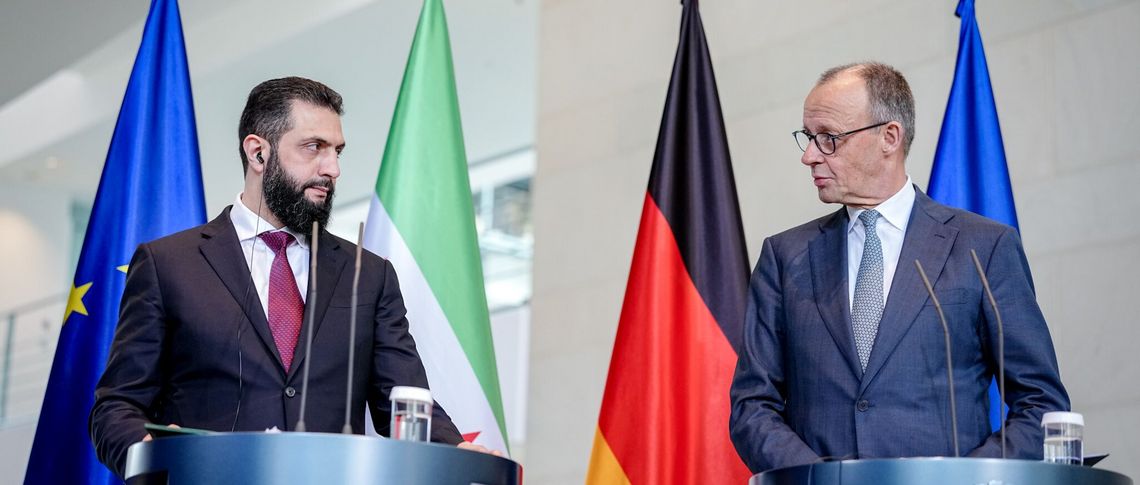
When it was announced that the Syrian President Ahmed al-Sharaa was coming to Berlin on a state visit, ‘the Syrians put their hands on their heads’. We use this typically Syrian expression to describe that something challenging lies ahead. In this case, concern is combined with scepticism because the visit signals change: Syria is no longer being regarded as a humanitarian case but as a political issue.
The discussions between the Syrian and German governments in Berlin were to produce a kind of deal: Germany would help Syria with its reconstruction, and Syria would ensure that as many people as possible return to Syria from Germany – either deported or of their own free will. But what about us Syrians here in Germany? We are the bargaining chips. Both sides view us this way. And that has an effect on us.
Let’s talk first about returns. The Syrian community in Germany is discussing this issue and weighing up the situation. The economic decline, weak infrastructure and fragile security all create the impression that daily life in Syria is highly unstable. Despite the wish of many to return and help reconstruct a country exhausted by the actions of the departed Assad regime, this desire is confronted with a complex reality. Families need to weigh things up. On the one hand, emotions come into play: who isn’t affected by homesickness? On the other hand, we have built up something for ourselves in Germany. Our children feel at home here, and what opportunities will we have if we return to Syria? How will the security situation evolve? What about the economy?
While public debate emphasised the humanitarian aspect in the early years, it now tends to weigh up the costs and benefits of refugees.
And there is something else weighing on our minds: for years, we have lived as a Syrian community under the microscope of German media. They have turned refugees like us into an amorphous mass. While public debate emphasised the humanitarian aspect in the early years, it now tends to weigh up the costs and benefits of refugees. On the one hand, issues relating to integration, as well as the burden on the welfare state and the property market, are highlighted and references are made to crime statistics. On the other hand, all of this is set off against positive aspects, focusing on the solution provided to demographic problems and the skills shortage in Germany. This was particularly evident in the days following the fall of the dictator Bashar al-Assad in December 2024: hardly had he been deposed and left the country than calls were heard in Germany for all Syrians to leave the country as quickly as possible. Just a few moments later came the objection that the departure of Syrian doctors would weaken the German health service.
The Syrian community in Germany is therefore in a quandary: many would like to head for Syria but only see limited opportunities there. Their situation here in Germany is, however, also uncertain. The tone of the political debate about us has sharpened considerably. The limits of what is possible and what can be said have been pushed significantly to the right. We are regarded as a mass that can be shoved around and used as a bargaining chip. And yet we are talking here about individuals who make decisions and have to sort out their lives. We feel like cats on a hot tin roof, moved by forces beyond our control.
Against this backdrop, any discussion about German assistance to rebuild Syria becomes distorted. The debate between parties often seems to be more about domestic politics than helping Syria to make a fresh start. Germany has launched a generous programme to help Syria rebuild. This is very positive and a welcome development, even though its motivation is not only drawn from the challenges facing Syria. The topic of economic support and reconstruction is therefore no longer viewed from a solely humanitarian perspective. It has become a factor in the political calculations relating to migration management.
Under pressure
And yet the size of the task stands in the way of the goal of German domestic policy: the situation in Syria demonstrates that it is not yet possible for many people to return. Some of the cities are in ruins, the infrastructure is dilapidated, and the economy is not yet able to provide the Syrian population – never mind the many people returning – with employment and an income. Reconstruction with German support will take time and it is not possible in the short term to achieve the domestic policy goals of a government that hopes to score political points with the shift it has announced on migration.
The issue of the return of refugees like us here in Germany is also of great importance to the government in Damascus. Politicians from Syria often contact us directly via social media and call on us to return to Syria and help with the reconstruction. It is clear, however, that humanitarian reasons are not their only motivation in giving us a chance to return to our country. They could also make good use of our support and investments made by Syrians from abroad. And there is another, extremely important reason: the new government in Damascus – under considerable pressure to prove itself – has turned the return of refugees from Europe into a barometer to gauge their success in stabilising Syria.
As long as the question of returns remains the central theme, serious negotiations and consultations on other important topics such as political freedom will remain on the back burner.
Alongside reconstruction and economic recovery, political stability also plays a key role. Let’s take minority rights. Several bloody massacres have taken place, with the issue of missing persons and the handling of crimes during the dictatorship not yet resolved. If, however, the government in Damascus succeeds in convincing people to swap their comfortable, safe homes in Berlin or Hamburg for Damascus or Aleppo, it can score some points. As if to say: ‘Take a look, everything’s hunky dory with us!’
Above all, however – and this has become particularly evident during the visit of Ahmed al-Sharaa to Berlin – the Syrian refugees in Germany and our possible return are acting as a bargaining chip between the two countries. This is only possible because the migration debate in Germany is being conducted in the way that it is. As long as the question of returns remains the central theme, serious negotiations and consultations on other important topics such as political freedom will remain on the back burner, even though the latter would be desirable and important for Syria to make a successful new start.
It therefore comes as no surprise that many Syrians in Germany are ‘putting their hands on their heads’, as the saying goes. Another catchphrase has been on our minds in recent times. During the uprising against the dictatorship of Assad, we would often chant on the streets: ‘Oh God, all we have is you, oh God!’ At the time, this slogan stood less for the deep faith of many people than for the recognition that demonstrators were not acting as individuals dissatisfied with their government but were the match ball and bargaining chips of greater powers. Ideally, we wouldn’t have to feel the same way today. To achieve this, the debate about migration policy should be disassociated from the reconstruction of Syria. Then everyone would be a winner: Germany, Syria and refugees like us.