The vast majority of the Israeli population supports the war against Iran and sees it as a justified response to the ongoing threat, perceived as existential, posed both by the Iranian regime itself and by its proxies in the region. Opposition leader Yair Lapid expressly backed the government, and the leader of the social democratic party The Democrats, Yair Golan, also stated that the Iranian threat must be eliminated. Israeli security experts had long pointed out that the success of the Twelve-Day War in June 2025 was by no means as resounding as claimed by Prime Minister Benjamin Netanyahu and US President Donald Trump. After the start of the current fighting, Social Democratic Knesset member Naama Lazimi also referred to this fact.
Israel's war aims are quite clearly defined: regime change in Tehran, dissolution of the so-called ‘axis of resistance’ (which essentially consists of Iran, Hezbollah in Lebanon, the Houthis in Yemen and Hamas), and an end to the threat to Israel posed by Iran's missile programmes and uranium enrichment. The hope is that the overthrow of the theocratic dictatorship in Tehran will lead to a paradigm shift in the Middle East and that the Iranian people will have a chance at freedom and democracy. The reactions so far from the Gulf states attacked by Iran confirm Israel's own perception of the war. With these attacks, the Iranian regime has clearly made a military and political miscalculation.
The effects of the war are massive in Israel: since the start of the fighting, the civilian population has had to seek shelter countless times throughout the country. Unintercepted rockets struck buildings in Tel Aviv and Beit Shemesh, killing civilians and injuring many others. Public life has largely come to a standstill. Until further notice, gatherings are prohibited and educational institutions are closed. Non-essential workplaces should not be attended, and an estimated 150,000 to 170,000 Israelis are stranded abroad due to the closure of airspace.
Domestic political disputes and the pre-election campaign in Israel are currently being completely overshadowed by the war. If Israel's war aims are achieved quickly, Prime Minister Netanyahu is likely to benefit most. In this case, it is expected that parliamentary elections could possibly take place as early as the end of June 2026.
Ralf Melzer, FES Israel
Lebanon
The war against Iran was expected, yet the Lebanese people are deeply shocked by its scale and by the chaos that this conflict has caused in the region in such a short time. The most pressing question in Beirut was: How would Hezbollah react? Would it enter the war – and if so, how would Israel respond? Many people are watching the events with concern – fearing that they will have to flee again or that traumatic memories of September 2024, when the war against Lebanon began, will be reawakened.
Even before the attack on Iran, Israel and Hezbollah had openly communicated their positions: the Israeli army warned Hezbollah against interference and threatened serious consequences for Lebanon — including damage to infrastructure such as the airport. For its part, Hezbollah announced that it would stand by Iran if the aim of the attack was regime change or the killing of Ali Khamenei. With the news of Khamenei's assassination, it was clear that Hezbollah would be called upon by the Iranian regime to intervene and thus, that a devastating war was imminent.
On Monday night, Hezbollah fired three rockets at northern Israel. At 1 in the morning, Beirut time, the fears became reality: violent attacks shook various parts of Lebanon, rousing the population from their sleep and leading to at least 30 deaths and hundreds of injuries within a few hours — including Mohammad Raad, deputy secretary-general and faction leader of Hezbollah in the Lebanese parliament. Other officials are also reported to have been killed.
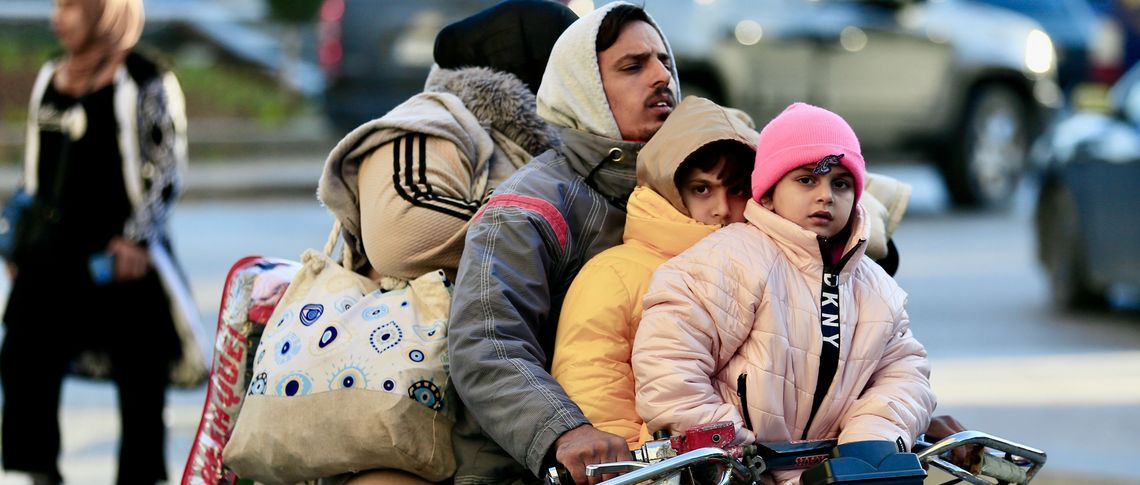
People were once again forced to pack up their essentials and flee to Beirut and the north in search of protection. Many are once again left without shelter and are camping on the streets — in the middle of the fasting month. The scenes are reminiscent of the horrific images from a year and a half ago, but many people feel that this war is different and more threatening.
There is great incomprehension as to what strategic benefit the firing of three rockets could have for Hezbollah in the Iran-Israel conflict, when it causes chaos in its own country. Many are wondering why the organisation broke its agreement with the Lebanese government to stay out of the war. The anger among the population, including within the Shiite community, is palpable. In addition, the Israeli military actions were apparently coordinated with the US. The American administration is disappointed with the Lebanese government and its handling of Hezbollah. The government must act; a crisis meeting was held on Monday.
Many people in Beirut assume that the war will not only involve short-term air strikes, but will continue for a longer period. The mobilisation of 100 000 Israeli army reservists on the Lebanese border points to a comprehensive military operation. Unlike in the past, the military objective this time could be the complete neutralisation of Hezbollah. The population is traumatised and exhausted, and there is a lack of financial resources and support.
Merin Abbass, FES Beirut
Syria
Despite the unprecedented military escalation between Israel and the United States on one side and Iran on the other, the situation in Syria has so far remained relatively calm — even though until the end of 2024, Syria was among the countries most heavily shaped by Iranian influence. With public sentiment still deeply marked by memories of Iran’s role in the Syrian conflict, the transitional government that assumed power in Damascus in December 2024 is attempting to redefine the country’s regional position.
On 1 March, the Syrian Foreign Ministry issued an official statement strongly condemning the Iranian attacks on Saudi Arabia, the United Arab Emirates, Bahrain, Qatar, Kuwait and Jordan, and announced enhanced internal precautionary measures. Both the Syrian transitional president and the Syrian foreign minister held telephone conversations with some of their counterparts in the affected countries.
Should the conflict drag on, Syria could also become a theatre of war simply by virtue of its geographical location. Already now, Syrian airspace has effectively become a transit and combat zone, although Syria itself is not an official party to the war. This poses considerable risks for the civilian population. In southern Syria, debris from drones and rockets has already fallen from the sky after being intercepted by Israeli air defence systems — though no casualties have been reported so far.
Given the presence of American military bases in Syria, the north-east of the country could also become an operational area for Iranian retaliatory strikes. However, the impact is not limited to military matters. Initial economic and social repercussions are already visible. Airspace closures across the region are affecting Syrian flight routes and compounding international transport disruptions. For a country whose economy is already severely weakened, even indirect disruptions can have serious consequences. Should the security situation deteriorate further and uncertainty increase, the risk of renewed displacement would also rise. On Wednesday, the Syrian land and sea ports authority announced it had closed its border crossing with Lebanon for departures after receiving a warning from Israel that Israeli forces may target the crossing. Arrivals remain open as long as Syrians are fleeing from Lebanon.
Friederike Stolleis, FES Berlin
Egypt
Tensions are also high in Egypt: Egyptians vividly recall the primarily economic consequences of the Israeli-US strikes on Iran in June last year. Fears of rising prices and constrained energy supplies are widespread. There is less concern, however, that the war could escalate into a regional conflagration that might eventually reach Egypt.
The latest conflict once again underscores the fragility of Egypt’s economic stability. The scale of the economic impact will largely depend on how long the conflict lasts. The longer it continues, the greater the risk of mounting economic strain — particularly increasing pressure on foreign currency reserves. Another challenge concerns national energy supply: following the closure of several of its gas fields, Israel has already turned off the tap — including Leviathan, the largest field supplying Egypt with gas.
On Sunday, President Abdel Fattah el-Sisi officially warned that any closure of the Strait of Hormuz would disrupt global oil flows and drive up prices, with severe repercussions for the Egyptian economy and revenue losses from the Suez Canal. A further risk scenario is that the Iran-aligned Houthis in Yemen could render the Red Sea so insecure that passage through the Suez Canal would become impossible.
Egypt, too, was reportedly not informed in advance about the strikes. The Egyptian foreign minister, Badr Abdelatty, has repeatedly stressed that there can be no military solutions to regional crises — Egypt is relying on diplomacy, dialogue and de-escalation, and has offered its mediation services. Evidently, the Arab Republic on the Nile has not been able to make its voice heard. However, a clear condemnation of the attack on Iran as a violation of international law has been notably absent. After all, the United States provides Egypt with more than one billion US dollars in annual military aid, and with its Israeli neighbour Israel there has not only been peace for more than 40 years, but also the aforementioned energy dependence.
Another aspect: around 11 million Egyptians live abroad, a large proportion of them in the Gulf states. Many people have family members and friends working there who are now stranded. They are worried about their safety; in the United Arab Emirates, Egyptians have already been injured by Iranian missile and drone attacks. The Egyptian government has now established a task force to assist Egyptians in the Gulf.
Almut Wieland-Karimi, FES Cairo
Yemen
The situation in Yemen has so far remained calm — though this could change quickly. The Houthis in the north of the country, which they dominate, are active members of the Iran-led ‘Axis of Resistance’ and have declared their solidarity with Iran, calling for mass demonstrations against the US and Israeli attack. Military support for Iran – through attacks on US military bases in Arab countries and on shipping in the Red Sea – has been threatened but has not yet materialised. The Houthis possess a large arsenal of ballistic missiles and drones – not least thanks to arms deliveries from Iran – with which they can reach Israel and the Arabian Peninsula.
The new Saudi-backed government, whose influence is largely confined to the south of the country, currently has limited capacity to rein in the Houthis. At present, there is no unified anti-Houthi front in the south. After the Southern Transitional Council – the separatist movement backed by the United Arab Emirates that had sought to establish an independent state in southern Yemen – was crushed in December 2025, the integration of its fighters into the regular army has yet to be completed. Reunification of Yemen is impossible without corresponding political steps. However, given current developments, it remains uncertain when the planned Southern Dialogue Conference planned for this purpose can take place. For now, it can be assumed that Saudi Arabia is prioritising its own national defence and border security. Without Saudi assistance, there is currently little prospect that concrete strategies can be developed within Yemen to curb the Houthis’ influence.
Astrid Becker, FES Yemen