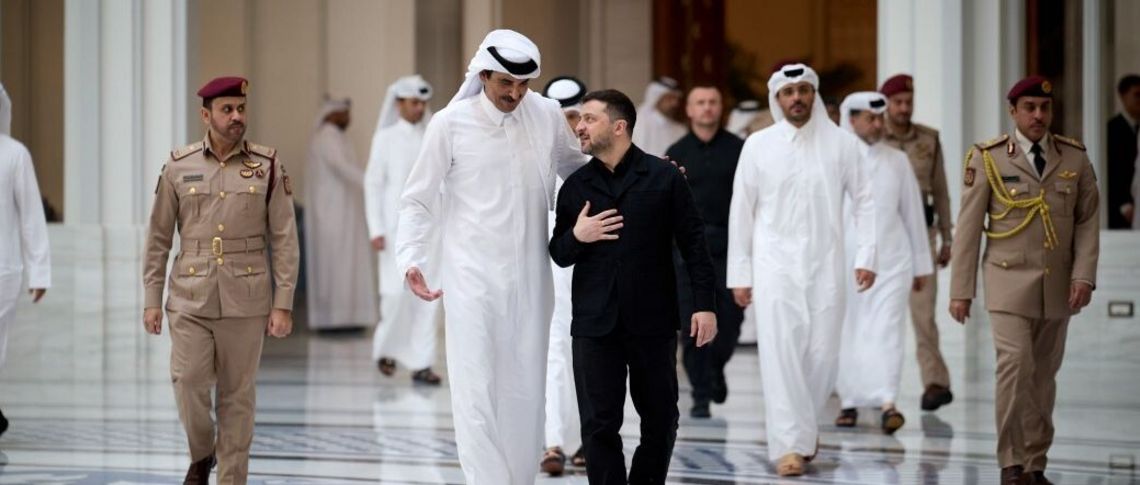
Ukrainian President Volodymyr Zelenskyy’s tour of the Middle East – visiting Saudi Arabia, the UAE, Qatar and Jordan – marked a fundamental shift in Ukrainian foreign policy. What we are seeing is Ukraine’s transition from the role of an aid recipient to that of an active provider of security. This is not merely a series of political visits, but the systematic establishment of a legal framework for major defence contracts. Here, Zelenskyy’s approach follows a ‘top-down’ model: first, a memorandum is signed at the level of heads of state to mitigate political risks, followed by direct investment and the deployment of the MilTech industry. This is a classic B2G (Business-to-Government) strategy, where the state opens up the market by removing bureaucratic restrictions for Ukrainian manufacturers of drones, electronic warfare (EW) systems and interception systems. It is expected that following these agreements, internal restrictions on the Ukrainian defence sector will finally be lifted, paving the way for full-scale technology exports in exchange for strategic resources.
It is noteworthy that the tour took place precisely at a time of intense public controversy with Washington. When the new Secretary of State, Marco Rubio, calls Zelenskyy’s claims regarding the link between US security guarantees and Ukraine’s withdrawal from the Donbas territories ‘lies’, Kyiv responds asymmetrically. Regardless of who is right in this dispute, the very fact of building strategic partnerships in the Gulf is a direct response to American pressure. Zelenskyy is demonstrating to Donald Trump’s administration that Ukraine has other options and alternative centres of influence. If Washington wavers in its long-term support, Ukraine is capable of becoming a critically important partner for key US allies in this strategic region. This sharply raises the cost of any attempt to ‘settle the Ukrainian question’ behind Kyiv’s back, as Ukraine’s agency is now underpinned by the interests of Riyadh and Abu Dhabi.
Taking action
The Ukrainian side’s central argument was based on unique intelligence expertise unavailable in Washington’s corridors of power. In an interview with NBC News, Zelenskyy revealed evidence of Russia’s direct involvement in the preparation of Iranian strikes against US strategic targets in the Middle East. A Russian satellite constellation took three series of detailed images of Prince Sultan Air Base – on 20, 23 and 25 March 2026. Ukraine was the first to identify and verify this pattern based on its own experience: the first image indicates preparation, the second, a simulation and testing of air defence systems, and the third indicates an attack within the next 24 to 48 hours. Although the NBC News editorial team noted that it was unable to verify this data independently, the events of 26–27 March provided stark confirmation of the forecast: Iran launched an attack with six ballistic missiles and 29 UAVs, resulting in actual casualties, including damage to an E-3 Sentry AWACS aircraft and injuries to 15 American service personnel. Zelenskyy assessed the level of Russian assistance to Tehran in this operation as 100 per cent, which effectively makes Moscow an accomplice in the attack on US forces.
For Riyadh and Abu Dhabi, this was a signal that could not be ignored: Moscow and Tehran are acting as a single military mechanism. Russia has become Iran’s ‘strategic quartermaster’, supplying it with critical weaponry even before the active phase of the war began on 28 February 2026. The contract for 48 Su-35 fighter jets, the transfer of Mi-28 helicopters and the lightning-fast delivery of ‘Iva’ MANPADS (signed just six days before the escalation!) – this is a direct threat to the Arab monarchies. Logistical support is disguised as ‘humanitarian’ channels, such as the 3610-tonne Tajik convoy, presumably linked to the ‘Ababil-2’ drone factory in Dushanbe. As British Defence Secretary John Healey aptly noted, we are seeing the ‘hidden hand’ of the Kremlin fanning the flames in the Gulf to divert the West’s attention and resources away from the Ukrainian front.
The results achieved in Qatar are particularly noteworthy. A ten-year defence agreement has been signed there.
Crucially, Ukraine is no longer merely making proposals – it is taking action. Ukrainian expert teams are physically present in several Gulf states and have already achieved several successful takedowns of Iranian drones. This is not a future contract, it is a verified result on the battlefield. It is precisely this fact that became the decisive argument for signing the agreements. A separate and underappreciated outcome of the tour was an agreement on the supply of diesel from the Middle East for a year, which demonstrates that ‘drone diplomacy’ is part of a broader economic shift. Not merely weapons in exchange for money, but a comprehensive partnership in which Ukraine gains both energy security and strategic resources.
The results achieved in Qatar are particularly noteworthy. A ten-year defence agreement has been signed there. Ten years is not a short-term reaction to a crisis; it represents a strategic horizon. The Emir of Qatar personally praised the work of Ukrainian experts in countering drones. This means that Ukraine has entered the region not as an arms seller, but as a long-term security partner.
It is impossible to ignore the contrast in diplomatic styles observed in the region. That same week, Donald Trump, in his characteristic manner, said of Prince Mohammed bin Salman (MBS): ‘He didn’t think he’d be kissing my arse, but now he has to be polite to me.’ This is the language of dictatorship and hierarchy from the century before last. Zelenskyy, by contrast, visited the same prince as an equal partner with concrete technological proposals and a ready plan to counter common threats. These two approaches to a single ally demonstrate that Ukraine offers what present-day Washington cannot provide. Respect for sovereignty through shared technological superiority and the exchange of real combat experience.
A separate highlight of the tour was the meeting with King Abdullah II in Jordan. Jordan is a critical hub for the defence of the airspace between Iraq and the Mediterranean, a country that experiences the consequences of Iranian escalation in its own airspace on a daily basis. This is precisely why the partnership here has a strategic, rather than merely symbolic, dimension. Relations between our countries have remained dynamic and trusting and are now reaching a level of genuine solidarity based on shared security interests.
For the Kremlin, the war in the Gulf is a tool for economic survival due to high oil prices and for circumventing sanctions in the Indian Ocean.
The phrase ‘security donor’ is a direct message to the Trump administration. It is an argument that strikes at the isolationist sentiments of some Republicans — Ukraine does not cost America money; it saves it. By defending American allies and bases with its own interception technologies, Kyiv proves its indispensability. When Zelenskyy says that ‘Saudi Arabia has what Ukraine is interested in’, he is identifying a threefold benefit: petrodollars to finance the Ukrainian defence industry, access to components that Russia is trying to cut off, and a powerful Saudi diplomatic channel of influence on the White House.
For the Kremlin, the war in the Gulf is a tool for economic survival due to high oil prices and for circumventing sanctions in the Indian Ocean. Russia is attempting to manage the chaos, directing it against the Western security architecture. However, Ukraine’s agency has thwarted this game. We have proposed to the region, from Riyadh to Amman, a common security framework, where Ukrainian solutions serve as a shield against Iranian aggression and Russian espionage. This is the most concrete result of ‘drone diplomacy’ to date. It marks a transition from declarations of intent to a signed framework for technological dominance. Ukraine itself is becoming a shield protecting the world’s energy infrastructure.