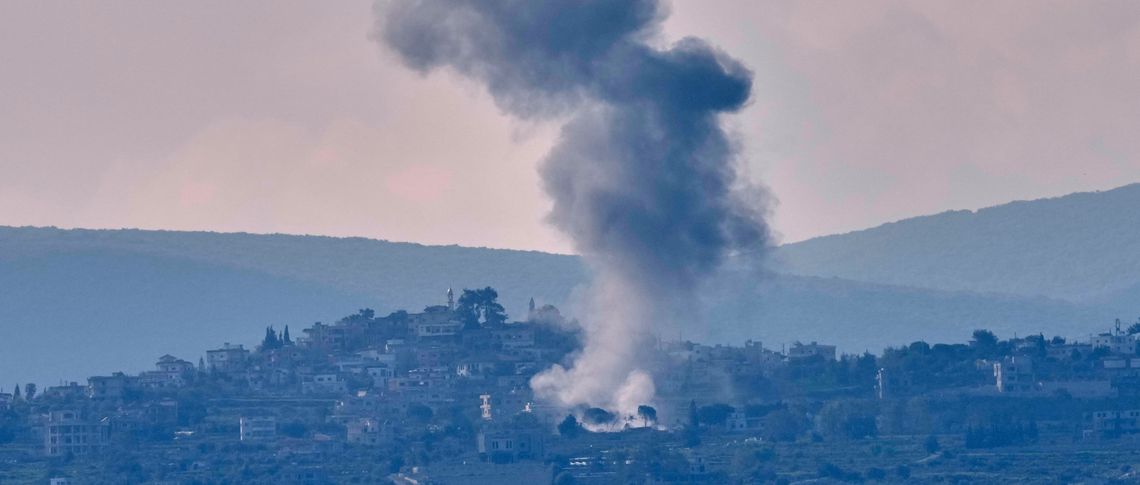
Lebanon has long become a central frontline in the escalating regional conflict. Recent developments mark a qualitative shift: what was once a tense border situation has turned into an active theatre of war. For more than three weeks, fighting between Israel and Hezbollah has escalated — now including ground troops. The military dynamics along the border have sharply intensified. The withdrawal of the Lebanese army from the south created a security vacuum, facilitating Hezbollah’s return to border areas.
In recent days, direct clashes have thus occurred between Israeli ground forces and Hezbollah units in southern Lebanon. Much indicates that the militia is preparing for a prolonged and costly confrontation. The attack on the Qasimia Bridge over the Litani River last Sunday represented a new peak in the escalation and provoked significant outrage in Beirut. The Lebanese government described the attack as a ‘dangerous escalation’ and called on the international community to intervene and prevent Israel from further expanding its military operations in Lebanon.
Israel today is governed by political forces openly promoting expansionist visions for the region.
Officially, the Israeli government has a clear goal: the complete disarmament of Hezbollah, in order to eliminate any military threat to Israel. Given Hezbollah’s rocket and drone attacks on northern Israel, this security concern is understandable. At the heart of the military strategy is therefore the systematic destruction of Hezbollah’s military infrastructure — including rocket positions, weapons depots, tunnel systems and observation posts. In addition, targeted strikes against fighters, stockpiles and logistical networks aim to sustainably weaken the organisation’s military capabilities.
However, the assumption that disarming Hezbollah would automatically usher in an era of peace and stability between Israel and Lebanon is overly simplistic. This argument rests on the notion that Israel acts solely in a reactive manner — and that with Hezbollah weakened, the reasons for confrontation with Lebanon would disappear. Yet this perspective ignores key developments in Israeli domestic politics over the past years. Israel today is governed by political forces openly promoting expansionist visions for the region. It is precisely for this reason that Israel’s current military strategy warrants critical scrutiny.
In early March, the Israeli army issued large-scale evacuation orders for southern Lebanon. Within two weeks, over one million people were displaced — more than a fifth of the Lebanese population. Many had already fled previously and had only just begun rebuilding their lives.
In Israeli military rhetoric, southern Lebanon is frequently portrayed as a Hezbollah stronghold. This portrayal relies on a very broad definition of what constitutes a ‘military target’. Homes, markets, and civilian facilities are repeatedly described as potential Hezbollah weapons depots. Such a perspective, however, reduces an entire region to a military problem while overlooking its complex social reality. Southern Lebanon is not a monolithic space but a diverse region with agricultural enterprises, small businesses, religious institutions, schools and a dense social fabric.
A new phase of occupation?
The attacks systematically destroy civilian infrastructure and increasingly isolate the south from the rest of the country. Agriculture, a central livelihood, is particularly affected. For many, the question is no longer when they can return, but whether they can return at all. This concern was amplified when Israel’s Defence Minister Israel Katz stated on 16 March that residents would not be allowed to return south of the Litani River as long as Hezbollah remained in the region.
Several key bridge connections have been destroyed, further isolating the south from the rest of the country. For the Lebanese government, these attacks are a clear warning sign. Israel justified the strikes by claiming that Hezbollah used these crossings for ‘terrorist purposes’ to move fighters into the south. Yet this reasoning raises questions. So far, there is no convincing evidence that the destroyed bridges played a central role in Hezbollah’s military operations.
The destruction of this infrastructure, therefore, primarily has another effect: it isolates the south of the country from the rest of Lebanon. This strategy is not new; the Israeli army acted similarly during the 2006 Lebanon war, bombing numerous bridges, roads and Beirut’s airport. In Beirut, there is growing concern that the infrastructural measures are laying the groundwork for establishing a security zone, heralding a new phase of occupation. For many Lebanese, this prospect evokes painful memories. Israel controlled southern Lebanon for nearly two decades before withdrawing its troops in 2000. The idea that this chapter of history might repeat itself is deeply troubling. If the isolation continues, a severe humanitarian crisis could unfold. This, in turn, would strengthen Hezbollah’s legitimacy to continue its fight against an ‘occupying power’, potentially garnering renewed ideological support from the Lebanese population and enabling the mobilisation of new fighters.
From the perspective of international law, the situation is clear: establishing a security zone on the territory of another state without its consent or a United Nations mandate is illegal. It effectively constitutes a military intervention or occupation. Furthermore, international humanitarian law prohibits the arbitrary displacement of civilians and attacks that cause disproportionate harm to the civilian population. The reality in Lebanon, however, shows how far actual warfare has diverged from these principles. According to the Lebanese Ministry of Health, more than 1 200 people have been killed in less than three weeks.
From the perspective of international law, the situation is clear: establishing a security zone on the territory of another state without its consent or a United Nations mandate is illegal.
Israel has a legitimate right to protect its population from Hezbollah attacks. This right, however, cannot serve as a justification for a military strategy that depopulates entire regions and systematically destroys civilian infrastructure.
The European Union must draw lessons from the bitter experiences of the Gaza conflict. There, too, escalating military confrontations led to massive destruction and immense human suffering — on both sides. Europe’s response so far has been primarily humanitarian aid, which is no longer sufficient. The EU urgently needs a clear strategy and must mediate between the Lebanese government and the Israeli state. Political and diplomatic initiatives are therefore essential.
France is currently working on a diplomatic proposal envisaging Israeli recognition by Lebanon, the withdrawal of Israeli forces and the deployment of the Lebanese army south of the Litani. The EU should support this initiative. Germany, for its part, should make clear to the Israeli government that a military occupation of Lebanese territory is unacceptable. At the same time, Berlin can play an important diplomatic role — for example, by supporting negotiations between Lebanon and Israel. This can be done unilaterally or in coordination with the EU.
Moreover, following the expiration of the UNIFIL mandate, Germany should advocate for a new international mission in southern Lebanon — whether under the United Nations or the European Union. Initial discussions about a mission under the EU’s Common Security and Defence Policy are already underway. At the same time, the Lebanese army must be strengthened to restore state control in the south and, in the long term, facilitate Hezbollah’s disarmament. The EU can make a direct contribution here through technical support. This is an opportunity for Europeans to be seen as influential political actors in the Arab world. Otherwise, not only does Lebanon risk descending into chaos, but the EU risks political irrelevance. The international community, therefore, has a direct interest in not looking away from this conflict.