Across South Africa, political parties have arrived at the same conclusion: manufactured anger at the ‘African immigrant’ wins more votes than confronting the country’s deep structural failures. This is not a failure of political will; it is a deliberate political strategy — one with a long global history, a racial logic and a predictable democratic cost.
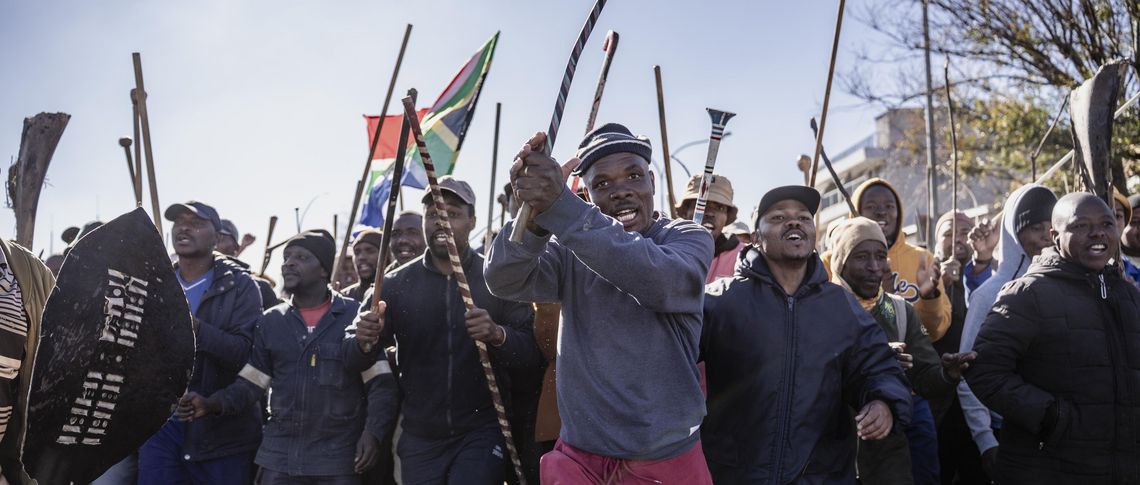
Nowhere is this strategy more visible than in the rise of March and March. The movement at the centre of the unrest has by now spread to every major city in South Africa. At least seven people have been killed in associated violence since March 2026, and the movement has issued a deadline for undocumented foreign nationals to leave the country by 30 June. Its founder, Jacinta Ngobese-Zuma, insists these actions are not xenophobic; that it is law enforcement. Every major claim she has made in support of that position has been empirically refuted. This is a deliberate programme designed to give suffering a cause that leaves the actual causes untouched.
That the targets of this campaign are specifically African is not incidental. The apartheid state defined itself against a constructed internal Other — the Black majority. The post-apartheid state replaced that logic with Pan-Africanism, constitutional universalism and solidarity across the continent. What is happening now is the inversion of that claim: the African immigrant constructed as the new internal threat, belonging weaponised against the very people the liberation movement defined itself in solidarity with.
The state normalises what the streets begin
The official unemployment rate in South Africa is 32.7 per cent, with 345 000 jobs lost in the first quarter of 2026. Youth unemployment among those aged 15–24 stands at 60.9 per cent. Public hospitals lose billions to corruption. Municipalities have been hollowed out by systematic looting. All of these problems are the predictable outcomes of a political settlement.
The post-apartheid transition transferred political management to a new class without transferring economic power to the majority. What was inherited was not a broken economy awaiting repair but a racialised capitalist structure that had always functioned precisely as designed — concentrating wealth, suppressing wages, externalising the cost of production onto Black working-class communities. The ruling African National Congress (ANC)’s historic failure is not corruption alone. It is the decision, taken at the negotiating table in the early 1990s, to accept the terms of an economic settlement that left this structure intact.
The competition to capture this anti-immigrant anger cuts across the political spectrum.
Into this accountability gap stepped a movement with a ready answer. According to March and March, it is not cadre deployment or the global financial architecture that limits what a developing economy can do with fiscal policy, but the immigrant. This vacuum also exists because unions, progressive actors and civic movements have failed to fill it. Political energy that might otherwise be organised around wages, service delivery or accountability is redirected toward the removal of the Other.
The competition to capture this anti-immigrant anger cuts across the political spectrum. Political parties like opposition party ActionSA have gone as far as absorbing leaders of the movement into their candidate lists. Similarly, within the MK Party, a breakaway from the ANC formed by former President Jacob Zuma, the language of liberation and anti-immigration sits alongside socialism and Zulu nationalism. This is the post-apartheid state’s identity contradiction made visible: a political formation that performs Pan-Africanism and solidarity externally while constructing the African migrant as an internal threat. Identity formation, after all, is a dual process of inclusion and exclusion — and movements that inherit the language of liberation without delivering material transformation resolve that tension by narrowing who belongs.
The Patriotic Alliance closes the loop between street politics and state power. Gayton McKenzie built his entire 2024 election campaign on anti-immigrant rhetoric: mass deportation, border closure, jobs for South Africans first. He won nine parliamentary seats, joined the Government of National Unity, and was appointed Minister of Sport, Arts and Culture. From inside government, the PA has watched anti-immigrant violence escalate through 2026 while producing no meaningful migration governance reform.
Racism as the operating system, not the bug
South Africa’s hostility toward African migrants is not a local aberration. It is one instance of a global pattern in which racial capitalism, confronted with the crisis it produces, generates movements that redirect power towards racialised Others rather than towards the structures responsible.
In the United States, Latinos accounted for nine in 10 ICE arrests in the first six months of 2025. The data shows this involved the removal of Mexicans, Guatemalans, Hondurans and Venezuelans — people whose migration to the United States is itself the product of decades of US-sponsored economic and political destabilisation of their home countries.
In Europe, the racial logic of border enforcement was made unusually explicit when Russia invaded Ukraine in 2022: member states that had for years detained, pushed back and allowed the drowning of African and Middle Eastern asylum seekers opened their borders within days to Ukrainian refugees. As Bulgarian Prime Minister Kiril Petkov stated so plainly: ‘These are not the refugees we are used to.’
The AfD’s surge to second place in Germany’s 2025 federal election and the Freedom Party’s historic first-place finish in Austria’s 2024 vote are driven by the same engine: wage stagnation, austerity and the sense of being left behind by the very institutions that were supposed to serve you.
Nkrumah and Rodney both anticipated this. The former warned that continental fragmentation into competing nationalisms would leave colonial economic structures intact. What he described as an external imposition has, in South Africa, been adopted as a domestic strategy. The instrument is a movement that convinces the poor to fight the poor.
Anti-Immigrant sentiment corrodes the founding identity of the post-apartheid state from within, replacing its constitutive logic of inclusion with precisely the exclusionary identity formation the liberation movement was built to end.
Walter Rodney, on the other hand, showed that African migration is the product of extraction, not African failure. The conditions that make the Zimbabwean cross the Limpopo and the Mozambican cross the Lebombo are the accumulated result of the same global economic architecture that made South Africa’s post-apartheid promise so difficult to honour. Economic pain does not automatically become progressive politics. Often, it becomes anger.
South Africa’s democratic project was always more than procedural. It was built on the explicit repudiation of racial exclusion — on the proposition that rights could not be conditional on ancestry, ethnicity or origin. Anti-Immigrant sentiment now corrodes this founding identity of the post-apartheid state from within, replacing its constitutive logic of inclusion with precisely the exclusionary identity formation the liberation movement was built to end.
The response that fails and fails reliably is one that leads with the rights of migrants, calls the marchers xenophobic and positions itself morally. It fails because it speaks to what the anger is doing wrong without addressing why the anger exists or what produced it. The alternative is not to celebrate migration or deny its complexity. South Africa does have real challenges with border management, with the asylum system’s backlog, and with the Home Affairs corruption that makes the system both dysfunctional and exploitable. These require serious policy attention. But none of them are what March and March is actually about.
The vacuum that vigilante movements fill is the product of a specific political failure: the failure of unions, civic movements and progressive parties to be present in communities before the crisis — with a credible structural account of suffering and a credible, co-created path through it. That is slower work. It does not trend. But it is the only work that shifts the terrain on which this politics operates.
South Africa approaches its November 2026 local government elections not in the grip of an immigration crisis, but in the grip of a political class that has decided an immigration crisis is what it needs as electoral fuel. The question the elections will answer is not which party wins. It is whether the political technology of the useful enemy has been normalised beyond the point of reversal — or whether enough of South Africa’s political culture still understands what is actually at stake.