The upcoming national elections in Bangladesh on 12 February are taking place just 18 months after a popular movement, led by university students, forced the fall of the Awami League. After 16 years of authoritarian leadership under Sheikh Hasina, there is now growing hope and good reason to think that the worst excesses of the authoritarianism of the previous government will remain in the past.
Although the immediate trigger for the government’s collapse was the student movement, public discontent had been building for years. The Awami League had become increasingly authoritarian, consolidating political control over the police, courts, and other key institutions. While elected in a landslide in 2008, subsequent elections in 2014, 2018, and 2024 were widely criticised as either rigged or boycotted by major opposition parties. Arbitrary arrests and enforced disappearances became common tools for suppressing dissent, and freedom of expression deteriorated sharply, with independent media facing sustained pressure. And thus, it comes as no surprise then that Hasina’s departure was met with widespread public celebration.
Old wounds and new beginnings
The election pits the two remaining major political forces against each other: the centre-right Bangladesh Nationalist Party (BNP), long the Awami League’s principal rival, and the Islamist Jamaat-e-Islami, which until recently had remained a secondary force and a junior partner in opposition alliances.
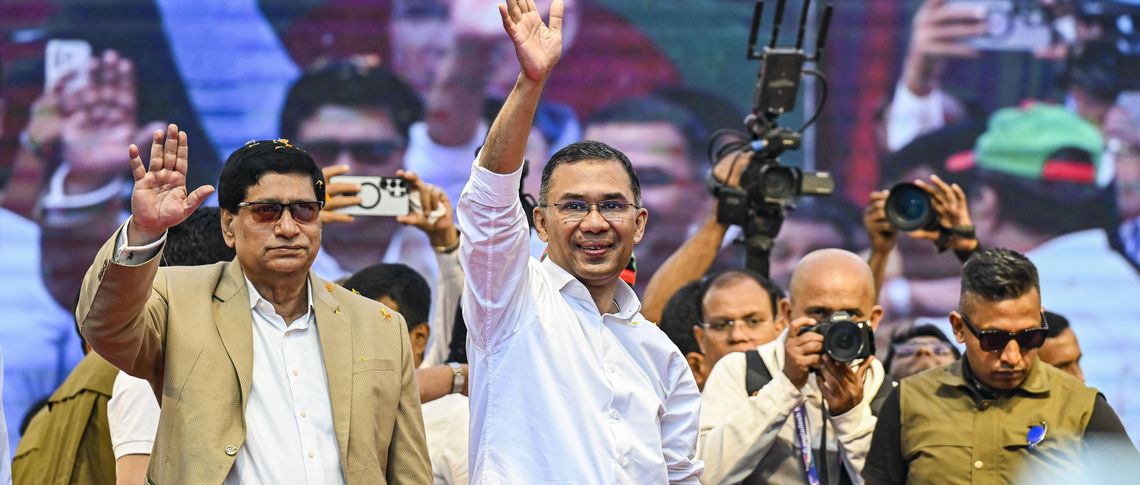
The BNP, led by Tarique Rahman, who recently returned to Bangladesh after 17 years in exile in the UK, was initially expected to be the overwhelming favourite. However, the party is hardly a reformist force and, in many respects, a mirror image of the disgraced Awami League. After August 2024, many hoped that the extortion networks and corruption rackets associated with the Awami League would disappear. But instead, in numerous cases, they were reportedly taken over by local BNP figures.
Rahman is both the party’s biggest asset and an Achilles heel. His return was well received, strengthened by the national sympathy following the death of his mother, the party’s former leader, shortly after his arrival. Yet memories persist of the last BNP government, when he was widely accused of corruption and abuse of influence.
Unlike the BNP, Jamaat is not widely associated with local-level corruption or extortion networks.
The BNP’s likelihood of success has been further complicated by the dramatic resurgence of Jamaat-e-Islami. Historically, Jamaat’s electoral appeal was limited by its Islamic fundamentalism as well as its role in supporting the Pakistan military during the country’s 1971 war of Independence. Its alleged involvement in war crimes led to the execution of several senior leaders in controversial trials under the Awami League government. The party had never secured more than 12 per cent of the national vote, and that was in 1991.
Since August 2024, however, the political landscape has shifted. Jamaat’s role in 1971 no longer carries the same weight, particularly among younger voters for whom the liberation war feels distant and less connected to present-day economic and political concerns.
Unlike the BNP, Jamaat is not widely associated with local-level corruption or extortion networks. Perhaps most significantly, it has worked to moderate its public messaging, emphasising governance reform, institutional accountability, and social justice over overtly Islamist rhetoric.
In the immediate aftermath of Hasina’s departure, many expected that a new ‘student party’ would emerge as a significant political force.
The National Citizens Party was established in February 2025, but by that point much of the goodwill initially enjoyed by the student leadership had dissipated, as they came to be seen as politically immature, inexperienced, and — in some cases — no less susceptible to corruption than the politicians they had sought to replace. Opinion polls suggest it has struggled to gain more than 5 per cent. The decision to ally with Jamaat in the forthcoming elections may well have further undermined its image as a real alternative, resulting in many of its women leaders leaving the party.
Although polls suggest that the BNP remains the favourite, Jamaat-e-Islami is certain, at the very least, to emerge from this election stronger than at any point in its history.
Nevertheless, student groups that emerged from the July uprising have remained influential during Yunus’ interim administration. In May 2025, street protests led the interim government, including three former student leaders, to criminalise the activities of the Awami League on the basis of its alleged role in the July killings. This decision effectively excluded the party from the election, prompting debate about the legitimacy of an election without one of the country’s largest political forces. Supporters of the ban argue that Awami League leaders have failed to acknowledge responsibility for the July violence and point to the conviction of senior party figures for crimes against humanity. The international community appears largely resigned to the Awami League’s absence from this election.
Although polls suggest that the BNP remains the favourite, Jamaat-e-Islami is certain, at the very least, to emerge from this election stronger than at any point in its history. The final result will likely depend on whether Awami League supporters abstain or, if they vote, where they transfer their support.
Voters will also decide on a ‘Yes/No’ referendum on a package of 47 constitutional reforms developed by the interim government following extensive consultations with political parties. If approved, the newly elected parliament will sit as a constitutional council for 180 days to enact the changes outlined in the July Charter.
With all parties having agreed in principle to the reforms, a ‘Yes’ vote appears highly likely. However, the BNP is less enthusiastic about certain elements, particularly proposals concerning the method of election of a second parliamentary chamber, and, if victorious, may seek to dilute or reinterpret aspects of the reform package.
For many voters, the choice of parties on offer falls well short of the hopes that followed 5 August.
The election will determine not only Bangladesh’s political direction but also the legacy of Mohammad Yunus and his interim government. His administration has faced criticism for failing to prevent large-scale arbitrary detentions of Awami League supporters and for its reluctance to confront political mobs. Yet if the election achieves high turnout and is widely regarded as free and fair, Yunus’ stewardship may ultimately be judged more favourably.
Still, for many voters, the choice of parties on offer falls well short of the hopes that followed 5 August. On one side stands a centrist but largely unreformed Bangladesh Nationalist Party likely to thwart important governance reforms; on the other, an Islamist party seen as less tainted by corruption, yet carrying the inherent risks associated with placing a religiously fundamentalist movement in power.
More positively, what seems certain is that the election will produce a functioning parliament and a strong political opposition able, for the first time in many years, to operate freely.