


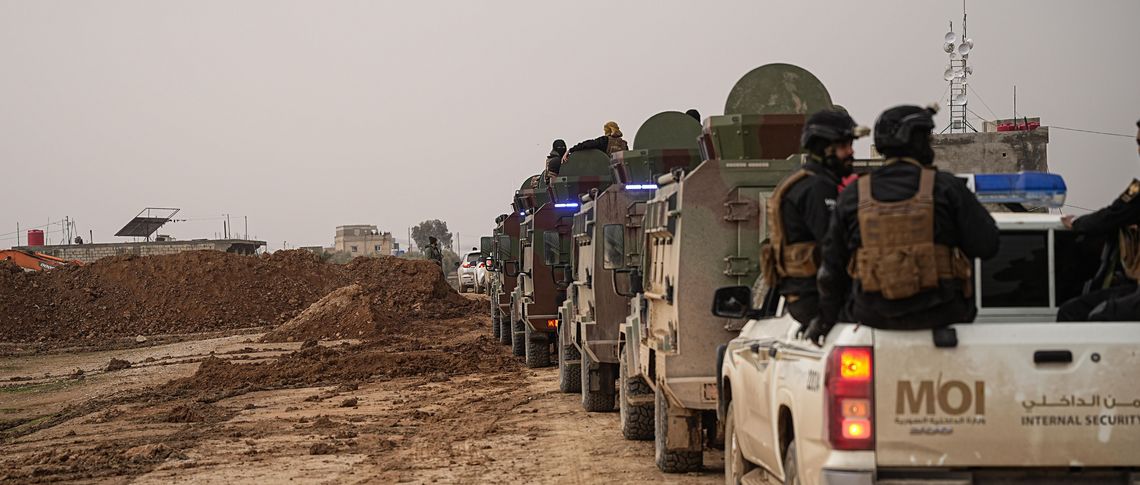
The transitional Syrian government in Damascus is currently moving ahead with steps to implement its recent agreement with the Syrian Democratic Forces (SDF). Reached on 29 January, the deal not only mitigated the immediate risk of a large-scale armed confrontation but also potentially created space for dialogue. Moreover, it allowed Kurdish demands to be articulated more clearly, focusing on political and cultural rights within the broader vision for a decentralised and pluralistic Syria.
Still, this settlement remains predicated on fragile, largely transactional arrangements. It also lacks robust monitoring mechanisms and depends on sustained commitment from European Union member states and regional powers to support transitional processes anchored in the rule of law. Without such a sustained, strategically designed engagement, Syria risks renewed conflict, authoritarian consolidation and exclusionary governance.
The events preceding the agreement highlight its vulnerability. In recent weeks, Damascus launched military operations against the Kurdish district in Aleppo city before advancing eastward into northeast Syria, with tacit American authorisation and mobilised domestic support. In response, the SDF abruptly withdrew from Arab-majority territories and consolidated positions in Kurdish-majority regions. Hostilities only ceased following multiple rounds of negotiations mediated by the United States, France and the Kurdistan Region of Iraq. The 29 January settlement provided neither party with a conclusive victory; instead, it established arrangements that allowed the Kurds to retain their administrative and military structures within their regions under a gradual integration into state frameworks, formalised through a presidential decree recognising Kurdish identity and substantial cultural and political rights.
Increasingly authoritarian
The confrontations were preceded by a long and cumbersome process that formally began with the signing of the 10 March 2025 agreement between the Syrian government and the SDF. The agreement marked the culmination of over a decade of oscillating confrontation and pragmatic cooperation between the two actors, ranging from conflicts in Kurdish regions and oil and goods trading to covert operations against ISIS leaders and tactical coordination during the offensive against Assad that led to the collapse of the family’s 54-year rule.
Following Hay’at Tahrir al-Sham’s (HTS) assumption of power in December 2024, leaders from both sides reached consensus on nine of 10 points. Implementation, however, stalled until atrocities committed in coastal areas prompted President al-Sharaa to request renewed negotiations. The resulting framework established general principles but relied on deliberately ambiguous language and fluid timelines, creating serious challenges for implementation.
The Damascus government prioritised regime consolidation over genuine transitional governance — concentrating executive and legislative authority in the presidency while conducting military operations against other groups, mainly minorities, accompanied by exclusionary rhetoric. Al-Sharaa’s diplomatic success in securing US, Saudi and broader Western support, alongside Turkish patronage and direct military support, effectively abandoned commitments enshrined in UN Security Council Resolution 2254, which outlines a roadmap for Syria’s political transition.
Fundamental divergence centred on whether integration meant the joint construction of new structures or incorporation into existing HTS-dominated institutions.
The SDF, for its part, conceptualised integration as a process of collaborative state-building rather than subordination to HTS-centric institutions. It insisted on comprehensive, nationwide frameworks while preserving its structural integrity as both an armed force but also an administrative authority with gradual integration within state bodies. At the same time, the SDF remained focused on developments in the Turkey–PKK peace process, considering it the main factor over integration in Syria. In doing so, the SDF’s administrative apparatus squandered political capital by failing to address grievances in Raqqa and Deir ez-Zor, neglecting to reform its institutions at a time it started losing advantage toward the central government, and sharing little transparent information with its own constituencies about the course of negotiations.
Reaching an agreement between two ideologically distinct local powers was therefore always a risky endeavour. Fundamental divergence centred on whether integration meant the joint construction of new structures or incorporation into existing HTS-dominated institutions. This was compounded by deep mutual distrust and the absence of national frameworks for armed-forces integration or reconciliation. Throughout the transitional period, the rebuilding – or rebranding – of state institutions proceeded unilaterally and without transparency, driven by a narrow circle within the new government.
The decisive factor enabling limited government operations against the SDF was the United States’ strategic reorientation, which effectively gave the transitional government a green light from its supporters to launch a limited operation aimed at forcing SDF capitulation or, at least, acceptance of its conditions.
By navigating the SDF challenge successfully, the central government has consolidated its authority. Remaining challenges are now largely confined to Alawite and Druze populations, which, along with Kurds and other minorities combined, make up around 40 per cent of Syria’s population. Damascus appears poised to employ similar coercive strategies: territorial containment combined with exclusion from central governance and national decision-making processes. This trajectory further entrenches hyper-centralisation around the presidency and loyalist networks, exemplified by appointments of unqualified cadres to diplomatic positions. Supporting unofficial paramilitary structures allows Damascus to maintain plausible deniability regarding atrocities while achieving strategic objectives through proxy violence. European actors consequently face the reality of engaging with an increasingly authoritarian governance model.
An opportunity for the EU
Given its long history, large diaspora presence and geographic proximity to Syria, the European Union must formulate a Syria policy that is architecturally distinct from US strategic priorities. Such a policy should centre European interests and values while deploying its economic leverage and diplomatic influence more decisively. It should prioritise partnership with all Syrian components, ensure Turkish alignment with diverse governance structures and prevent Syria from being instrumentalised in regional power competitions. The Syrian diaspora should function as a constructive intermediary rather than as an amplifier of identity-based antagonisms promoted by Damascus and armed factions.
Migration challenges require reframing through skilled labour exchange partnerships and local-level development programmes that facilitate voluntary return while maintaining European connectivity. This approach demands investment in localised livelihood programmes and economic infrastructure, coupled with credible security guarantees for returnees. At the same time, the EU must insist on representational diversity in governance structures and a firm commitment to rule-of-law principles, explicitly challenging the emerging Arab Sunni-centric governance paradigm. Failure to enforce inclusive frameworks through conditionality risks renewed internal conflict with regional spillover effects. Marginalising substantial population segments in a resource-depleted, infrastructure-devastated country will leave Europe carrying the financial burden for reconstruction without commensurate policy influence, as Damascus invokes sovereignty principles while accommodating deeper regional power intervention.
While the conflict was settled with the January agreement, it remains fragile and lacks effective monitoring mechanisms. This creates an opportunity for the EU and its member states to play an active role in supervising the government–SDF ceasefire implementation. Such engagement is essential given that the latent Kurdish–Arab conflict, characterised by profound mutual distrust and cross-border Kurdish solidarity networks, presents significant escalation risks beyond Syrian borders and directly affects regional stability and European security interests. Atrocities committed across Syrian territories further increase the risk of conflict expansion.
While providing stabilisation assistance and addressing migration concerns, the EU must ensure robust civil society space and protect independent, professional media.
As UNSC Resolution 2254 remains the authoritative framework for Syria’s transitional period, the EU should consistently remind all actors of their obligations under it. They must also ensure unrestricted access for independent UN accountability bodies, including the International, Impartial and Independent Mechanism (IIIM), the Commission of Inquiry (CoI) and the Independent Institution on Missing Persons (IIMP), operating in parallel with implementation agencies such as UNDP, UNHCR and WFP. Despite legitimate criticisms, these processes and institutions remain essential safeguards for transitional stability and provide critical safety mechanisms when local conflicts exceed the management capacity of resource-constrained authorities with limited governance experience and significant internal contradictions.
While providing stabilisation assistance and addressing migration concerns, the EU must ensure robust civil society space and protect independent, professional media. Syrian populations have repeatedly demonstrated a commitment to freedom of expression. The authorities’ deployment of hate speech as preparatory infrastructure for military operations against any opposition group requires systematic monitoring.
The European Union and allied powers must calibrate their support for nascent Syrian governance structures through explicit conditionality and strong incentive mechanisms that mandate genuine transitional processes and preserve open political space. Sustainable stability depends not merely on formal agreements between armed actors but on creating political space for diverse voices, protecting vulnerable communities from identity-based violence and preventing the mobilisation of sectarian grievances that have historically preceded major escalations in the Syrian conflict.
The temptation to support a pragmatic strongman after years of conflict may appear to offer stability after the upheavals of the Arab Spring. Yet unconditional endorsement that disregards representational diversity and authentic transitional frameworks will catalyse renewed conflict cycles.


