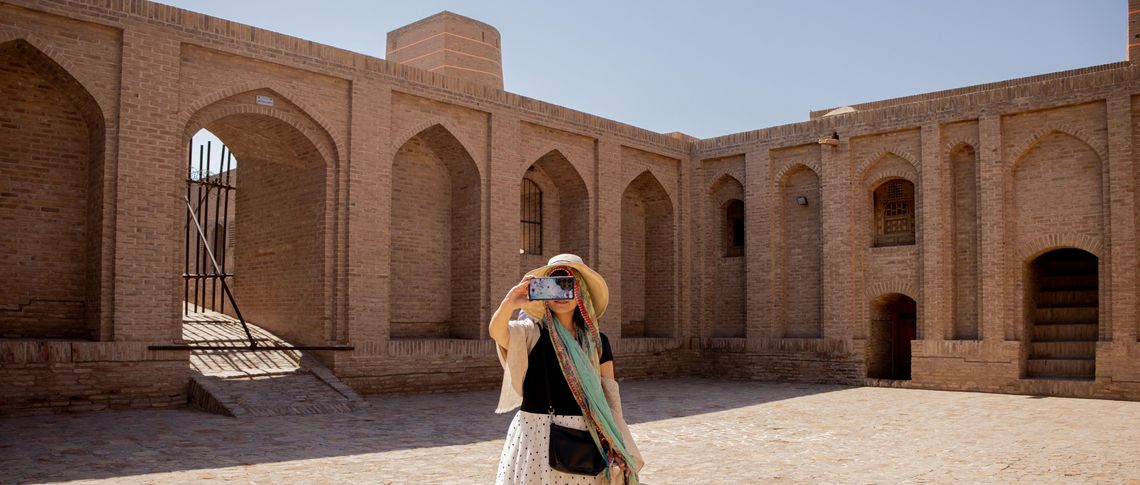
Five years after the Taliban seized power, Afghanistan is one of the most repressive countries in the world for women and girls. Their rights to education, work and freedom of movement in public spaces are severely restricted, while poverty has skyrocketed across the country. And yet, Afghanistan is still attracting tourists.
As the recent Weltspiegel documentary and the podcast Ferien bei den Taliban (Holiday with the Taliban) revealed, Afghanistan is gaining popularity as a tourist destination. But is it okay to go on holiday to a country run by the Taliban? Many seem to think so. Some say they want to form an impression of the country first-hand, hoping to meet locals and discover what lies beyond what they see on the news. One tourist said, ‘I want to see for myself whether it really is as bad as they say.’ But is that actually a possibility? And is that reason enough to travel to a country where women and girls are systematically oppressed?
Unlike with many travel influencers, however, the situation is more complicated with tourists. Influencers actually benefit from downplaying the repressive regime and even presenting Afghanistan as a dream tourist destination. They deliberately create a distorted picture of reality by showing only certain aspects, while ignoring the systematic oppression and crises. The tourists featured in Weltspiegel are different. They speak freely of the contrasts in Afghanistan: impressive landscapes and a rich cultural heritage on the one hand, and severe oppression and poverty on the other. They simply want to form their own authentic impression of life there.
Significant aspects of Afghan life remain inaccessible to tourists.
Yet visiting Afghanistan does not necessarily mean understanding it. Quite the opposite: the desire for an authentic experience could result in tourists encountering a carefully controlled reality — and believing this to be more authentic than the picture presented in the media. The tourist experience in Afghanistan is restricted in ways that tourists can’t control. They have to travel with a tour company that explains the rules of behaviour to them, while representatives of the de facto authorities are all around. Armed Taliban militia decide who is allowed to pass at checkpoints, exerting considerable influence over travel routes and opportunities to meet people. Significant aspects of Afghan life remain inaccessible to tourists — such as the oppression of women behind closed doors or the camps housing people who have been forced to return from Iran and Pakistan.
This contrast is patently clear in the case of Western female tourists. Their privilege allows them to travel around Afghanistan, while shielding them from such a major part of the reality they seek to understand. They have considerably more freedom of movement than Afghan women themselves. They can visit a national park that local women cannot. And unlike Afghan women, they do not have to cover their faces. They may be travelling in the same country, but they enjoy greater freedoms and experience a different reality.
There is something else that affects the supposed authenticity of the tourist experience: it is not just the Taliban who determine what tourists can see. Tourists’ own perspectives also shape their impressions, particularly when it comes to safety, which is mentioned several times in Weltspiegel. For many tourists, safety means being able to travel through the country without feeling exposed to danger. The low risk of terrorist attacks is particularly emphasised, which can be explained by the fact that the Taliban – who were responsible for those attacks in the past – are now in power.
For Afghan women, though, safety means something completely different: freedom of movement, access to education and employment, and protection from arbitrary actions by the state and their family. In this sense, life is decidedly not safe for most Afghan girls and women. When a tourist explains that the armed Taliban make her feel safe and provide her with a sense of protection, it is those very men who are part of the system that severely curbs the freedom of Afghan women.
Normalising a repressive regime
That isn’t to say that tourists’ perspectives are completely off the mark — they just show a limited view of the country. When someone describes Afghanistan as ‘safe’, that comes from their own personal travel experience, not the lived experience of the people who live there. When this perspective is then shared with others, it can also reinforce the Taliban’s narrative that, after decades of war, they have created security and order.
Let’s look at it another way: tourists take a photograph with a Taliban member to show their friends back home. In doing so, they turn a symbol of a repressive regime into almost a tourist attraction. Their dominance becomes part of a commodified travel experience and somewhat trivialised in the process.
This normalisation is exactly what the Taliban want: the regime itself now promotes Afghanistan as a safe tourist destination offering unspoiled nature, hospitable people and travel on a shoestring. There are economic interests behind this; after all, tourism brings money into the country. At the same time, an increase in foreign visitors can help the Taliban portray a rather different image of Afghanistan to the outside world — a tourist destination as much as any other, without any systematic oppression in sight.
So, is it okay to go on holiday to a country run by the Taliban? There are two main arguments for why it is not:
The first problem is limited authenticity. In Taliban-controlled Afghanistan, tourists see the country through a controlled lens. It is difficult to develop a truly comprehensive understanding of the people there when both the regime and tourists’ own privileged perspectives determine what they see and experience.
The second problem is the impact of tourism itself. Travelling to Afghanistan can help normalise relations with the Taliban and make their rule accepted as just a part of everyday life. Anyone travelling to Afghanistan today will undoubtedly gain a different perspective on the country, but not necessarily a more authentic one. And in doing so, they are not merely observers of this political reality; they also play a part in shaping it.