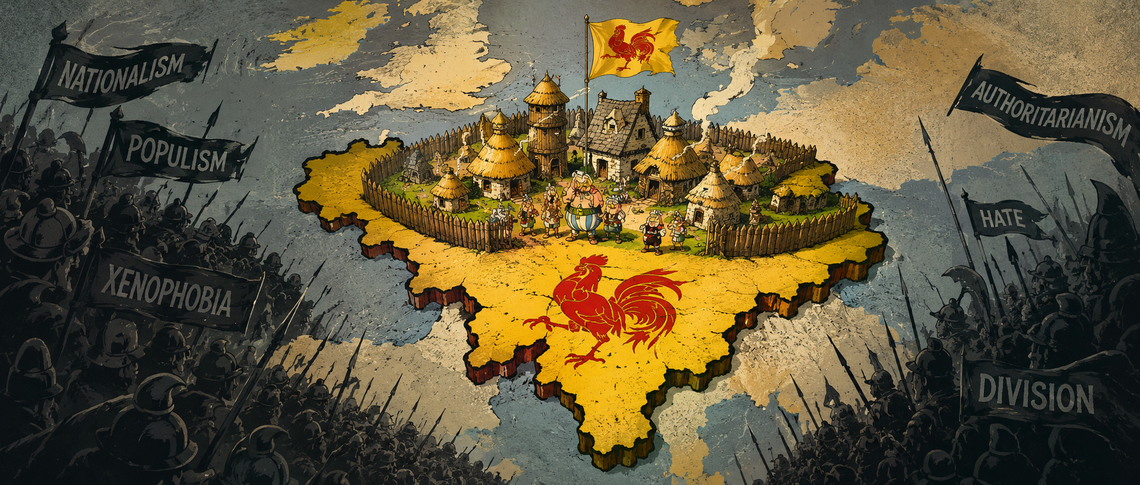
According to a recent study by 150 political scientists, nearly one in five Europeans now votes for the far right. This share has increased dramatically over the past three decades. In France, Austria and the United Kingdom, far-right parties are closer than ever to political power. Other countries long assumed to be immune, such as Germany and Spain, have recently witnessed the rise of successful radical-right movements. As support for these parties has grown, movements once considered beyond the political pale have become fixtures in national politics. At the same time, their authoritarian, populist and often xenophobic rhetoric has increasingly been normalised, both in the mainstream media and across social media.
Against this backdrop, one Western European region stands out as an exception: Wallonia, the French-speaking south of Belgium, is now one of the few places in Western Europe where a far-right party has failed to gain ground. This is surprising for several reasons. Wallonia has experienced heavy deindustrialisation, economic insecurity and political dissatisfaction — the very conditions often associated with support for the populist right. Wedged between Marine Le Pen’s heartland to its south and the more right-wing politics of Flanders to the north, Wallonia has been resisting far-right mobilisation for over 30 years. Its three dominant political parties – social-democrats, liberals and Christian-democrats – still command up to 75 per cent of the vote; a combined share that has remained roughly the same since the end of World War II. As a result, many Walloons pride themselves as being Europe’s last bulwark against the far right, invoking the image of the small Gaulish village in Astérix that famously resisted Caesar’s Roman legions.
Class mobilisation
But unlike in Astérix, the Walloon ‘village’ doesn’t have a druid or miracle potion to bolster its defence. Its electoral system is almost completely identical to that of Flanders, where the far-right nationalist Vlaams Belang (previously: Vlaams Blok) has been embedded in the party system since 1987. Nor are Walloons exceptionally progressive. On immigration, religious freedoms and many ethical issues, they hold views that are broadly comparable to those of the average European and, in some respects, are even more conservative than those of Flemish voters. While Walloons generally favour left-wing economic policies, many also support a more conditional, or welfare-chauvinist, approach to social spending.
If Walloon voters are not exceptionally progressive, then a different question emerges: why has the far right failed in Wallonia when it has succeeded almost everywhere else?
The short answer points to political agency. By and large, Walloon parties have continued to prioritise traditional socio-economic issues while giving relatively little attention to the new cultural conflicts that have come to dominate politics elsewhere. In this sense, Wallonia still remains a ‘mobilised class society’: a political system where social class continues to be an important reference point for voting behaviour. This is borne out by postelectoral surveys, where economic policy, unemployment and inflation have been the most salient issues in most recent elections, especially among working-class voters.
A unique feature of the Walloon system is its cordon sanitaire médiatique: a formal agreement among media practitioners to bar ‘anti-democratic’ forces from the public debate.
An important influence for this agenda-setting has been the social-democratic Parti Socialiste (PS), which has been the dominant political force in Wallonia since the Second World War. While social-democratic parties across Europe embraced a middle-class shift toward social investment and activation policies, PS notably continued to endorse ‘old left’ interventionist and redistributive policies; uniting left-authoritarian workers around a common core of class interests. As a result, many Walloon voters still define their political choices in relation to their class background. The PS reinforces these loyalties through its close ties to left-wing trade unions, mutual insurance organisations and socio-cultural associations. Through this dense network of local civil-society organisations, the party maintains direct channels of communication with its electorate.
A second factor is the sustained cooperation among all major parties to contain the far right. In 1993, five Walloon parties signed an agreement to ‘never to associate oneself in a political coalition with groups or parties that defend ideologies or proposals that could undermine the principles of democracy’. This commitment to ostracise the far right has developed into one of the most effective examples of a cordon sanitaire in Europe: Walloon parties neither govern nor formally cooperate with the far right, nor engage in any form of political debate with its representatives.
A unique and arguably the most distinguishing feature of the Walloon system is its cordon sanitaire médiatique: a formal agreement among media practitioners to bar ‘anti-democratic’ forces from the public debate. Most major media outlets, including the public broadcaster RTBF, have voluntarily adopted guidelines stipulating that the far right should not be featured without contextual framing of their positions. Under this cordon médiatique, live broadcasting of far-right politicians in interviews or talk shows is prohibited. When Donald Trump was inaugurated, RTBF, for instance, delayed live coverage by two minutes in order to allow time for framing and fact-checking of his speech.
These political and contextual measures helped ensure that the Walloon far right never gained sustained momentum. But they also cut short existing movements. While the far-right Front National and Parti Populaire did gain seats in Wallonia in the past, they crumbled through weak leadership and lack of visibility. In 2021, the new Chez Nous party was formed with the support of Vlaams Belang, Rassemblement National and the Dutch Partij voor de Vrijheid. Despite becoming the most popular Walloon party on social media, it failed to gain seats in the 2024 federal elections and was ultimately disbanded in 2025.
Militant consociationalism
Political scientists have therefore branded Wallonia as a ‘militant consociational democracy’: a system marked by power-sharing for insiders, but by considerable thresholds for anti-systemic outsiders. As one of the most successful models of far-right ostracisation, one could question whether such a model could be exported to curb far-right challengers elsewhere. Indeed, many scholars argue that a strict non-engagement policy is one of the most efficient strategies to prevent the rise of political challengers. However, such a strategy becomes far less effective once these actors are already embedded within the party system, as is the case in most European democracies. Moreover, sustained ostracisation depends on broad and stable support from citizens, civil society and political elites — a constellation that is unlikely to exist outside Wallonia.
It therefore appears that Wallonia’s far-right exceptionalism rests on specific scope conditions that are difficult to replicate. Nevertheless, the Walloon experience suggests that the success of the far right is not driven by ideological support alone, but also depends on whether political and institutional environments are receptive to its mobilisation strategies. Whether the far right will be able to penetrate the Walloon stronghold in the coming decades remains an open question.