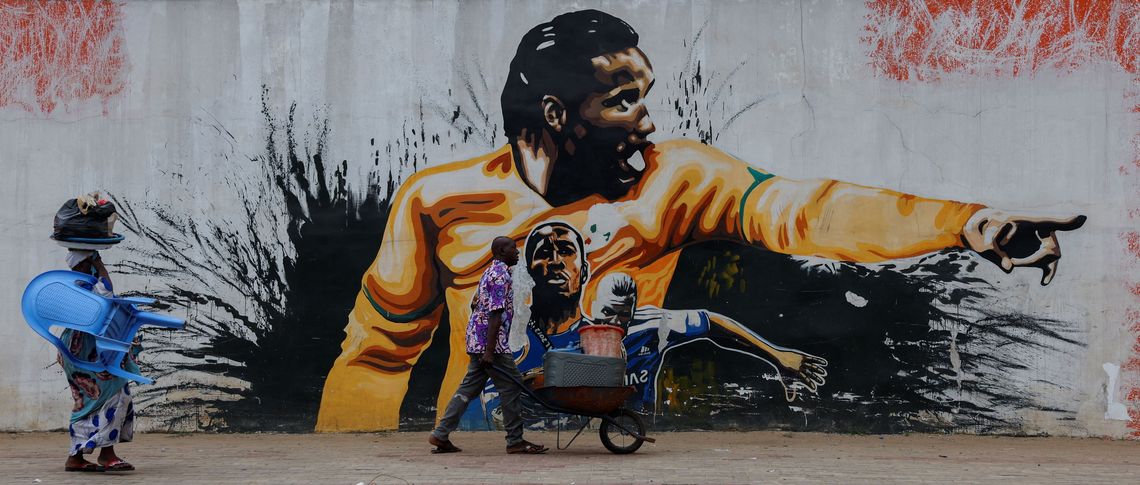
On 20 June, the Éléphants of Côte d’Ivoire will meet Germany in Toronto in their second World Cup group-stage match.
When the country first qualified for a World Cup 20 years ago, it was in the midst of a brutal civil war. Speaking from the team dressing room, the nation’s biggest star at the time, Didier Drogba, made an emotional appeal to the warring parties to begin peace negotiations. The Ivorians were eliminated early from the tournament — but Drogba’s message endured. A peace agreement was eventually reached in 2007.
Yet the peace remained fragile. Following the presidential election in 2010, the conflict flared up again, driven primarily by disputes over the distribution of resources between north and south and by ethnic tensions. The forces of Alassane Ouattara ultimately prevailed militarily. He became the country’s new president, while his rival, Laurent Gbagbo, was transferred to the International Criminal Court. Since 2010, Ouattara has been re-elected four times, most recently at the end of 2025.
With average annual growth of 6.5 per cent, Côte d’Ivoire ranks among the fastest-growing economies in the world.
Two decades later, Côte d’Ivoire has left the war behind and emerged as one of Africa’s economic success stories. Yet many of the issues Drogba highlighted at the time remain unresolved: political reconciliation, social inclusion and the question of whether power in the country can change hands peacefully and democratically. This is precisely the key test for the next phase of Ivorian development.
Today, the country’s economy is three times larger than Senegal’s, and its growth rate exceeds that of Ghana. With average annual growth of 6.5 per cent, Côte d’Ivoire ranks among the fastest-growing economies in the world. The exploitation of gold reserves, newly discovered natural gas deposits and an export-oriented agricultural sector are driving growth. Forty per cent of the world’s cocoa production comes from Côte d’Ivoire. The electrification of the entire country is being pursued with great determination.
As host of the 2024 Africa Cup of Nations, the country presented itself as a dynamic business destination: gleaming shopping malls, new industrial projects and, with Tour F, the construction of Africa’s tallest skyscraper. Victory for the national team crowned these efforts.
Unresolved questions
Yet the country’s economic rise masks political weaknesses. The legacy of the civil war – still referred to in Côte d’Ivoire simply as ‘the crisis’ – has never truly been addressed. Better social protection and a fairer distribution of the benefits of growth are also still in their infancy. At the same time, the political elite is growing increasingly elderly. Some observers already speak of the country’s ‘Cameroonisation’, referring to the long-serving ruler Paul Biya, who has remained in power there for more than 40 years. This gradual entrenchment of the political system increasingly contradicts the country’s economic dynamism. Finally, the question of presidential succession remains vague and unresolved. This creates uncertainties that could deter investors in the years ahead.
The social reckoning with the civil war years has been highly inadequate, as Drogba’s appeal was only partially heeded. There is peace, but genuine political reconciliation has failed to materialise. Tensions between north and south, as well as questions of citizenship and national belonging, persist but are rarely discussed publicly or addressed politically. For many Ivorians, the wounds and trauma of the civil war remain painfully present. The political reconciliation process was largely confined to the leaders of the opposing camps and has delivered little justice for most victims.
Despite the economic boom, many people have seen few benefits from the country’s success. More than a third of the population still lives below the poverty line, while average years of schooling remain below the Sub-Saharan African average. At the same time, the government often pursues its modernisation strategy through authoritarian means. Entire neighbourhoods in Abidjan are being demolished, and trade unions report growing pressure. This is fuelling social discontent — and with it risks to political stability in the post-Ouattara era.
A country’s economic attractiveness tends to decline as leaders remain in office for extended periods, as investors become wary of entrenched structures, growing patronage networks and uncertain political transitions. This is particularly problematic for Côte d’Ivoire, where no transfer of power since independence has occurred without conflict.
Côte d’Ivoire is an economic success story — but one with significant political pitfalls.
President Ouattara is now 84 years old. The unresolved succession question and increasing political stagnation are widely seen as risks to the Ivorian economic engine, which depends heavily on foreign investment. The most recent elections at the end of 2025 did little to change this picture. Instead, the incumbent was re-elected with almost 90 per cent of the vote in a highly repressive political climate. Turnout of no more than 35 per cent reflects growing political apathy among the population. More recently, attempts to position the president’s brother, Téné Birahima Ouattara, as his successor have prompted surprise. The current defence minister and deputy prime minister may be somewhat younger than the president at 70 years old, but this can hardly be described as a genuine generational change.
New roads, bridges and other concrete infrastructure may generate economic growth, but they will not be enough to secure social peace. That will require social housing for the rapidly growing population and greater investment in education and healthcare. The regional context also presents challenges. Instability in Mali and Burkina Faso is increasing pressure on West Africa’s economically successful coastal states. This makes domestic political stability all the more important for Côte d’Ivoire.
The question of succession will also have foreign-policy implications. While many West African countries are redefining their relationship with France, the Ivorian leadership continues to favour continuity. Whether this approach will endure after Ouattara remains an open question.
Côte d’Ivoire is an economic success story — but one with significant political pitfalls. As the Ouattara era draws to a close, attention is increasingly turning to what comes next. Can a genuine generational change in both government and opposition be achieved, paving the way for real reconciliation? And how can the fruits of economic growth be distributed more fairly?
When Germany faces Côte d’Ivoire at the World Cup, it will be meeting one of Africa’s economic success stories. Yet the country’s future will not be decided on the football pitch. It will depend on whether Côte d’Ivoire can achieve something unprecedented in its modern history: a peaceful and broadly accepted transfer of power. Only then will Didier Drogba’s appeal from 2006 truly have been fulfilled.