Since the US and Israel’s attacks on Iran, which violated international law, a debate has flared up in Germany that follows a striking pattern: the gradual undermining of international law. This phenomenon is not new. What is new is the intensity with which these attacks are being made and the political centre from which they originate.
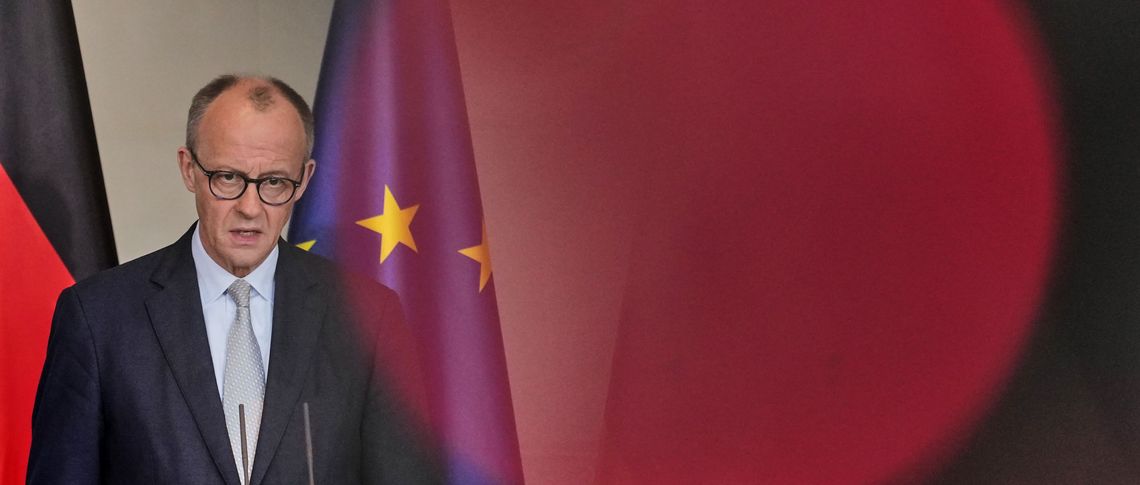
Even during the Twelve-Day War in the summer of 2025, Chancellor Friedrich Merz had declared that Israel was doing the ‘dirty work‘ for Europe. Even then, criticism of this was muted. Since then, the tone has hardened: the media are calling for ‘more dirty work, less international law’, and centrist politicians even claim that ‘international law serves dictators and authoritarian systems’. So, the enemy is the law?
What is unfolding here are not mere slips of the pen in the arts pages. Something is slipping politically. In political debates, media commentaries and security policy analyses, international law increasingly appears as an obstacle to a supposedly more realistic foreign policy. What is particularly striking about the debate is the ease with which some commentators, in the name of a supposedly realistic human rights policy, are prepared to call into question central principles of international law. Precisely where moral outrage at the situation in Iran is rightly being voiced, there suddenly emerges a call to treat the UN Charter’s prohibition on the use of force as a hindrance — a legal formality. One should not allow oneself to be held back by ‘legal shackles’ when pursuing morally imperative goals.
In light of the inhuman mullah regime in Iran, this stance appears, at first glance, resolute and pragmatic. On closer inspection, however, it proves to be dangerously short-sighted. The prohibition on the use of force enshrined in the UN Charter – perhaps the most important normative innovation of the 20th century – did not, in fact, arise from idealistic exuberance, but from the experience of two world wars. The realisation that states should no longer be free to decide on the use of military force was the consequence of an era in which precisely this freedom had led to mass human rights violations. So-called peacekeeping law is therefore not a moral fever dream, but institutionalised historical experience. It is not an attempt to abolish power politics, that would be illusory, but a way of containing it through rules.
An impossible dilemma
Particularly paradoxical is the claim of an alleged dilemma between human rights and international law. This argument regularly surfaces precisely when military interventions outside the existing legal order are to be legitimised. One must choose, so the extreme thesis goes. Either one adheres to international legal norms or one protects people from grave injustice.
However, this juxtaposition is misleading for several reasons. Firstly, the international human rights system is, of course, itself part of international law. Anyone who attacks ‘international law’ in general terms therefore simultaneously delegitimises the treaties, institutions and procedures on which global human rights protection is based.
Secondly, the prohibition of the use of force in the UN Charter does not primarily protect state sovereignty, but rather societies and civilian populations. It was created to prevent the spiral of attack and retaliation that has been known for millennia. It is precisely this conflict dynamic that we are currently witnessing in the Middle East: a dozen states are now militarily involved in the war against Iran, and more than 1300 people have been killed, including 165 children at a girls’ school in the south of the country.
A greater danger comes from democracies that do not break the law, but bend it.
Thirdly, the war against Iran, in the way it is justified, is not a good example of such a dilemma. Neither the US nor Israel has seriously claimed to be acting in the name of human rights. US Secretary of Defence Pete Hegseth and US Secretary of State Marco Rubio have even explicitly stated that this is not about ‘regime change’. That the Iranian regime is massacring its own population and committing the gravest human rights violations is undisputed. Yet the US-Israeli attacks do not, in fact, aim to protect the rights of the Iranian people. This is precisely why this war serves as a particularly poor example of an alleged tension between international law and human rights.
There are cases in which the tension between the prohibition of the use of force and human rights more clearly determined the motives of the parties to the conflict. The NATO intervention in Kosovo in 1999 was contrary to international law, but it stopped a massacre — and at the same time failed to prevent further killings. But Kosovo does not serve as a free pass. It was a borderline case that was discussed as such, with a serious legal burden of justification, with international debate, and with an attempt to subsequently translate the action into norms, from which the ‘responsibility to protect’ emerged as a concept. What we are witnessing today is the opposite: no burden of justification, no debate, no development of norms. Instead, the simple assertion that the law ends where political interests begin.
No one expects the regime in Tehran to take international law seriously. A state that executes demonstrators, uses political prisoners as bargaining chips and systematically deprives women of their rights, has effectively excluded itself from the community of law-abiding nations. This has been documented, condemned and must be prosecuted under international criminal law. Regimes such as this are proof that the law has enemies. However, it is not so much the law’s open opponents that pose a danger to it. A greater danger comes from democracies that do not break the law, but bend it. That do not reject it, but rebrand it. Not: ‘we ignore international law’, but: ‘the particular circumstances call for a nuanced interpretation’. This practice erodes international law from within, far more effectively than any open hostility. For as soon as universal rules are replaced by situational moral judgements, decision-making power inevitably shifts to those actors who have military means at their disposal. For those who flout international law, such as Trump, a world without binding rules is not a threat, but a strategic opportunity. Anyone who, in the name of supposed realism, undermines the authority of international law is – whether intentionally or not – actively contributing to precisely this shift.
Practice has shown
Other voices draw a different conclusion from the example of Iran: since international law is no longer being observed anyway, one should rely less on the law and instead speak more soberly about power, interests and geopolitical necessities.
This diagnosis is not merely analytically simplistic. The fundamental error lies in its very premise. In no other area of law would one conclude that the law is meaningless simply because violations exist. The weakness of international law is not an argument against the law; it is an argument for its defence. Its authority stems from political practice, from institutions and from expectations. Strengthening institutions such as the International Criminal Court would be the correct course of action. But anyone who rhetorically undermines their authority – as Merz does in the case of arrest warrants against Netanyahu, which he intends to ignore if necessary – contributes to their erosion. To then cite this weakness is hypocritical.
The military intervention in Afghanistan ended after two decades with the return of the Taliban.
Furthermore, there is little historical evidence to empirically support the notion that authoritarian systems can be democratised through external military intervention. Recent history, on the contrary, provides cautionary examples. The 2003 Iraq War began with fabricated threat scenarios and the promise of bringing democracy and stability to the country. Instead, what followed were years of occupation, a destroyed state, hundreds of thousands of deaths and a strengthened Iran. The military intervention in Afghanistan ended after two decades with the return of the Taliban. Libya, too, where an initially limited intervention led to regime change, remains characterised by political fragmentation and violence to this day.
It is precisely here that the real dilemma of the current debate becomes apparent. It is not the tension between human rights and international law invoked by Merz. The real dilemma is another: the German government is bowing to Trump’s will because it does not want to upset the US, particularly with regard to support for Ukraine, which is defending itself against an illegal war of aggression. Securing this support is an understandable motive, but no argument for accepting the US-Israeli breach of law. This raises a further, very concrete question for German policy: under Article 26 of the Basic Law, Germany must not participate in acts of aggression contrary to international law, either directly or indirectly.
The Spanish Prime Minister has refused to allow the US to use Spanish military bases for this war and is consequently criticised in the German debate as unfit for alliance.
This also applies to logistical support provided via military infrastructure on German territory, in particular the US Ramstein Air Base. Last summer, in its Ramstein ruling, the Federal Constitutional Court emphasised that the Federal Government must take action in the event of serious risks of systematic violations of international law by other states. This also applies to allowing acts of aggression contrary to international law to be carried out from one’s own territory. This duty is not a political option, but a constitutional obligation. Pedro Sánchez demonstrates that adherence to the law is possible. The Spanish Prime Minister has refused to allow the US to use Spanish military bases for this war and is consequently criticised in the German debate as unfit for alliance. The signal this sends is devastating: anyone who abides by the law is regarded as a troublemaker.
When Federal Chancellor Friedrich Merz declares that international law ‘achieves nothing’, this is not sober realpolitik. It is a declaration of bankruptcy vis-à-vis the principles of Nuremberg and vis-à-vis the promise to respect the law even when it comes at a political cost. What is presented as pragmatism is in truth a capitulation to the logic of imperial power politics, which relies on military force to enforce its own interests. For a German Chancellor, such a stance is in fact more than just a political mistake. It is a breach of the very historical responsibility from which the German constitutional order emerged in the first place. This responsibility, however, is not a political option, but a constitutional obligation. Anyone who disregards it is in breach not only of international law, but also of their own constitution. That is the dilemma.