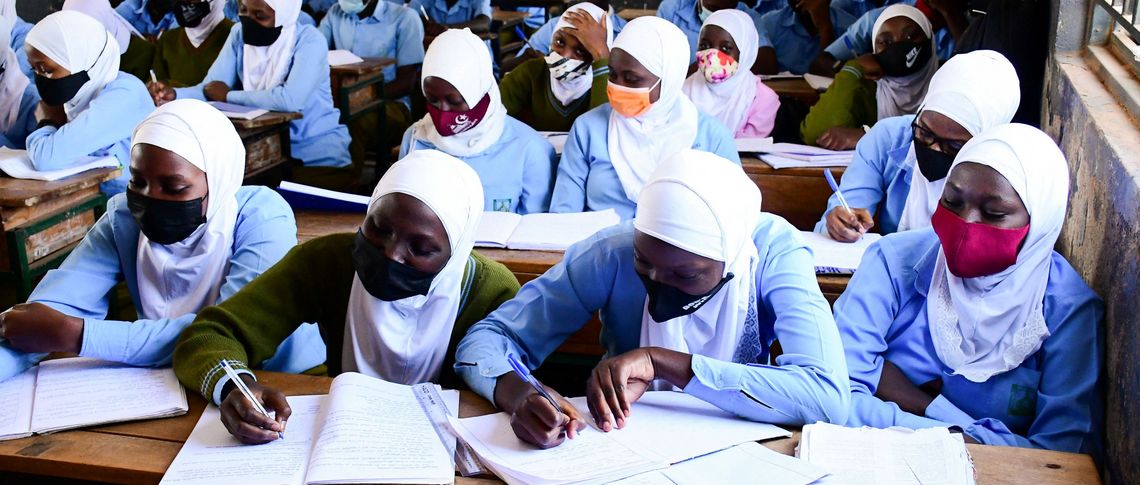
Ugandan schools have just reopened after having been closed for nearly two years because of the pandemic. More than 10 million students have had to stay at home. What were the last two years like for children and parents in Uganda?
It has been difficult for both the children and parents, especially for those parents who lost their sources of income to feed and look after their children for two years. Authorities reported in 2021 that two in ten children in Uganda were having less than a meal a day because they didn’t have access to school feeding programmes. For parents in Uganda, having children in boarding schools is a saving mechanism. School terms last four months and meet all expenses related to children while parents meet costs for only two to three weeks during school breaks. For a family with five or more children, it has been expensive and challenging to meet all daily expenses related to children for two straight years.
Most parents lived in fear of what could befall their children while, as absurdly as this may sound, staying at home. That’s because schools are generally considered safer places for children. Whatever the concrete figures are, there has been a considerable increase in teenage pregnancies, and more child abuse cases reported in the last two years. The uncertainty of when schools would reopen, the unending confinement in homes was traumatising for the children.
No other country has had its schools closed for such a long period. What was reason for the long school closure? Was Uganda particularly harshly affected by the pandemic?
Covid-19 numbers were not as high as in our neighbouring countries. The fact that Uganda was not as harshly affected could be attributed to stringent control measures like early curfew, the closure of schools, and long lockdowns. These same measures, however, led to the loss of so many jobs and sources of livelihoods for a majority of Ugandans, leaving them healthy but poorer than they were before the pandemic. The very long closure of schools could be attributed to the unpreparedness of education institutions, and the inability of health facilities to deal with a surge of cases in schools.
Broadband coverage in Uganda is minimal, even compared to many other least developed countries in Africa. Many households do not even have access to electricity. This must have ruled out online learning for the majority of children. Did children receive other forms of instruction?
Online learning and homeschooling was the reserve of a minority of Ugandans who could afford the options. The majority of students across Uganda were left stranded, or at best, left with the option of tuning in to scheduled TV and Radio learning programmes, notwithstanding the limited access to necessary devices and regular electricity supply shortages in some places. Access to these alternative forms of learning were mostly available in urban areas.
Despite the government’s efforts to print learning materials for more than two million students in the two years, the distribution reach was low and left the majority of rural and poor students not catered for. The lack of student interest in these non-interactive modes of learning coupled with lack of learning materials and increased household chores all contributed to many students being left out of any form of learning.
Authorities have warned that at least 30 per cent of students may never return to school. Why do these children not to return to school? Are there specific characteristics of non-returnees?
A sizeable percentage of the ten million affected primary and secondary students may never go back to school because many girls got pregnant or married, other students resorted to informal work as farm or domestic workers, as riders of boda bodas (motorcycle taxis) or street hawkers. Either they lost interest in school or their parents can’t support the school fees anymore because they lost their income due to the pandemic.
Despite the push to allow pregnant girls to come back to school, with measures to curb stigmatisation, there is some resistance especially from church leaders to allow pregnant girls back in school. This will leave a majority of those girls out of school.
The difference in access to learning options during the two years increased the existing gap between the urban middle classes and the rural poor. This may translate into more urban than rural students returning to school after two years and a widened literacy gap between rural and urban Ugandans.
Does the Ugandan government have a strategy to help children return to school?
All teachers are required to be vaccinated before resuming work. But only about 60 percent of all teachers are currently vaccinated. Students above 18 years are mandated to be vaccinated. The government is trying to make arrangements to support struggling private schools to resume business by, for example, waving operating licences or negotiating with commercial banks to grant schools interest free loans. But the government needs to release more funding especially for government schools to put in place necessary infrastructure and learning tools for the implementation of Standard Operating Procedures in these public schools.
In 1997, Uganda was one of the first African countries to offer free elementary school education. Is Uganda now walking back on their achievements? Is the country facing a ‘lost generation’?
The two-year closure has really dipped the numeracy and literacy levels of a generation, with many of these kids still grappling with the risk of not returning to school again. However, if over ten million children can return to schools, as a country, we can still realise our potential in a few years. I would call on all religious and cultural leaders to use their influence and platforms to encourage parents to return all children to school, especially girls instead of castigating them for getting pregnant.
Were teachers and other staff paid during the school closures? Will most of them return to school or have many moved to other jobs?
Most teachers were laid off or not paid during school closure, especially those in private schools. A few were retained for the online studying programmes. Many teachers resorted to different businesses like farming, vending, private tutoring and boda boda riding, alternatives that provide them with better daily incomes than a monthly salary from teaching. Those teachers may never return to their old profession. Officials envisage a shortage in teaching staff on reopening of schools.
Even before the pandemic, Uganda was facing significant socioeconomic inequalities. During the pandemic, the poverty rate rose by more than 10 per cent. How will the consequences of the long school closures impact Ugandan society?
The high dropout rate is going to increase the number of people engaged in the informal, precarious economy. Moreover, it will have a lasting negative impact on the literacy levels and gap between the rich and poor in Uganda.
The abuse on children, early marriages, and emotional toll of such a long closure has left a lasting negative impact on the mental health of both children and parents. My own children were so tired of being home and always excited at any opportunity to visit relatives and friends. They labelled home a prison and their mother the prison warden because of having to study at home.
This interview was conducted by Anja Wehler-Schöck.