For years, Turkish foreign policy has relied less on fixed alignment than on selective manoeuvre: keeping channels open to competing power centres, resisting full strategic dependence and preserving room for action in a fractured region. But the war against Iran is not only putting this approach to the test but also creating a situation which pushes Ankara into a far more cautious and constrained position. Turkey is neither a belligerent nor a bystander. It is something more uncomfortable: a frontline state that cannot afford to take sides, yet is absorbing the costs of a conflict it did not choose and cannot easily escape.
These costs are accumulating across the economy, the security sphere and the regional order itself. Each, in isolation, may still look manageable. Taken together, however, they pose a deeper question. Can Turkey’s cautious middle position in this war really hold?
Tangible impacts
Turkey entered this conflict with strong pre-existing economic fragility. Years of unorthodox monetary policy, currency depreciation and elevated inflation have already eroded household purchasing power and business confidence. The Iran war has not created Turkey’s economic crisis — it has accelerated and deepened it.
This is most visible in the energy field. Iran has historically supplied approximately 14 per cent of Turkey’s natural gas imports — a structural dependency that war-driven disruptions to supply have translated directly into domestic price pressure, feeding on an inflation environment already difficult to contain. Transportation costs, industrial inputs and consumer prices have all been affected.
Beyond energy, the war has thrown Turkey’s connectivity ambitions into uncertainty. Ankara has long sought to position itself as a transit hub linking Central Asia, the Middle East and Europe. For Turkish planners, regional stability is not merely a geopolitical aspiration. It is part of the economic model itself.
To be sure, some in Turkey see Iran’s weakening as a potential opening, one that could reroute freight, energy flows and aviation traffic toward Turkish territory. But such gains, if they materialise, are medium-term and conditional. In the short run, instability across Iran and Iraq means weaker investor confidence, delayed infrastructure returns and the risk that a fractured Iran could generate the same cross-border pressures that Syria once did: refugee flows, illicit networks and wider economic contagion along Turkey’s southern flank.
Iran has served a functional purpose in Turkey’s regional balance-of-power calculations.
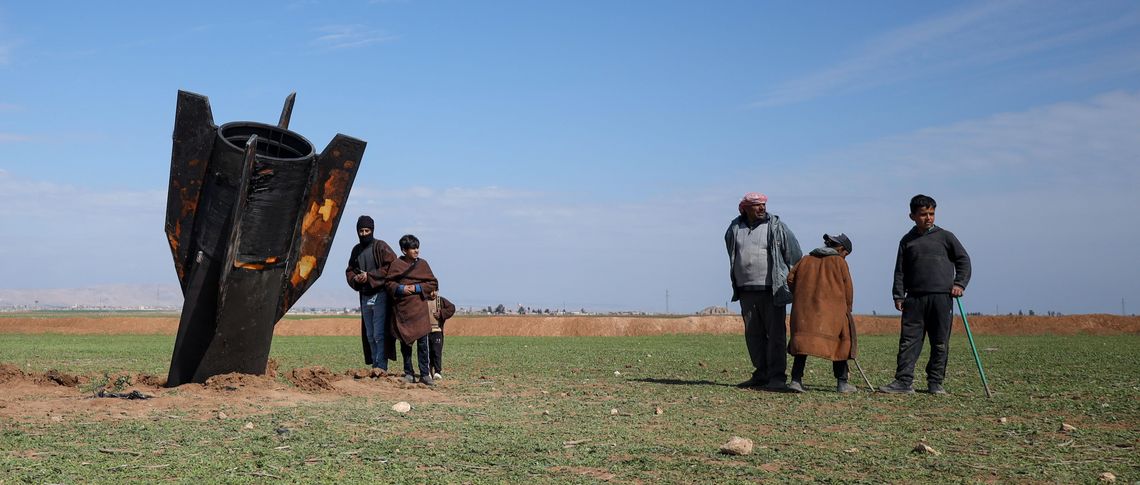
The security consequences have been the most viscerally immediate. Turkish authorities have confirmed that at least three ballistic or cruise missiles originating from Iranian territory have struck or been intercepted within Turkish borders. NATO air defence assets were involved in the interception. The Iranian government has denied responsibility, attributing the incidents to technical malfunctions or third-party actors.
The Turkish government’s response has been notably calibrated. Officials confirmed the origin of the projectiles while deliberately avoiding language that would intensify the crisis. Critically, Ankara has not invoked Article 5 of the North Atlantic Treaty, despite the formal eligibility of the incidents. This restraint is a deliberate strategic choice to preserve diplomatic channels and avoid a binary escalation that would force Turkey to align with one camp against another.
The deployment of additional Patriot missile batteries has reignited the politically sensitive debate about Turkey’s air defence architecture. The decision to acquire the Russian S-400 system in 2019, and the subsequent exclusion from the F-35 programme, left Ankara outside of the full interoperability in NATO’s integrated air defence network. The current crisis has exposed that gap with unusual clarity and pushed the issue back into public debate.
The economic and security pressures, significant as they are, may not be the primary driver of Turkish anxiety. What is harder to manage, and what animates Turkish strategic thinking at a deeper level, is the question of what the post-war regional order looks like if Iran is comprehensively weakened or destabilised.
Turkey’s strategic calculus has never been premised on ideological affinity with the Islamic Republic. Yet Iran has served a functional purpose in Turkey’s regional balance-of-power calculations. It was a counterweight to Israeli influence and one of the few remaining actors capable of anchoring a multipolar regional architecture. The net effect of the conflict, from Ankara’s perspective, has been a shift toward Israeli regional primacy, a development that the Turkish government views with considerable unease.
That anxiety has also been reinforced by Israeli rhetoric. Speaking in February 2026, former Prime Minister Naftali Bennett described Turkey as ‘the new Iran’ and warned of an emerging Turkish threat. The significance of such language lies less in its analytical precision than in what it signals to Ankara — that a more assertive Turkey in a post-Iranian regional order may increasingly be viewed by Israel as a strategic problem. Whether this amounts to a settled doctrine in Israeli state policy or reflects the harsher tone of a war climate is open to debate. Its effect on Turkish threat perceptions is not.
The Kurdish dimension
Of all the risks the war has generated for Turkey, the Kurdish dimension is the most complex.
Before the war, Ankara had been engaged in a negotiated disarmament process with the PKK, whose imprisoned leader, Abdullah Öcalan, called on the organisation to disarm and dissolve in February 2025. The PKK announced it would comply in May 2025, representing the most serious attempt in the organisation’s nearly fifty-year history to end an insurgency that has claimed tens of thousands of lives. The war with Iran has placed that process under direct pressure.
The mechanism is specific. The PKK’s Iranian affiliate, the Kurdistan Free Life Party (PJAK), explicitly rejected Öcalan’s call to disarm. Reports, initially denied by Washington, indicated the CIA was considering arming Kurdish factions inside Iran to foment internal pressure on the regime. President Trump also encouraged Iranian Kurds to take up arms, saying it would be ‘wonderful’ if they did, before reversing course within 48 hours. For Ankara, the implications were obvious. A war that reactivates armed Kurdish actors across Iran would not stay confined to Iran.
What Ankara fears now is not simply the weakening of a neighbour. It is the erosion of a regional order in which the Kurdish question, however violently, had remained bounded.
Turkey and Iran have, for decades, managed the Kurdish question together. Not as allies, but as two states with a convergent interest in preventing Kurdish territorial consolidation along their shared border. Joint operations against PJAK and PKK infrastructure, intelligence-sharing mechanisms and coordinated cross-border strikes represent a form of security co-governance that has a durable functional logic. What Ankara fears now is not simply the weakening of a neighbour. It is the erosion of a regional order in which the Kurdish question, however violently, had remained bounded.
Iran occupies a different place in Turkey’s strategic imagination than Syria or Iraq ever did. The Turkish-Iranian border, formalised in 1639, is one of the oldest stable frontiers in the region. When Turkish officials insist on Iran’s sovereignty and territorial integrity, they are not only making a diplomatic point; they are also expressing a historical memory of order and a strategic fear of what follows when one of the region’s few enduring state structures begins to break down.
That is why Turkey’s response to the war has been so careful. Ankara is trying to hold several lines at once: to absorb the economic shock without deepening domestic fragility, to contain the security fallout without being dragged into direct confrontation, to prevent a new wave of Kurdish insurgency across its borders and to resist a regional order defined either by Iranian collapse or unchecked Israeli primacy.
Whether this still gives Turkey room to shape the emerging order, or simply leaves it more exposed as that order hardens, remains the central question of Turkish foreign policy.