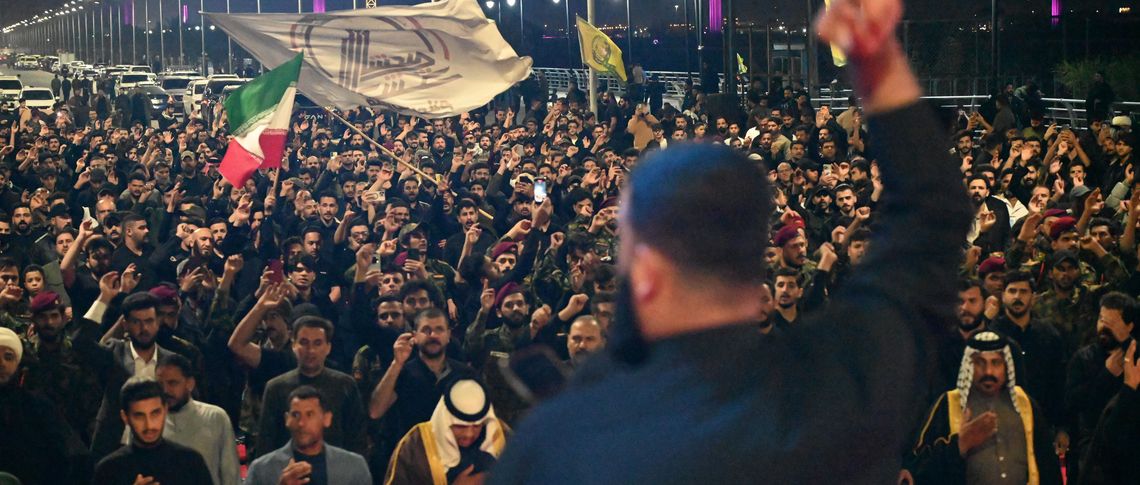
Iraq has been trying its best to stay out of the Iran war, even if in vain. Just a few months ago, Iraq seemed more stable, more secure and more self-reliant than it had been in years. But now the country is in danger of being dragged back to the dark days of instability.
When the ‘Twelve-Day War’ between Israel and Iran broke out in June 2025, Iraq was barely affected. Two years earlier, Baghdad had even mediated tensions between Iran and Saudi Arabia. Prime Minister Mohammed Shia al-Sudani’s government also managed to keep Iranian and American interests in balance inside Iraq, with some degree of success. Polls showed rising satisfaction with the government and its ‘Iraq First’ agenda. The November 2025 election saw a relatively high turnout of 56 per cent. Even long-running disputes between Baghdad and the Kurdistan Regional Government (KRG) over oil revenues and direct contracts with foreign firms had been settled at least for the time being. Meanwhile, the Iraqi government pushed ahead with ambitious infrastructure projects, prompting The Economist to label Baghdad as ‘The world’s surprise boomtown’.
More than two decades after the US-led invasion that toppled Saddam Hussein in 2003 and nearly a decade after ISIS was defeated following its 2014 onslaught, Iraq finally seemed to be on a path toward a brighter future.
But the war between the United States, Israel and Iran has now revealed Iraq’s deep internal tensions. Many of the structural problems that have long fuelled conflict under the country’s profoundly ethno-sectarian system remain, despite its recent period of stability. The very same tensions already hampered the formation of a new government after last year’s elections.
Powerless
The official line from Iraq’s leadership is that the country won’t be drawn into the war, and any violations of Iraqi sovereignty and attacks launched from Iraqi territory against its neighbours are not acceptable. The rhetoric is remarkably consistent from across the political spectrum – from the Shiite caretaker prime minister and the Sunni speaker of parliament to the Kurdish president, the KRG and the Supreme Judicial Council. All of them have condemned the American and Israeli strikes, mourned the death of Iran’s Supreme Leader Ali Khamenei and congratulated the appointment of his successor. Yet calls for military action are notably silent. There have even been calls for restraint and diplomacy from the highly influential Grand Ayatollah Ali al-Sistani, Iraq’s highest Shiite authority and a moderate, nationally oriented counterweight to Iran’s revolutionary leadership. For all this carefully calibrated rhetoric, the Iraqi government is practically powerless to stop the violence unfolding within its borders. There are three developments that clearly illustrate this:
Firstly, Iran-aligned militias operating under the banner of the Islamic Resistance in Iraq (IRI) have joined the conflict on Tehran’s side. They have been using drones and rockets to hit US and international military and civilian sites, such as bases, airports, embassies and hotels, as well as oil and port infrastructure. It is not always clear whether Iran or Iraqi militias are behind them. In response, the United States and/or Israel are striking IRI fighters and logistics hubs, deliberately targeting their operational leadership.
PMF leaders have expanded deep into the economy (including sensitive sectors like telecommunications) and wield significant political influence, controlling ministries and roughly a third of parliament through allied parties and loyalists.
Some of these militias are part of the Popular Mobilisation Forces (PMF), an umbrella organisation that, on paper, answers to the Iraqi prime minister and receives state funding. In reality, though, its factions largely operate autonomously from Iraq’s official security forces, increasingly clashing with them. Some militia groups have even threatened violence against the Prime Minister personally if he takes any action against them.
At the same time, the PMF itself is divided. Despite their fierce anti-American and anti-Israeli rhetoric, key factions are holding back militarily. They face the struggle of keeping up their image as a force of ‘resistance’ and their ties with Iran, without jeopardising the political institutional foothold they’ve secured inside Iraq. PMF leaders have expanded deep into the economy (including sensitive sectors like telecommunications) and wield significant political influence, controlling ministries and roughly a third of parliament through allied parties and loyalists. But as US strikes increasingly hit PMF hubs and leadership figures, the pressure is mounting on all factions to take a more active role.
With more than 90 per cent of Iraq’s export revenues coming from oil, a financial and budgetary crisis is now on the horizon.
Secondly, Iraq’s Kurdistan region is increasingly becoming a battleground for proxy conflict. Iraqi militias and/or Iran are targeting Western military and civilian assets there, as well as oil infrastructure and Iranian-Kurdish opposition groups – sometimes hitting Kurdish Iraqi facilities as well. Reports in early March suggested the US and Israel were equipping these opposition groups in Iraq for a possible ground offensive and that they had even already crossed the border. The Kurdish government in Erbil firmly denied this. Still, Baghdad remains wary that US pressure could ultimately push Erbil into backing these efforts. Meanwhile, Kurdistan Democratic Party (KDP) President Masoud Barzani has urged the central government to curb militia attacks, even threatening to deploy Kurdish Peshmerga forces.
Thirdly, the Iraqi government has no control over the near-total collapse of its oil and gas exports, caused by the blocked shipping routes through the Strait of Hormuz. Pipeline deliveries to Turkey from northern Iraq have also been temporarily halted, partly due to the infrastructure damage from the war, but also because of fresh disputes between Baghdad and Erbil over customs revenues, with the KRG attempting to take advantage of its position. While the US has since pressured Erbil to compromise, this can only make up for a fraction of the lost exports from southern Iraq. With more than 90 per cent of Iraq’s export revenues coming from oil, a financial and budgetary crisis is now on the horizon. There is also a risk of power outages, as Iraq’s electricity generation depends significantly on Iranian gas imports, which are currently suspended. The country was already hit by a nationwide blackout in early March, most probably linked to the war.
Iraq first
All of this leaves Iraq’s central government facing a stark dilemma. If it fails to stand up to the militias, the US is likely to step up its strikes and Iraqi Kurdistan may become more responsive to American pressure, strengthening its hand in energy disputes. But if the government does take decisive action against the militias, it risks provoking the PMF and large parts of the Shiite population, potentially triggering internal violence.
At the same time, sectarian tensions could deepen once again. Sunni politicians have so far remained cautious or largely silent. But on social media, some Sunni Iraqis are openly celebrating attacks on what they call ‘PMF terrorist groups’. Conversely, many Shiites have grown increasingly uneasy since Ahmed al-Sharaa came to power in Syria, fearing renewed Sunni assertiveness at home. There are also rising concerns about the security of Iraqi prisons holding around 5700 ISIS fighters transferred from Syria by the United States.
Iraq’s government is at the mercy of larger geopolitical forces.
These pressures are complicating efforts to form a new government in Iraq. Kurdish factions remain divided over their presidential candidate, while the Shiite Coordination Framework – the country’s most powerful political bloc – is split over whether to back the return of the Iran-aligned former Prime Minister Nouri al-Maliki. Even before the war, the Trump administration had strongly opposed Maliki and threatened to freeze Iraq’s foreign reserves held at the Federal Reserve unless PMF groups were disarmed. As the conflict escalates, positions within the Shiite Coordination Framework have hardened further over whether a strongly pro-Iranian candidate is a wise choice under the current circumstances, meaning Mohammed Shia al-Sudani is likely to remain in a caretaker role for some time.
One thing is clear: Iraq’s government is at the mercy of larger geopolitical forces. Despite its ‘Iraq First’ ambitions, it is largely unable to counter the centrifugal and destabilising dynamics within the country. Even if a ceasefire were to happen soon between the US and Iran, the forces unleashed inside Iraq will not be easily contained.