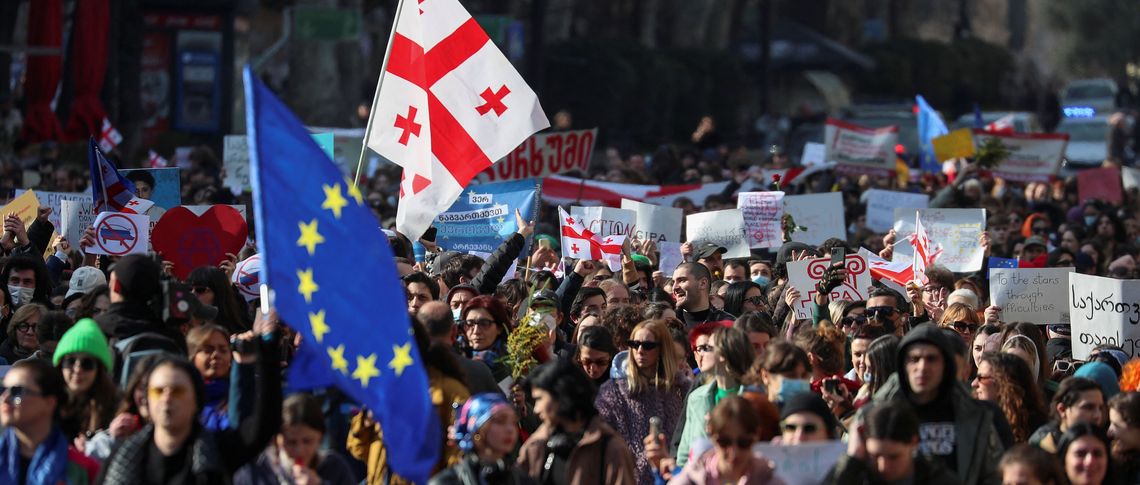
Since the early 1990s, Georgia has been striving for closer ties with the European Union, dreaming of obtaining candidate status and eventually becoming a member of the EU. For an ordinary Georgian citizen, it was and remains obvious that membership in the European Union is the only guarantee of a peaceful future for the country, its economic and social development, political stability, respect for citizens’ rights and the rule of law.
Unlike Ukraine and Moldova, throughout the 1990s and even the first half of the 2000s, the countries of the South Caucasus were not seen as European countries; they did not even have any theoretical prospects of joining the EU. The ‘European country’ question was partially resolved by Georgia’s membership in the Council of Europe, and this recognition of Georgia became undeniable after the signing of an Association Agreement. All these years, Georgia has been an active member of the Eastern Partnership, where it has always exhibited more ambitions than most participants, successfully implementing the Association Agreement, as well as initiating the ‘Association Trio’ co-operation format with Moldova and Ukraine — which share the ambition to join the EU. But when EU enlargement stalled in the Western Balkans, the viable chance of Georgia’s European prospect in the coming decades faded away.
Russia’s aggression against Ukraine created a new geopolitical reality that significantly increased the importance of EU enlargement. The previous soft policy of transforming the neighbourhood could no longer withstand the direct forceful pressure of Russia (and other authoritarian states) or arguments related to the threat of force. And thus, a European prospect for Ukraine, Moldova and Georgia became realistic once more. Ukraine and Moldova were granted EU candidate status in 2022, and Georgia was granted a ‘European perspective’. But why was Georgia given a lower status than the other two trio partners? The most obvious reason was the apparent setback in Georgia’s democratic development, especially the attempt to adopt the Hungarian-Russian vision of the Foreign Agents Act, the tolerance of radical anti-Western groups, the government’s reluctance to implement important reforms (especially in the justice sector) and the presence of informal oligarchic rule.
The Georgian government claimed to have fully implemented most of the recommendations, whereas the interim report published by the European Commission confirmed the implementation of only three of the 12 conditions.
To qualify for candidate status, Georgia had to improve its quality of democracy by fulfilling 12 political conditions, such as depolarisation, electoral reform and improving the efficiency of institutions, reform of the justice system, media freedom, protection of minority rights, gender equality, inclusion of civil society in the decision-making process, the election of a new ombudsman by way of a pluralistic compromise, as well as legal guarantees for the implementation of European Court of Human Rights (ECHR) judgments.
The Georgian government claimed to have fully implemented most of the recommendations, whereas the interim report published by the European Commission in June 2023 confirmed the implementation of only three of the 12 conditions. The remaining priorities were recognised as being at an initial, intermediate or advanced stage. Various independent sources representing civil society and expert circles were also close to the European Commission’s conclusions in their assessments.
It was precisely this circumstance that put into question whether the process would end positively for Georgia, which is why everyone in the country, from civil servants and politicians to civil society and active citizens, was overjoyed to receive the European Commission’s recommendation to grant Georgia candidate status. Indeed, the relatively ‘soft’ judgement by the EU has provoked many conflicting opinions. The government and the ruling political force claimed that the result was positive due to their efforts and hard work. In turn, civil society and political opposition parties felt that the judgement was due to the dedication of the Georgian people to the European path. Some experts say that the decision was purely geopolitical: the EU, which has suffered so much from the war in Ukraine starting in 2022 and is now facing a ‘second front’ in the Middle East, was in danger of widening its geopolitical gap with authoritarian powers. Under these circumstances, it became important to have as many friendly countries on its side as possible, and the prospect of enlargement could have a very direct impact on this.
There have been several decisions of the European Council and the Council of the EU throughout the history of the EU enlargement policy when they refused to grant a new status against the recommendation of the Commission.
On 8 November, the European Commission recommended that Georgia be granted EU candidate status ‘on condition that it takes the following steps’; the nine newly proposed steps mainly contain modified and more detailed requirements compared to the previous 12 priorities in parts that were not sufficiently fulfilled. At the same time, there are new conditions: fighting disinformation and anti-European propaganda, strengthening control in the security sector and the need for Georgia’s convergence with the foreign and security policy of the EU. The new priorities also focus on the electoral system and judicial reform, de-oligarchisation and apparent political depolarisation.
There have been several decisions of the European Council and the Council of the EU throughout the history of the EU enlargement policy when they refused to grant a new status against the recommendation of the Commission. These cases were rather exceptions related to certain bilateral disagreements between an EU Member State and an applicant/candidate country. Usually, each recommendation of the European Commission is the result of intensive consultations and exchanges with representatives of the Member States in their permanent representations in Brussels. Thus, it is likely that EU Member States will not object to granting candidate status to Georgia at the next European Council to be held on 15 December. Although, of course, Hungary’s recent announcement that it will block the entire enlargement package if the European Commission does not allocate billions in aid from the EU budget could jeopardise the whole process, including the decision on Georgia.
Nevertheless, even if the European Council responds favourably and grants Georgia candidate status, its future could be very murky. There is no certainty that the Georgian authorities will effectively implement the proposed steps in such a way that the Commission will recommend that the country start EU accession negotiations next year.