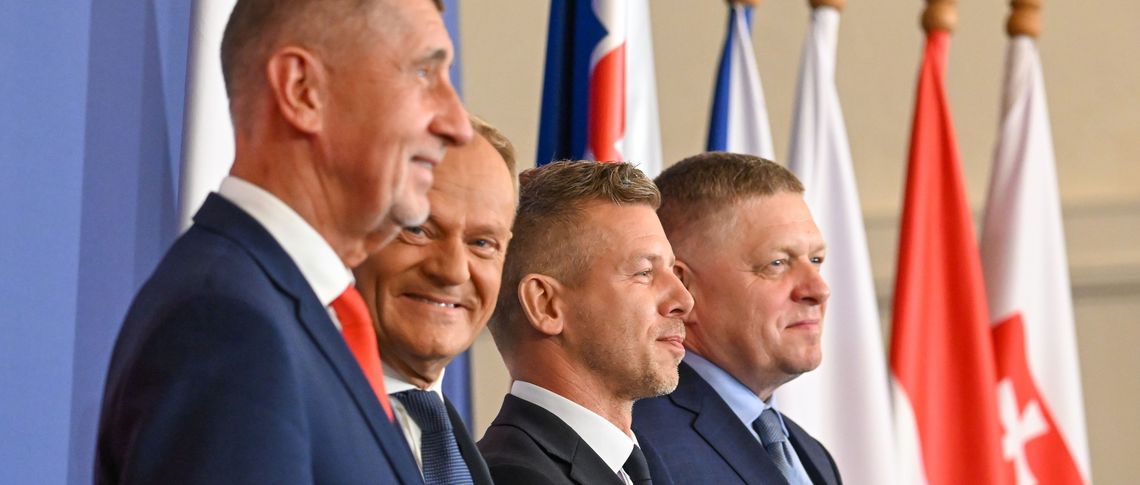
Of the many minilateral formats in Europe, the Visegrád Group (V4) has grown to be the most visible – and the most infamous – largely due to the European ambitions of the project and its political leaders. After a four-year hiatus in political-level cooperation, the group seems to be gaining a new lease of life. Once again, a Hungarian prime minister is at the forefront, attempting to lead the grouping. However, ‘Visegrád 2.0’ will differ from the format we knew before cooperation effectively froze in 2022 — both in the internal dynamics of the grouping and in the way it relates to the broader European context.
It was during the years in office of the previous Hungarian prime minister, Viktor Orbán, that the V4’s reputation reached its peak notoriety. Over the years, Orbán relied on his ideologically aligned Visegrád partners to lend legitimacy to his increasingly isolated European agenda. By portraying Central Europe as the sole bastion of true European values – untainted by Western decadence and liberalism – the V4 was turned into a symbol of programmatic opposition.
Hungary’s new prime minister, Péter Magyar, has prioritised a different approach to Central Europe and Visegrád cooperation. Even before the April elections, the Tisza party began building relations with Donald Tusk’s government in Poland. Mending relations between Budapest and Warsaw was seen as the sine qua non of robust regional cooperation, one that would not be derailed by profoundly different positions on Russia.
Magyar’s strategy for the V4 is to promote shared interests within the EU framework, rather than acting as a permanent opposition from the outside.
Tisza won the elections on promises to eradicate monstrous corruption, improve the general state of the country, and restore Hungary’s standing as a reliable ally within NATO and the EU. Magyar thus has no interest in fighting with Brussels. Firstly, because he urgently needs the release of EU funds. Secondly, despite his patriotic – or, to some observers, nationalist – streak, he genuinely seems to believe that active and constructive EU membership serves the Hungarian national interest, unlike the constant conflict staged by previous Fidesz governments. Magyar’s strategy for the V4 is therefore to promote shared interests within the EU framework, rather than acting as a permanent opposition from the outside.
Over the past decade, V4 cooperation has repeatedly defaulted to a ‘2+2’ format. For a few years, the Fidesz government in Hungary and the PiS government in Poland were the primary EU troublemakers, while Czechia and Slovakia seemed comparatively constructive, especially under Prime Ministers Fiala, Matovič and later Heger. After 2022, the group split over policies toward Russia and Ukraine, positioning Poland and Czechia against Slovakia and Hungary. Under the current post-election alignment, however, the division runs between a generally pro-EU camp (Hungary and Poland) and a Eurosceptic camp (Czechia and particularly Slovakia).
As the largest player in Central Europe with aspirations to shape major European policies, Poland has rarely afforded top priority to the Visegrád cooperation. After 2022, when Orbán’s willingness to maintain friendly ties with the Kremlin became entirely unacceptable, halting any meaningful political cooperation, Poland turned away from Central Europe. As security and defence rose in importance, Warsaw looked north, building connections with the Baltic and Scandinavian states, with whom it is much better strategically aligned. However, with Orbán out of the prime minister’s office, Poland may well accept Magyar’s invitation to reshape Central Europe, shedding the region’s reputation as a hotbed of troublemakers and Eurosceptics — a move that could further strengthen Poland’s leverage in Brussels.
How do Czechia and Slovakia fit into this picture?
Robert Fico, with his openly pro-Russian stances and attempts to water down the rule of law in Slovakia, is not a natural strategic partner for Poland, nor for the new Hungarian leadership. In the case of Hungary, mutual relations are further burdened by the unresolved historical issue of the Beneš decrees — though in the past, the V4 format allowed both countries to sideline such disputes. Andrej Babiš remains closer to the political mainstream than Fico, but he leads a coalition government that includes pro-Russian extremists and anti-EU provocateurs mimicking the MAGA movement. Furthermore, both Babiš’s ANO and his coalition partners, the Motorists for Themselves, belong to the Patriots for Europe group alongside Orbán’s Fidesz.
Fico and Babiš may view the V4 through the lens of wishful thinking, hoping for a return to the broad ideological kinship of the past, even despite the leaders belonging to different political families. Yet, even if Magyar agrees with them to an extent, both Hungary and Poland clearly view the V4 not as an ideological alliance, but as a platform for pragmatic cooperation that, however, does have limits. Prague and Bratislava thus cannot expect Warsaw and Budapest to support them in potential rule-of-law conflicts with the EU. Moreover, aligning too closely with Czechia or Slovakia amid ever-increasing tensions with Russia carries an indisputable reputational risk that neither Tusk nor Magyar can afford.
What are the areas then where the four countries can actually find common ground and cooperate effectively at the EU level?
The first and most significant area of shared interest is the negotiations on the European Union’s long-term budget, the Multiannual Financial Framework (MFF). All four countries agree on the absolute need to preserve cohesion and agricultural funds and to prevent excessive centralisation of their disbursement. The V4 is not alone in this; the ‘Friends of Cohesion’ group comprises 16 countries in total. The V4 coalition can also exert pressure on energy policy, where all four states advocate for balancing the green transition with industrial competitiveness, placing particular emphasis on revising the European Emissions Trading System (ETS) framework.
Rather than acting as a blocking entity driven by conflict with Brussels, the V4 is poised to become a pragmatic actor without seeking broader ideological or geopolitical alignment.
Migration also remains a key topic for the V4. Although the countries approach it from different angles based on domestic realities – including hosting high numbers of Ukrainian refugees, particularly in Poland and Czechia – all four remain united in rejecting mandatory relocation quotas or financial substitution requirements. Unlike a decade ago, the V4 is by no means isolated among the other member states in its criticism of the migration pact.
Finally, the V4 countries continue to support EU enlargement, emphasising a merit-based accession process. Crucially, this consensus applies primarily to the candidate countries of the Western Balkans. Public sentiment toward Ukraine’s accession remains tepid across all four nations, while the positions of their governments are cautious at best. However, while individual Visegrád countries may express doubts about Kyiv’s EU integration independently, it is highly unlikely that this issue will be formally coordinated at the V4 level, as it hinges on broader strategic considerations where the four capitals simply do not align.
In the future, Europe can indeed expect a Visegrád comeback. Rather than acting as a blocking entity driven by conflict with Brussels, the group is poised to become a pragmatic actor, promoting selected common interests in a more nuanced and constructive manner, without seeking broader ideological or geopolitical alignment. In this sense, the V4 could return to its original roots.
At this stage, however, a few key unknowns remain. In 2027, parliamentary elections will be held in Slovakia and, crucially, Poland, where a potential victory for PiS and other Eurosceptic forces could disrupt the current Polish-Hungarian relationship. In Czechia, the conflict-of-interest allegations surrounding the prime minister could escalate tensions with the EU, making close alignment with Prague unsavoury for Magyar and Tusk. Finally, once the war in Ukraine concludes and the European agenda shifts toward a broader security architecture and hard security guarantees, the V4 format will likely naturally recede into the background.