


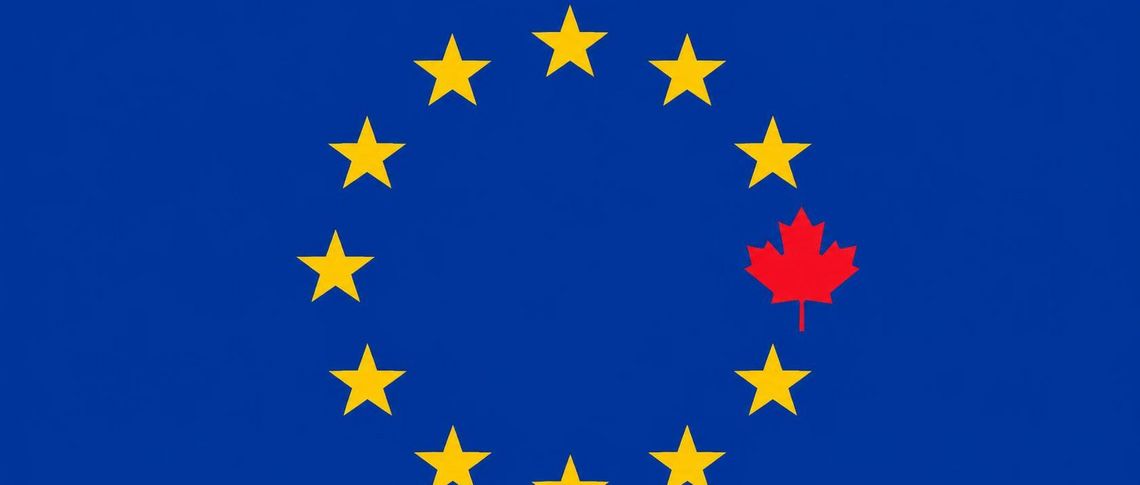
When Marta Kos, the Commissioner responsible for EU enlargement, recently proclaimed the ‘autumn of enlargement’, she was probably not thinking of Canada. Commission President Ursula von der Leyen’s proposal to admit Canada as an ‘associated member’ of the EU came as a major surprise to most observers of her State of the Union address. Yet this initiative raises a question that goes far beyond relations with Ottawa: what exactly should membership of the European Union mean in the future?
New forms of association can help the EU to work more closely with like-minded partners. However, problems arise when this leads to different classes of membership and countries such as Canada are granted extensive access to the EU, whilst long-standing accession candidates in the Western Balkans continue to wait for the promised accession — or are expected to settle for limited membership rights. New openness to the outside world must not undermine internal enlargement.
What about the accession candidates?
Reactions to von der Leyen’s proposal were, in any case, mixed. US President Trump ranted about a possible hostile act against his country and threatened further tariffs, and not everyone in Europe was enthusiastic about the idea either. Some EU Member States felt sidelined and would have preferred to discuss the Commission President’s offer in advance rather than being presented with a fait accompli. One of the few people in the know was, at least, Canadian Prime Minister Mark Carney, who, in his speech to the European Parliament in Strasbourg, preferred to speak of an ‘alliance for the future’ between the EU and Canada.
In any case, efforts will now be made to expand and deepen relations. Both sides will have the opportunity to discuss the details at their summit in Montreal at the end of October. On the economic front, the focus will be on fully implementing the CETA free trade agreement and intensifying economic cooperation, particularly in the areas of (critical) raw materials, energy, digital technology and financial services. The development of common standards for artificial intelligence is also on the agenda. Furthermore, Canada could participate in the Erasmus+ programme, strengthening scientific exchange across the Atlantic. In terms of foreign policy, the EU and Canada entered into a security and defence partnership last year, and Canada is the first non-European country to participate in the EU’s SAFE instrument, which promotes investment in the defence industry through joint procurement.
There is certainly nothing wrong with increased cooperation between the EU and democratic countries, and should the ‘Canadian model’ prove successful, further such alliances with other states cannot be ruled out.
This means that there is already intensive economic and political cooperation across the Atlantic on many levels. Shared fundamental democratic values and foreign policy positions also contribute to this, as does – undoubtedly – Mark Carney’s call for alliances of middle powers. These powers should not isolate themselves, but should work together to protect the international order and jointly strengthen their sovereignty in the face of the great powers. There is certainly nothing wrong with increased cooperation between the EU and democratic countries, and should the ‘Canadian model’ prove successful, further such alliances with other states cannot be ruled out. It could even lead to even deeper cooperation with neighbouring European countries that are part of the European Economic Area but do not seek EU membership, such as Norway or Iceland. In London, too, the specific details and implementation of the proposed ‘associated membership’ are likely to be closely monitored, with conclusions drawn from this regarding the UK’s relationship with the EU.
This points to an EU that, rather than simply distinguishing between members and non-members, will in future offer varying degrees of political and economic affiliation. Whilst this may make sense, it raises the question of where the accession candidates actually fit into this new order.
In need of a glimmer of hope
Close attention is also being paid to the EU candidate countries. Just a few months ago, Chancellor Friedrich Merz had already attempted to make ‘associated membership’ an attractive prospect for Ukraine, including security guarantees and further financial support. On the path to eventual full EU membership, Ukraine would assume an observer role within the European institutions but would not, for the time being, be allowed to participate in decision-making. In Kyiv, the German initiative met with little enthusiasm, and President Zelenskyy insisted on the agreed-upon EU accession negotiations. Such approaches are also viewed with some scepticism in other candidate countries. This is hardly surprising, given that in recent years ideas for gradual integration have been developed, concept and strategy papers on the subject published, and new formats launched, such as the European Political Community.
People in Podgorica, Skopje and Tirana have already been waiting far too long for their long-awaited accession to the EU. The fact that voting rights in the Council are now also to be restricted for new members is meeting with strong opposition in Montenegro, for example. However, ‘second-class membership’ – which might also mean foregoing their own EU Commissioner – is not in the interests of the candidate countries. Added to this are special rules, such as, in particular, clauses safeguarding the rule of law and the EU budget. The ‘Pre-Enlargement Policy Reviews’, long postponed by the European Commission and now announced for the end of September, will certainly address these and other points and are intended to set out how the EU intends to remain capable of enlargement. The last accession took place more than 13 years ago, and even a frontrunner such as Montenegro is unlikely to actually be able to join the EU until the end of the decade at the earliest — not to mention Ukraine and other candidates. The credibility of European enlargement and reform policy has been severely damaged and urgently needs a glimmer of hope.
In light of past experience, Kos argued, the EU must ensure it does not let any ‘Trojan horses’ in.
Before announcing the ‘autumn of enlargement’ referred to above, Enlargement Commissioner Kos had already outlined a few fundamental thoughts on the future of enlargement policy in a speech in Zagreb in August. Firstly, she emphasised that the interests of existing Member States must be protected vis-à-vis the new members and spoke of the EU’s experience with far-reaching transitional measures. Secondly, she supported internal reforms and referred to the ‘passerelle clauses’, which make it possible to replace unanimity with a qualified majority in certain areas. She could also envisage a downsizing of the EU institutions. Thirdly, Kos advocated stricter safeguards to prevent breaches of the rule of law and the Union’s fundamental values. In light of past experience, she argued, the EU must ensure it does not let any ‘Trojan horses’ in. Finally, she spoke in favour of the gradual integration of candidate countries on their path to membership. The Commission intends to publish details of how these elements will be implemented in the near future. However, the fact that Commission President von der Leyen, whilst announcing roadmaps for the most advanced candidates in her State of the Union address, made no reference to the ‘policy reviews’ or further-reaching reforms, suggests that no major breakthrough is to be expected.
Whatever specific proposals Brussels may put forward, they must not result in the path to EU membership becoming even longer for the current candidate countries than it already is. Every round of enlargement to date has led to the accession criteria being tightened further, making admission to the EU increasingly difficult. It is, of course, understandable that some would prefer to admit the democratic frontrunners and economic powerhouses – such as Iceland, Norway or Canada – into the EU. However, if this were to give rise to new forms of ‘associated’ or tiered membership, it must be clear what place they would occupy within the European order. Otherwise, greater flexibility risks turning into a hierarchy of membership.
Canada, in particular, illustrates this dilemma: closer cooperation with a democratically and economically strong partner is an obvious step and can be beneficial to both sides. Yet it would be difficult to justify if a country with no prospect of accession were to receive far-reaching benefits from a new form of membership, whilst countries in the Western Balkans, after years in the accession process, were offered only membership with restricted rights. As Mark Carney emphasised, isolation is not the solution, and greater cooperation is the order of the day. But this must also apply to the EU’s accession candidates, so that the autumn of enlargement is not followed by a winter of stagnation.


