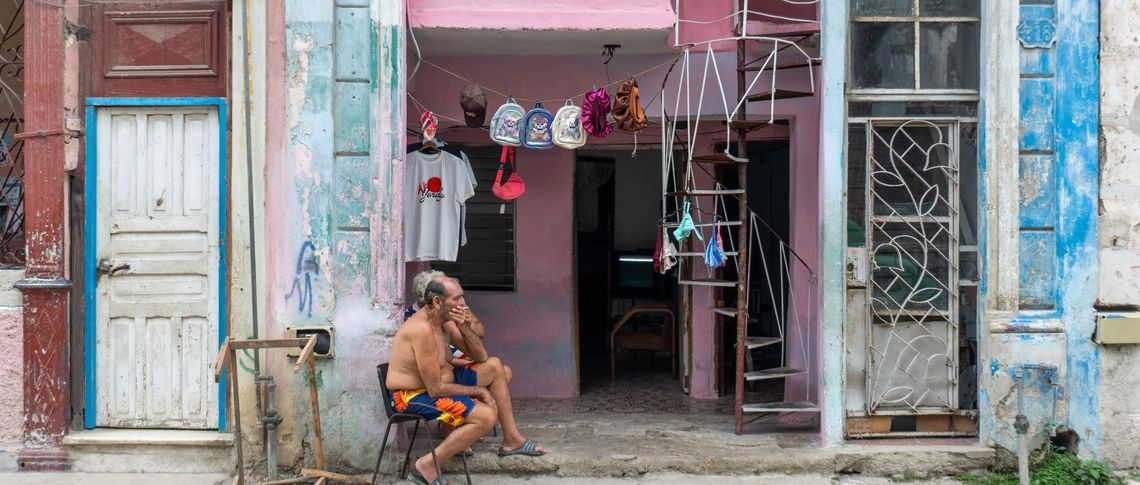
Ever since the Berlin Wall fell 37 years ago and the communist Eastern Bloc collapsed, Cuba has been debating economic reforms to its socialist system. Essentially, the discussion always revolves around the same issues: less state planning, more personal responsibility. In other words, a strong dose of capitalism as an antidote to inefficient and corrupt state bureaucracy.
Little has happened since then. Phases of liberalisation and opening up have been followed by phases of tightening and control. Time and again, hardliners within the party, the military and the bureaucracy have put the brakes on. The reason — the reforms fuelled inequality and resentment towards the newly wealthy privileged class. Underlying this was, above all, the fear of losing power and control, and of infiltration by the class enemy, or, in the Cuban interpretation, US imperialism.
Throwing money down a bottomless pit
Suddenly, things moved very quickly. Last week, the parliament – which had been convened in haste and with a rather incomplete quorum, as many MPs were unable to travel to Havana due to the petrol shortage – passed a 176-point reform programme which observers have described as ‘historic’ given its far-reaching implications. In the process, some of the ‘sacred cows’ of the socialist state economy are being brought down. For instance, there will be no more blanket subsidies in the future, instead, support will be targeted solely at the socially disadvantaged. This spells the end of the ‘Libreta’, the state food ration card that has granted the population access to virtually free food and hygiene products for over half a century, even though, in the face of the economic crisis, it had recently become little more than a piece of waste paper.
The second taboo to be broken is decentralisation. From now on, state-owned enterprises and provinces are to be less dependent on the central government in Havana and will be allowed to make their own decisions on staffing and wages. The absurd extremes to which this centralisation had led were captured by directors Juan Carlos Tabio and Tomás Gutiérrez Alea in their 1995 classic Guantanamera, in which a corpse had to be transported from Santiago de Cuba to Havana for burial – that is, all the way across the island, in a battle against bureaucracy.
Cuban exiles are permitted to invest directly on the island.
Private companies are finally to be permitted to operate in the agricultural sector; until now, only cooperatives had been authorised. Agriculture on the Caribbean island, once renowned for its sugar production, is now almost completely in ruins: millions of hectares of arable land lie fallow due to a lack of machinery, fertilisers, technology and labour. Cuba imports the majority of its food. Much of this comes from China, Turkey or Arab countries, but also from the neighbouring US – despite the embargoes. Private investment is now also permitted in the energy sector. The reforms will also allow individuals to own more than one private company in the future.
However, the liberalisation also targets trade, foreign investment and integration into the global economy. For example, private banks and financial institutions are to be authorised to operate in the microcredit sector. Numerous restrictions on foreign exchange transactions are being lifted. Consequently, businesses and private individuals may now open and operate foreign exchange accounts without prior authorisation. Foreign firms are permitted to select their own staff and are no longer required to go through state employment agencies. Furthermore, they are no longer obliged to enter into joint venture agreements with the state. Cuban exiles are permitted to invest directly on the island. This is intended to attract foreign investors and fresh capital.
Months ago, US Secretary of State Marco Rubio had already stated that political reforms and a change in the leadership were needed – but Havana categorically rejects this.
Almost all of these reforms have been under discussion for years. Even Vietnam and China have repeatedly urged the Cuban leadership to move in this direction, because, despite their historical ties, geopolitical interests and ideological affinities, they were tired of throwing money down a bottomless pit. Fifteen years ago, whilst the island was still receiving oil in abundance from its brother nation Venezuela and the then US President Barack Obama was reaching out to the island, the circumstances would have been ideal for such a transformation.
Now, beneath the sword of Damocles of the oil embargo and the threat of US intervention, it is actually already too late: the coffers are empty, legitimacy among the population has been squandered, and the reforms can only take effect if the US plays its part, lifts its sanctions against Cuba and supports the country’s integration into the global economy. However, that is out of the question at present. The US government holds the upper hand geopolitically and wants more. Months ago, US Secretary of State Marco Rubio had already stated that political reforms and a change in the leadership were needed – but Havana categorically rejects this.
The potential of democratisation
The Speaker of the Cuban Parliament, José Luis Toledo, made it clear when the package was passed that ‘the reforms do not mean abandoning the state’s social role’. Washington’s reaction was correspondingly cool: the US State Department described the economic reforms as modest, too late and ‘superficial smoke signals’. This is a typical strategy to create the illusion of change, only to quickly reverse the reforms as soon as the regime’s control is threatened.
The strategies of either side are clear. Cuba is playing for time and hoping that Trump will lose the mid-term elections in the autumn, thereby losing his interest in Cuba and the backing for his stranglehold tactics. Washington will probably let Havana continue to squirm for the time being and wait to see whether words are followed by deeds – and how quickly. Meanwhile, political pressure is likely to continue to mount during the secret talks. Military intervention is not yet off the table either. This game of poker is ultimately about one thing: who dictates the terms for Cuba’s transformation.
The EU has, in fact, sidelined itself when it comes to Cuba.
So far, the Cuban people have had little say in the matter. Although protests against power cuts, water shortages and food shortages are a daily occurrence, they are swiftly and brutally suppressed. Unlike in Venezuela, there is no organised opposition on the island with charismatic leaders, a clearly defined political programme and broad support. This currently plays into the hands of the ruling elite. But this need not remain the case in the long term, especially if the reforms take hold and more and more people become independent of the state.
Transition processes in Eastern Europe have shown that civil society actors (and, unfortunately, organised crime too) know how to capitalise on the turmoil of such periods of upheaval. However, this could lead to all sorts of outcomes: permanent instability, a mafia-style oligarchic regime, or democratic structures. For the latter to emerge, however, the process – and above all the regime in Havana – would require discreet international support; at present, this seems conceivable only through countries such as Mexico and Brazil, with the backing of the UN or the Vatican.
Neither Latin America as a whole nor the EU currently has any relevant supranational structures with appropriate leaders. Quite the contrary. The EU has, in fact, sidelined itself when it comes to Cuba. Firstly, Trump’s sanctions forced most European companies to abandon their investments in and business dealings with Cuba, without Brussels doing anything to oppose this. And a few days ago, the European Parliament – with a majority of right-wing and conservative MEPs – called for sanctions against Cuba’s President Miguel Díaz-Canel and for an end to cooperation with Cuba – in other words, entirely in line with Trump’s thinking and spirit, without so much as a hint of independent ideas to defend European interests. Another small step towards geopolitical and geo-economic irrelevance.