


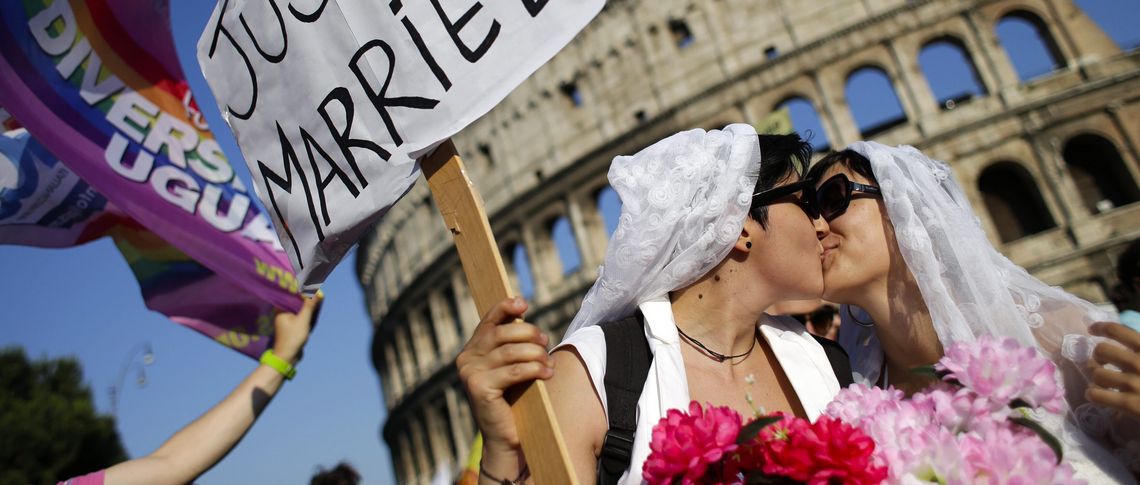
Ten years after the introduction of civil unions, Italy remains the only major country in Western Europe without same-sex marriage. While the rest of the continent has long moved on – from the Netherlands in 2001 to Greece and Estonia in 2024 – Italy has remained stuck.
The failure to legalise same-sex marriage is no longer simply a question of LGBTQIA+ rights. It has become a symbol of a broader political and democratic stagnation in which Italian institutions increasingly lag behind society itself. While public opinion has moved decisively in favour of marriage equality, much of the country’s political class remains trapped between ideological conservatism, coalition calculations and institutional inertia.
Thirty years of hesitation
The journey towards recognising LGBTQIA+ rights in Italy has been slow and conflict-ridden. It took 30 years of legislative proposals, beginning with a bill introduced in 1986 by Communist MPs Alma Agata Cappiello, Ersilia Salvato and Romana Bianchi, and a government crisis to arrive at a law recognising same-sex civil unions.
The legalisation of same-sex civil unions in 2016 marked a significant step forward for LGBTQIA+ rights in Italy. Yet civil unions still differ from marriage in important ways, especially regarding adoption rights, which remain explicitly denied to same-sex couples. Marriage also carries greater social legitimacy and easier international recognition.
By the time the Renzi government managed to pass civil unions legislation in 2016, amid considerable controversy, nine EU countries had already legalised same-sex marriage, and seven more would follow in the next decade. Italy thus arrived at civil unions well past the deadline, while the rest of Western Europe had long moved on.
The delay on same-sex marriage cannot simply be reduced to Catholic culture or the idea that Italians are inherently more conservative than other Europeans.
Unsurprisingly, today, Italy ranks near the bottom of Western Europe on LGBTIQ+ equality: in ILGA-Europe’s 2026 Rainbow Map, which monitors 49 countries across the continent, Italy placed 36th with a score of just 24.11 per cent, less than half the EU average of 52.10 per cent and well below the broader European average of 42.73 per cent.
This stagnation is all the more striking when set against Italy’s earlier record on civil rights. During the 1970s, Italy was broadly aligned with the rest of Western Europe in expanding individual freedoms through divorce and abortion legislation.
Divorce was legalised in 1970 through the Fortuna-Baslini law, thanks to a broad parliamentary coalition that united liberals, socialists, republicans and communists against the opposition of the Christian Democrats and the neo-fascist Italian Social Movement. When conservatives later attempted to repeal the law through a referendum, Italians overwhelmingly voted to keep divorce legal. A similar pattern emerged with abortion. Italy legalised abortion in 1978, only a few years after France and West Germany, and ahead of countries such as the Netherlands, Spain and Belgium. Once again, attempts to overturn the law through a referendum failed decisively.
The delay on same-sex marriage thus cannot simply be reduced to Catholic culture or the idea that Italians are inherently more conservative than other Europeans. Italy was not historically disconnected from broader European trends on civil rights. But what distinguishes the country today is rather the growing inability of its political system to translate social change into institutional reform.
A widening gap between politics and society
Recent data from Eurispes shows that support for same-sex marriage in Italy has grown steadily over the past decade, rising from 47.8 per cent in 2016 to 66.8 per cent in 2025 — a near 20-point increase in less than 10 years. Italian politicians, however, have never made the protection of LGBTQIA+ rights a priority.
From the ‘better fascist than faggot’ shouted on live television by MP Alessandra Mussolini to the current government’s crackdown against the recognition of children of same-sex couples, right-wing parties have weaponised anti-LGBTQIA+ rhetoric as part of their identity propaganda. Since taking office, Meloni and her allies have intensified their confrontation with the LGBTQIA+ community, opening a new front on surrogacy, better known by the derogatory term ‘womb for rent’. Even though heterosexual couples made up 90 per cent of the Italians resorting to surrogacy abroad, the government has openly linked the practice to same-sex couples. Conservative newspapers and several TV pundits helped amplify this misleading narrative as part of a broader culture war.
Most recently, this playbook has found a new vehicle in Futuro Nazionale, the far-right party launched by former General Roberto Vannacci in February 2026. At the party’s founding congress in Rome last weekend, speakers denounced what they called the ‘LGBTQ dictatorship’ — the latest in a string of slurs Vannacci has been mainstreaming since his 2023 bestseller Il mondo al contrario, in which he told gay people they were ‘not normal’, attributed their visibility to an international ‘gay lobby’ and argued that gay couples do not constitute a family.
Even broad social consensus can fail to translate into institutional reform when political stability takes precedence over civil rights.
The fault, however, cannot solely be attributed to right-wing politics either. Left-wing parties have often prioritised other issues themselves. In 2007, the second Prodi cabinet shelved the DICO bill – a proposed civil partnership framework open to same-sex couples – in the face of fierce opposition from the Catholic wing of his own coalition and a 200 000-strong rally in Rome organised by the Bishops’ Conference, which even drew two of Prodi’s own ministers to the stage. A similar pattern emerged in 2021 with the defeat of a bill which would have strengthened protections against discrimination based on sex, gender, sexual orientation, gender identity and disability. While right-wing parties did lead the campaign against the law, the centre-left Democratic Party ultimately chose not to escalate the confrontation in order to preserve Mario Draghi’s broad coalition government.
This shows how even broad social consensus can fail to translate into institutional reform when political stability takes precedence over civil rights. The episode also exposed the limits of Italy’s progressive parties, which have often defended LGBTQIA+ rights rhetorically while avoiding political risks when decisive moments arrived.
The 2022 general election offered another telling snapshot of where Italian politics stands on equality. Only two of the four main coalitions, the PD-led centre-left alliance and the M5S list, included same-sex marriage in their manifestos. Both the centre-right and the centrist Third Pole, which styled itself as a liberal reformist force, made no mention of LGBTQIA+ rights.
As Italy marks 10 years since the introduction of civil unions, the debate over same-sex marriage is no longer only about values. The real issue is that Italy’s political system continues to lag behind on issues where society has already moved on. And a political system incapable of translating broad social consensus into institutional reform ultimately risks turning democratic stagnation into a permanent condition.


