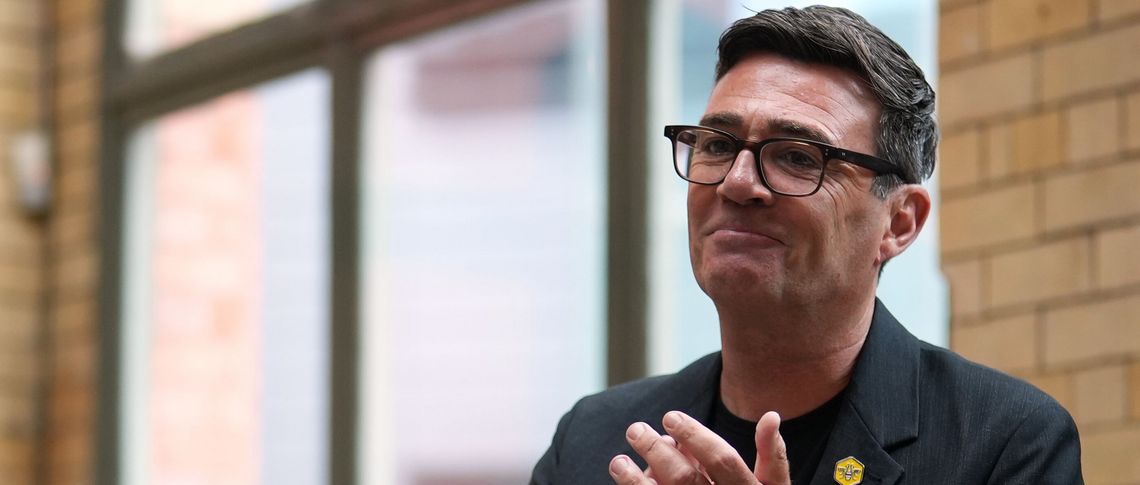
Barring a last-minute entry into the race to replace Keir Starmer as Leader of the Labour Party, and Prime Minister of Great Britain, Andy Burnham looks set to become the next British PM. If no other candidates come forward and secure 20 per cent of the Parliamentary Labour Party by the time nominations close on 15 July, then this will be a fact. And what might an Andy Burnham-led government mean for the direction of the UK? Can he turn around Labour’s dire performance in the opinion polls?
The peculiar nature of Burnham’s ascent to power, not through a general election or an internal contest, means he is not required to set out policies ahead of becoming PM. His authority as Prime Minister depends on his ability to command a majority of members of parliament which he will have no trouble doing, at least initially, as Labour has 403 MPs out of 650 in the House of Commons.
At the centre of his pitch to the nation is a rebalancing of the UK so that the regions and nations outside of London and the south east play a bigger economic and political role.
What Burnham has sought to do is set out the broad vision and direction he would take as Prime Minister. Last Monday, he chose his political base and home of Manchester, where he has given up the Mayoralty to return to parliament, to deliver his first substantive speech and paint the first brush strokes of his vision for Britain. At the centre of his pitch to the nation is a rebalancing of the UK so that the regions and nations outside of London and the south east play a bigger economic and political role. He symbolised this with a promise to create a ‘Number 10 North’ in Manchester, to shift the epicentre of political power away from being solely focussed on Westminster.
Many questions of detail remain, which he sought to avoid taking on the day, much to the assembled media’s displeasure. Especially considering that, communicating a clear vision for the country is a significant part of what Keir Starmer was criticised for not doing. Still, starting with an outline vision of a more geographically equal country where each region plays its part has been widely welcomed by the party.
Replicating Manchester
Andy Burnham’s politics have been forged in the experience of leaving Westminster where he had served as Health Secretary and in the Treasury under the last Labour government, and becoming Mayor of Greater Manchester. The Mayors are a relatively new political development for the centralised UK, lacking devolved powers but with considerable convening ability to drive place-based strategies. In his speech, Burnham said he will be bringing the pragmatic approach to No.10. In Manchester, he has worked closely with public and private sectors to drive the fastest economic growth of any city region in the UK, created a new qualification to improve the skills of young people, and made housing a priority. All received a reference in his speech on national politics, with policy commitments to ‘the biggest council housing building programme since the postwar period,’ a promise to give every young person ‘a clear path into a reindustrialised Great Britain,’ and expecting companies to create more opportunities for young people through work placements and apprenticeships.
A large part of Burnham’s success in Manchester has been the move to put local buses under public control to create the popular ‘Bee Network’, named after the city’s symbol which derives from its industrial history. He has pledged to apply this approach to the essential services of water, housing, energy and transport to make them more affordable, although ‘greater public control’ is yet to be defined. However, he has also vowed to maintain the current fiscal rules that the Labour government has adopted. It is also not clear whether greater control means public ownership of some of those services that come with a significant price tag. The appointment of Chancellor of the Exchequer in a Burnham government will be critical to shaping the destination of the public finances and to fulfilling his ambitions. While speculation is intense, no announcement has been made.
What they tell us is that Andy Burnham cannot be easily pigeonholed into one Labour faction or another.
Burnham, perhaps wisely, has steered clear of media questions about every policy area. Yet it leaves major areas of ambiguity. Labour’s immigration reforms have been controversial with the party and the progressive wing of Labour’s support; however he has kept his counsel on them since becoming de-facto PM-in-waiting. He has previously expressed his support for Britain one day rejoining the European Union, but played down speculation about this in recent weeks, suggesting he does not want to re-run Brexit arguments. It may be that Burnham decides to make further interventions on these questions before he becomes PM. But if not, observers are left looking to his record in Manchester for clues as to which way he will go. What they tell us is that Andy Burnham cannot be easily pigeonholed into one Labour faction or another. His public interventions during Keir Starmer’s premiership have been to the left of the leadership, such as his calling for the end to the two-child limit on welfare payments before it was abolished. But this could also be read as reflecting the relative freedom that comes with speaking your mind as a regional mayor, compared to being a member of the government bound by collective responsibility.
Speaking his mind is something Andy Burnham has been given a lot of credit for. He’s mastered the use of talking directly to voters, whether in person or via social media, and his plain speaking is part of what attracts people to him. But big questions remain. Crucially, how he will judge the major political questions of the day when it comes to the public finances, like how to fund increased defence spending. His place-based economic strategies have worked in Manchester but the economic geography of England, Scotland and Wales is so uneven, that he will need a strong national economic growth strategy too.
People like Andy Burnham because he is different to other politicians. He will need to maintain that strong authenticity when he shuts the door of No.10. He will have to talk a different political language to inspire the country to mobilise behind his government. The charge that he didn’t win a mandate at a general election may put him under pressure to go to the country sooner than his parliamentary backers would wish. Labour has rolled the dice, and it remains to be seen where this ends. But after Monday’s speech, many in and around Labour felt something they had not for some time: hope. Hope that things might get better if there is sufficient imagination and leadership to reconnect with the country and deliver the change that Labour promised.