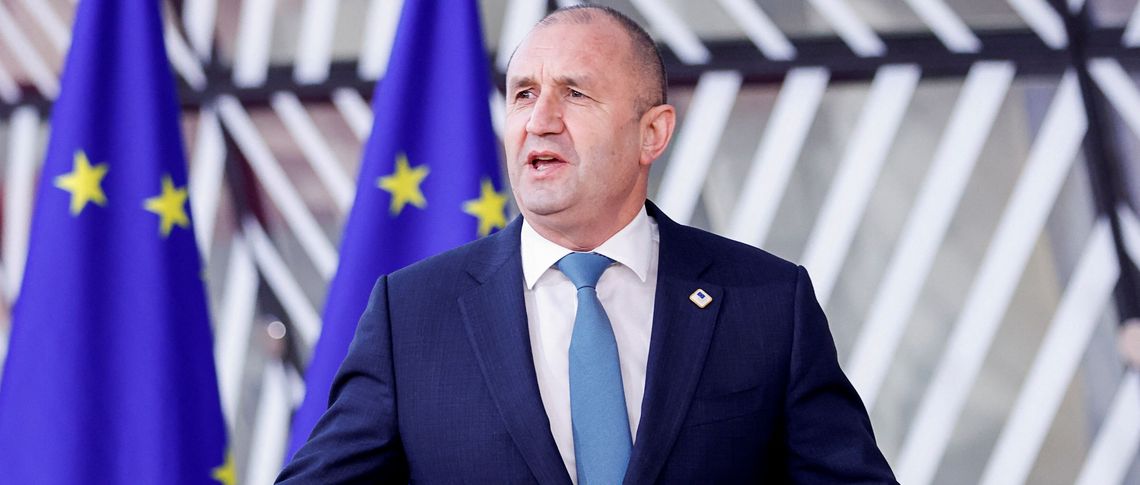
The so-called centre-left alliance led by former head of state Rumen Radev has won the parliamentary election by a clear margin. Is the result primarily a vote for him, or rather against the existing political system?
Ultimately, the result is both. Radev has been the country’s most popular politician for years and was able to mobilise many voters through his personal profile and clear message. At the same time, however, the election result is also an expression of deep frustration with the political system as a whole.
Since 2021, Bulgaria has been caught in a veritable electoral spiral: eight snap parliamentary elections, unstable coalitions and caretaker governments have severely shaken confidence in politics. The main triggers were major corruption scandals following over a decade of conservative government.
Added to this is the fact that the largest anti-government protests in decades took place as recently as December 2025. These were directed not only against corruption, but also against rising living costs and economic uncertainty. Radev succeeded in channelling this discontent into a political force. With a clear anti-corruption narrative and the promise to overcome the political deadlock, his alliance ultimately even secured an absolute majority — a result not seen in Bulgaria for almost 30 years.
For years, Bulgaria has been regarded as particularly prone to corruption; some even speak of a ‘hijacked judiciary’. How realistic is it that Radev can actually bring about change?
In purely mathematical terms, the conditions are better than ever before. Fundamental judicial reform in Bulgaria requires a two-thirds majority in parliament. Radev could achieve this together with other parties, in particular the right-wing liberal alliance ‘We Continue the Change – Democratic Bulgaria’ and other stakeholders.
In terms of substance, the issue has been on the agenda for years. The liberal reformist forces in particular have repeatedly attempted to push through changes, but have failed due to resistance from established parties such as GERB and DPS, which are deeply entrenched in state structures and at the local level. These two parties are regarded by many as the central pillars of the so-called ‘corruption model’ in Bulgaria.
At the same time, one must not underestimate the structural hurdles. Radev’s alliance is still very young politically and brings together very different actors with sometimes conflicting interests. There is currently a lack of stable structures, particularly at the local level, where corruption is often firmly entrenched. It therefore remains to be seen whether fundamental change will actually succeed. A realistic scenario is also that existing corrupt practices will simply shift in favour of new actors.
Because of his perceived closeness to Russia, Radev is already being dubbed the ‘new Orbán’. Is Bulgaria on the verge of a shift in foreign policy, or are these concerns overblown?
During the election campaign, Radev did indeed take positions that set him apart from many of his European counterparts. For instance, he advocates for resuming dialogue with Russia, particularly in the energy sector, and he questions key EU policies such as the Green Deal. He is also critical of sanctions.
Following the election, he emphasised that he seeks ‘pragmatic and respectful’ relations with Moscow and considers cooperation between the EU and Russia to be fundamentally necessary. At the same time, however, he does not question Bulgaria’s EU and NATO membership. Labelling him the ‘new Orbán’ thus falls short. Structurally, Radev is taking office with a clear anti-corruption mandate and is therefore more comparable to new political challengers such as Péter Magyar in Hungary.
This interview was conducted by Nikolaos Gavalakis.