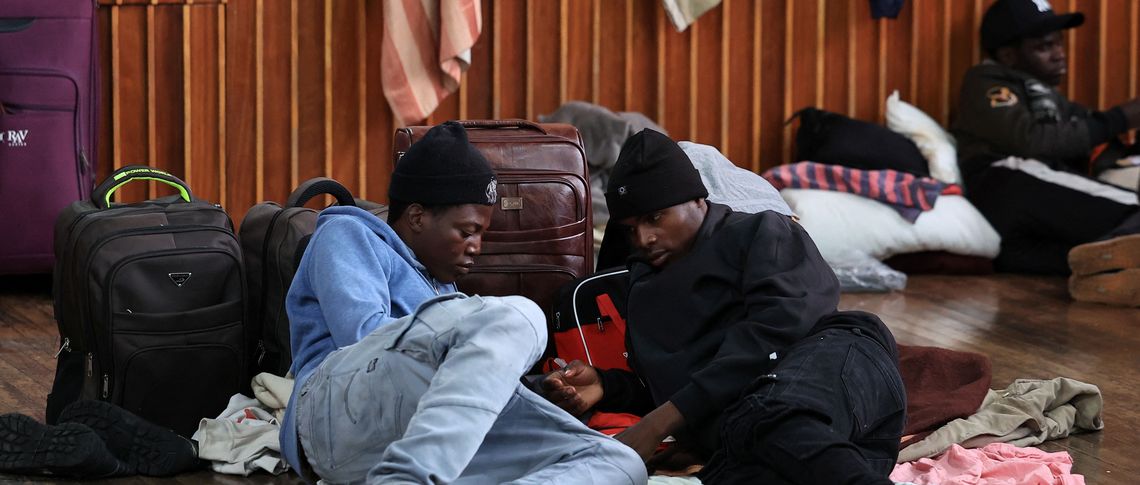
As the Ethiopian Airlines Boeing 787-9 Dreamliner touched down at Kotoka International Airport in Accra on Wednesday, 27 May 2026, loud cheers erupted from passengers on board. They were among the first of Ghanaian immigrants evacuated from South Africa, where a surge in anti-immigrant protests and mob violence has once again thrust the country into global headlines. Their return was more than an evacuation: it symbolised yet another chapter in the country’s long and unresolved struggle with anti-African violence, a structural form of Afrophobia whose persistence threatens both continental integration and the ideals of Pan-African solidarity.
The protests began in late April and have intensified throughout May across multiple locations. They are driven by emotionally charged, divisive narratives promoted by anti-immigrant groups who have harnessed the anger and frustration of ordinary South Africans, blaming foreigners for taking jobs, causing a drug epidemic in townships and burdening social services.
Most concerning, however, is how their dangerous rhetoric, combined with direct action involving vigilante-style door-to-door sweeps to identify undocumented immigrants, has proved brutally effective in disrupting immigrants’ lives and creating widespread insecurity. African nationals, including those on life-saving anti-retroviral treatment, have been dragged out of hospitals while attacks on maternity clinics in Gauteng have denied pregnant foreign women essential care. In KwaZulu-Natal, school children have been forced to stay home. Now, with anti-immigrant groups issuing a June 30 deadline for mass deportations, fears are mounting of a repeat of the 2008 pogroms.
Tragic as these developments are, none of them are new. Since the collapse of Apartheid in 1994, South Africa has repeatedly convulsed with waves of anti-immigrant sentiment and violence. There have been 1 295 violent incidents targeting migrants between 1994 and December 2025, resulting in the killing of 696 people and the displacement of almost 129 000 others. With few minor exceptions, the targets have remained the same: African nationals from neighbouring countries like Lesotho, Mozambique and Zimbabwe, as well as others from further afield such as Ghana and Nigeria. This is why the language commonly used to describe these attacks deserves closer scrutiny.
Afro-phobia, not xenophobia
The term xenophobia has become the accepted label for South Africa’s recurring violence against migrants. Yet xenophobia, strictly speaking, implies hostility towards foreigners in general. What persists in South Africa is better described as Afro-phobia, a targeted prejudice against people of African descent. The distinction is important in a country which originated as a settler colony and where Black identity has long been negotiated against economically dominant White Afrikaners.
The term also highlights parallel dynamics across the continent, where migration continues to provoke local tensions despite the African Union’s (AU) aspirations for free movement and integration. Indeed, several African states, including Ghana, Nigeria, Chad, and Tanzania, have themselves also conducted mass deportations of African migrants during periods of economic hardship or political uncertainty.
Yet, it is only in South Africa that Afrophobia has acquired such a repetitive, mass and intensely destructive force with elements of mob actions and vigilantism. This uniqueness stems from the country’s peculiar socio-economic context and enduring legacy of Apartheid. While democratic reforms dismantled legal segregation decades ago, the structural legacy of apartheid continues to shape South Africa’s economy, making it one of the most unequal societies in the world. White South Africans, who make up roughly seven per cent of the population, continue to control disproportionate shares of corporate wealth, land and capital. Meanwhile, Black South Africans face persistently high unemployment and limited opportunities.
The response of the South African government to the grotesque violence has been marked by shocking disconnects between presidential rhetoric and inadequate on-the-ground enforcement.
Although post-apartheid corrective policies such as Broad-Based Black Economic Empowerment and an extensive social grant system have helped raise a Black middle class and layer of elites, they have not fundamentally altered the structure of economic power where race and economic power remain closely intertwined. Little wonder then that anti-immigrant sentiment and accusations that foreigners are taking jobs are widespread in low-income townships where the majority of Black South Africans still find themselves decades later.
Despite the plurality of narratives, blaming immigrants for South Africa’s social crisis is disingenuous. At about three million, immigrants account for less than five per cent of South Africa’s total population of 62 million. Moreover, two recent studies revealed that ‘just four per cent [of the working population] could be classed as international migrants’. And while international migrants often record lower unemployment rates than other groups, this is not because they are ‘taking jobs’ from South Africans but rather because they are more likely to accept precarious, informal and poorly paid work without benefits or formal contracts.
Evidence also challenges another common accusation that migrants dominate local commerce and crowd out South African entrepreneurs. In fact, fewer than two in 10 informal business owners were cross-border migrants, and migrant-owned businesses contribute significantly to local economic activity.
Sadly, the response of the South African government to the grotesque violence has been marked by shocking disconnects between presidential rhetoric and inadequate on-the-ground enforcement. At the same time, public statements by some government ministers have done little to calm tensions, while some have even appeared to endorse the violence. This weak and ambivalent response has severely strained South Africa’s relations with its neighbours, resulting in several African ambassadors and high commissioners boycotting ‘Africa Day’ events in South Africa in protest. It has also provoked palpable disbelief across Africa that a country whose black majority’s struggle against apartheid attracted Pan-Africanist and global solidarity has now come to be associated with anti-immigrant attacks directed against fellow Africans.
A continental approach for action
Understandably, many African states wish to seek remedy for the violence their citizens have suffered. Calls for retaliatory measures are surging across the region. This has raised fear of potential attacks on South African business interests abroad.
As counterintuitive as it may sound, it is worth stressing that enacting retaliatory measures without exploring alternative remedial channels will only deepen the crisis while threatening to undermine the broader goal of continental unity. Despite the growing populist violence, only a third of South Africa’s adult population harbours extremely negative views of international migrants and far fewer endorse the ongoing violence. Therefore, extreme retaliatory measures, apart from having the tendency to punish a whole population for the actions of a minority, might boomerang and push the majority into the arms of the rabble-rousers.
This is a chance the African Union cannot miss to prove it is not the toothless bulldog that many on the continent consider it to be.
Under the governing principles of the African Union, member states bear a responsibility to protect individuals within their jurisdiction from all discrimination and harm, whether by state or non-state actors. Mass deportation also constitutes a grave violation of Article 12 (5) of the African Charter on Human and Peoples’ Rights. Therefore, any violation by member states can be remedied within the mandate of either the AU’s Peace and Security Council or the African Commission on Human and Peoples’ Rights, with appropriate sanctions meted out to the erring states alongside necessary reparations for damages.
States like Ghana have already taken the lead. Earlier in May, Accra formally petitioned the AU, calling on the organisation to strengthen its mechanisms for monitoring member states’ obligations under the Constitutive Act and the Charter on Human and Peoples’ Rights, establish a fact-finding mission to investigate the root causes of the violence, and facilitate dialogue and reconciliation initiatives. So far, the AU has not issued a formal response, nor has it launched a formal probe as requested. Instead, the continental body has scheduled the issue for formal debate on the agenda of the Eighth Mid-Year Coordination Meeting taking place on 27 June.
But it goes without saying that this is a chance the African Union cannot miss to prove it is not the toothless bulldog that many on the continent consider it to be.