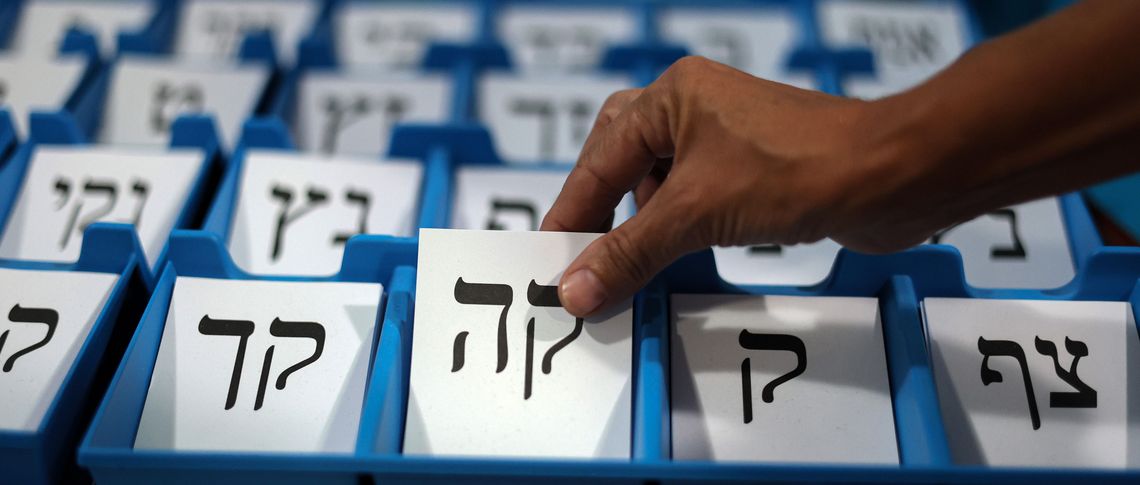
One of the most revealing controversies in the Israeli election campaign did not take place in a television studio or at an election rally. Instead, it centred on aeroplane seats. Since Israeli citizens are generally unable to vote by post, the Fly&Vote initiative organised six scheduled flights to fly Israelis living abroad back to their homeland to cast their votes. The right-wing Likud party opposed the initiative before the Central Elections Committee. The dispute ended in a compromise. According to the organisers, around 53 000 Israelis planned to fly in to vote. Democracy, it seems, may in some circumstances require a plane ticket.
Some are spending four-figure sums in dollars, rearranging their work schedules and crossing entire continents, just to put a ballot paper in an envelope. Many Israelis who have left the country in recent years are young, well-educated and secular, and thus belong to those sections of Israeli society that tend to be most opposed to Netanyahu and his government. The fact that they are determined to fly back to Israel for a short stay says a great deal about what this election is all about: liberal-minded and centrist Israelis view it less as a routine political contest and more as an acute emergency.
Israel is not moving to the left
Consequently, a very high turnout is expected in Israel on 27 October. Among the liberal, secular and centre-left camps, there is a very strong sense that every vote counts in this election. There are also signs of unusually high voter engagement amongst the Arab population, which makes up around 21 per cent of Israel’s population, particularly amongst younger eligible voters. Many feel that this time it is not merely another election, but a chance to stop something before it becomes permanently entrenched.
And therein lies the paradox. Voter mobilisation can shift the balance of power, but it cannot reverse demographic realities. Even if the liberal camp fills aeroplanes, polling stations and voting booths – and perhaps even succeeds in ousting Netanyahu – this does not necessarily mean that Israel is moving to the left, or even back towards the political centre.
Around 640 000 Israelis aged between 18 and 22 are eligible to vote in a Knesset election for the first time.
The figures speak for themselves: polls conducted in the final weeks of the election campaign do not paint a clear picture of which political camp is in the lead. On one point, however, everyone agrees: neither Benjamin Netanyahu nor his opponents appear set to secure a clear majority of 61 seats. Gadi Eisenkot’s centrist party, Yashar, has repeatedly challenged Likud for the title of strongest party and was even ahead at times.
However, Netanyahu’s opponents do not constitute a political camp in the strict sense of the term, but rather an electoral construct. They range from left-wing democrats, via Gadi Eisenkot, to Naftali Bennett and Avigdor Liberman on the political right. It is possible that no alternative government will be able to survive without the votes of the Arab parties. Were Netanyahu to lose, therefore, this would not necessarily mean that Israel has shifted to the left politically. The country has become more conservative and religious, and is more preoccupied with itself than before.
Around 640 000 Israelis aged between 18 and 22 are eligible to vote in a Knesset election for the first time. The significant proportion of religious and ultra-Orthodox Israelis amongst them reflects a general demographic trend. First-time voters are more likely to support Netanyahu’s camp and tend to be more conservative and more religious.
Who will take political responsibility?
Netanyahu’s core electorate may now be showing less enthusiasm than in previous election campaigns. However, that does not mean it has disappeared from the scene. Israeli society is exhausted. Three years after 7 October, the trauma still has a profound impact on everyday life. Israelis have endured massacres, war, endless reservist deployments, evacuations, funerals, rocket and drone attacks from up to seven fronts, and long periods spent in air-raid shelters and safe houses. Many Israelis feel completely alone in the world and deeply misunderstood by the West.
This state of mind has political consequences. It breeds mistrust of outsiders and contempt for lectures from abroad, and reinforces the urge to close ranks as a nation. Yet the threats are by no means imaginary. The missiles were real. The bomb shelters were real. The massacre was real. Nevertheless, a society that comes to the conclusion that it cannot trust any outsider may, at some point, decide that even those who hold different views within its own borders cannot be trusted.
This is where the more fundamental challenge for the liberal camp lies. Even if it wins the election, it will inherit a country that has not necessarily developed in a liberal direction politically. Still, one issue should take precedence over all ideological differences: political responsibility.
Senior officials from the military and security apparatus accepted responsibility and resigned from their posts. Netanyahu did neither.
Three years after the worst security disaster in Israel’s history, Netanyahu’s government has still not set up a state commission of inquiry to investigate the failings that led to 7 October. The Israeli army conducted internal investigations, as did the domestic security service, Shin Bet. Senior officials from the military and security apparatus accepted responsibility and resigned from their posts. Netanyahu did neither.
Instead, he is increasingly resorting to a more sinister, conspiracy-theory-driven explanation for the disaster. He no longer merely accuses high-ranking security officials of failing to understand the warnings prior to 7 October, but alleges that they recognised the danger and deliberately withheld crucial information from him.
Netanyahu recently stated publicly that the then Shin Bet chief, Ronen Bar, had ‘decided not to call and inform the Prime Minister’ on the night before the massacre, even though, according to Netanyahu’s account, there had been clear signs of an imminent threat. Netanyahu’s wife, Sara, went one step further and suggested, without any evidence, that the opposition politician Yair Golan may have known about the attack in advance.
This goes far beyond the usual attempt to shift the blame onto others following a national disaster. It is a conspiracy narrative in which Netanyahu portrays events as though senior security officials had knowingly withheld crucial information from him, whilst hostile forces at home and abroad were working to oust him from office.
If it is possible for a prime minister to remain in office for years, to shape national security policy to a decisive extent, to appoint senior officials and to direct the affairs of state – and then, following the greatest disaster of his term in office, to claim that responsibility lies everywhere but with him – what purpose does an elected political leadership serve at all?
Should Netanyahu remain in office and Yariv Levin remain Minister of Justice, the government would be starting from a much more advanced stage in its plan to steer Israel away from democratic values than it was in January 2023.
The progressive camp and the centre-left parties now face an unusual challenge. They are not offering Israel a traditional political shift to the left. There is no sign of a large-scale resurgence of the pacifist movement, nor of large sections of the population returning to the political convictions of the 1990s. A credible alternative to Netanyahu will almost certainly bring together very different political forces: the political centre, the secular and religious right, and the liberal camp.
This alliance would be held together not so much by a unified stance on the Palestinian question or on diplomatic matters, but by the demand for a competent government, a fair distribution of burdens, institutional restraint and political accountability. That may sound modest, but in today’s Israel it is not.
The second major issue in this election is the future of judicial reform. Should Netanyahu remain in office and Yariv Levin remain Minister of Justice, the government would be starting from a much more advanced stage in its plan to steer Israel away from democratic values than it was in January 2023. A law that has already been passed provides for greater political influence over the appointment of judges following the election. Attorney General Gali Baharav-Miara has long been in the government coalition’s sights. Pressure on judicial oversight bodies, independent media and other institutions capable of curbing the government’s power has now become part of everyday political life.
Democracies do not usually collapse because the military strips parliament of its powers. They are gradually eroded.
Supporters of judicial reform argue that Israel’s judges and judicial officials have become too powerful and that elected politicians must have the opportunity to actually govern. Yet Israel has neither a written constitution nor a second chamber of parliament, no federal system and surprisingly few checks and balances that could place limits on a resolute parliamentary majority. If the appointment of judges is politicised and press freedom is curtailed, if independent judicial officials are dismissed, there is hardly anything left to protect citizens from the power of the executive.
Democracies do not usually collapse because the military strips parliament of its powers. They are gradually eroded – through legislation, personnel decisions and habit. Here, a standard disappears; there, an independent public official is dismissed and an institution is declared the enemy – and at some point, something that was once considered outrageous becomes the norm. In this election, therefore, there is more at stake than the possibility of a change of government.
Perhaps this is the last realistic chance to restore a democratic principle before its absence becomes the norm: whoever governs bears responsibility for what happens during their term in office. And whoever wins an election is by no means the owner of the state.
Israel can weather a right-wing government just as well as a left-wing one. And it can cope with political mistakes. But what no democracy can survive so easily is a political culture in which no one takes responsibility for a disaster, in which institutions that place limits on power are treated as enemies, and in which an election victory is seen as an acquittal for everything that happened before. 27 October is Israel’s last chance.