Four years after Gustavo Petro’s historic election, Colombia once again finds itself at a crossroads. However, the run-off election on 21 June is neither a mere contest between candidates nor a vote on left versus right. Instead, Colombians are deciding between two fundamentally different visions of how their state should function in the future.
Faced with a power vacuum at the state level, fighting between armed groups over drug routes, illegal mining and smuggling in outlying areas, increased violence against civilians, forced displacement and humanitarian crises in rural areas, as well as pressing fiscal constraints, Colombians are confronted with the question: will a shift towards an authoritarian, military-dominated security state prevail? Or will institutional consolidation succeed in keeping the fragmented country governable through political integration?
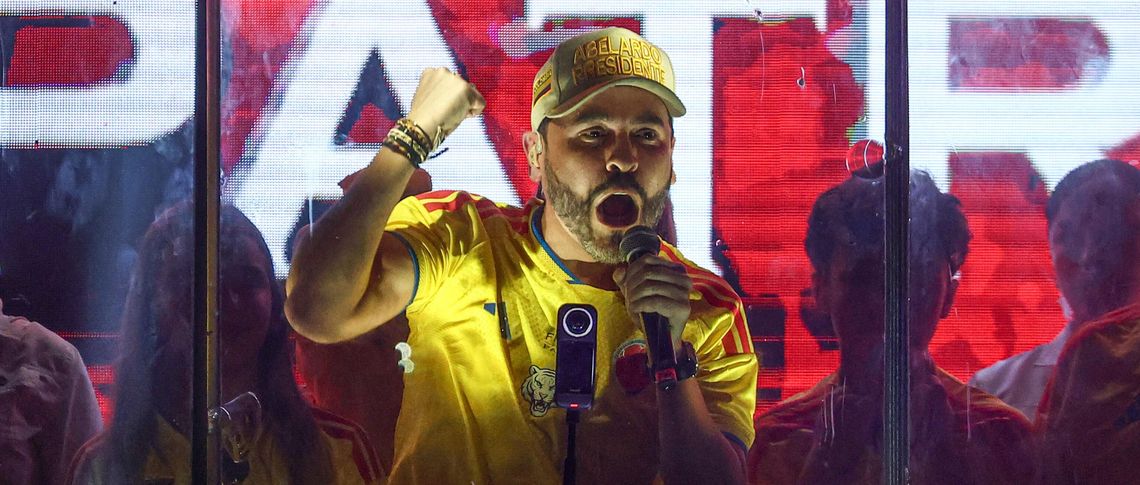
In doing so, voters are also answering the question of the kind of statehood that might still be possible in a country characterised by inequality. These choices also reflect the social alliances that back the two camps: Voters can vote for the model put forward by the far-right first-round winner, Abelardo De La Espriella: his alliance taps into the desire for state order and combines this with the promise of military toughness. The new-right challengers have adopted a course that combines populist rhetoric with a technocratic promise of stability.
The pull of the ‘iron fist’ approach
Authoritarian responses are presented as an alternative to a system that is perceived as gridlocked and ineffective due to conflicts between the executive and legislative branches, as well as contradictory regulations. Whilst the frontrunner advocates radical breaks, including withdrawal from the United Nations, his deputy acts as a moderate counterbalance and is intended to serve as a bridge to business circles. This combination of authoritarian security policy and a radical market focus finds favour with evangelical and military-minded voter groups. At the heart of this is an uncompromising crackdown on organised crime. The price of this course of action is also clearly stated: a 40 per cent reduction in the size of the state, the cutting of up to one million public-sector jobs, and the end of the ongoing peace process and the institutions that underpin it.
However, the absence of state authority only partly explains the popularity of far-right positions. Even in regions where a majority had voted in favour of the peace agreement in 2016, calls for a ‘firm hand’ and state authority are gaining support. This reflects not so much a rejection of peace as the realisation that the state’s promised capacity to act and the promised improvements have so far failed to materialise.
Regardless of the election result, the new government will face the same structural hurdles.
Either that, or voters are giving their mandate to Iván Cepeda of the ruling left-wing Pacto Histórico: as a representative of trade unions, urban centres, conflict-affected peripheral areas and historically marginalised groups, he stands for a model that relies on institutional reforms. Other groups are also being addressed in terms of personnel: the nomination of a recognised leader from the Nasa indigenous group for the vice-presidency exemplifies a power-political connection to the territories.
The leading left-wing candidate distances himself from an authoritarian ‘iron fist’ approach; instead, the focus is on compromises that derive their legitimacy from civil society alliances. His candidacy stands for the continuity of the peace process. At the same time, it responds to existing disappointments with the proviso that armed groups must not be allowed to expand their territorial control any further.
Regardless of the election result, the new government will face the same structural hurdles. Large parts of the country remain outside state control. However, as long as the periphery lacks access to water, educational opportunities or medical care, ideas conceived in the capital will not bear fruit.
All too often, competing armed groups step into this vacuum, effectively acting as surrogate states. The fact that calls for a ‘firm hand’ are gaining ground is therefore less a rejection of peace than a consequence of this lack of state presence. Bogotá’s scope for political action is constrained as much by empty state coffers as by a Congress without a majority. There is often a lack of parliamentary support for tax reforms and a lack of staff and political will to enforce existing rules. However, whilst a left-wing president could rely on the strongest parliamentary group, a right-wing incumbent would have only a small parliamentary group to fall back on. Both would be dependent on alliances and would have to strike compromises.
On the surface, this election is about security or peace, about libertarian populism or socio-ecological transformation. At its core, however, it is about the question of how a state can be governed.
Internationally, too, the scope for action is limited. Neither the US nor China will solve Colombia’s structural problems. External support can facilitate reforms, but it cannot replace a functioning state. Whether the next government prioritises security or integration, the crucial task remains the same: to establish a presence of state institutions where they have hitherto been absent. If Bogotá were to fall to an advocate of far-right ideas, the White House would have yet another ideological outpost on the continent. For Europe, however, such a change of course would still have consequences: it would lose an important partner in climate and environmental protection, as well as in the debate on the taxation of multinational companies.
This would also mean losing an ally in multilateral bodies and in the socio-ecological transition for the coming years. It currently remains to be seen whether, following the election, there will be a return to democratic and institutional stability – going beyond mere technocratic promises of order – or whether the political order will become even more fragmented. There is no indication that the country’s deep social divisions will be overcome any time soon. This increases the risk that the situation could spiral into renewed violence. Those who did not vote in the first round could now tip the balance: only if the left manages to mobilise the approximately 17 million non-voters in its favour can a victory for the right be prevented.
This election and the resulting course of action are of great significance both for Colombia and beyond. On the surface, this election is about security or peace, about libertarian populism or socio-ecological transformation. At its core, however, it is about the question of how a state can be governed when its territorial control, institutional capacities and political legitimacy have been eroding for years. The real challenge, therefore, will only begin after election day. For regardless of the election result, the next government will face the same reality: armed groups control parts of the periphery, public finances are strained and there are no stable parliamentary majorities. The winner will secure the presidency. Whether they will also gain the ability to govern the country remains the crucial unanswered question.