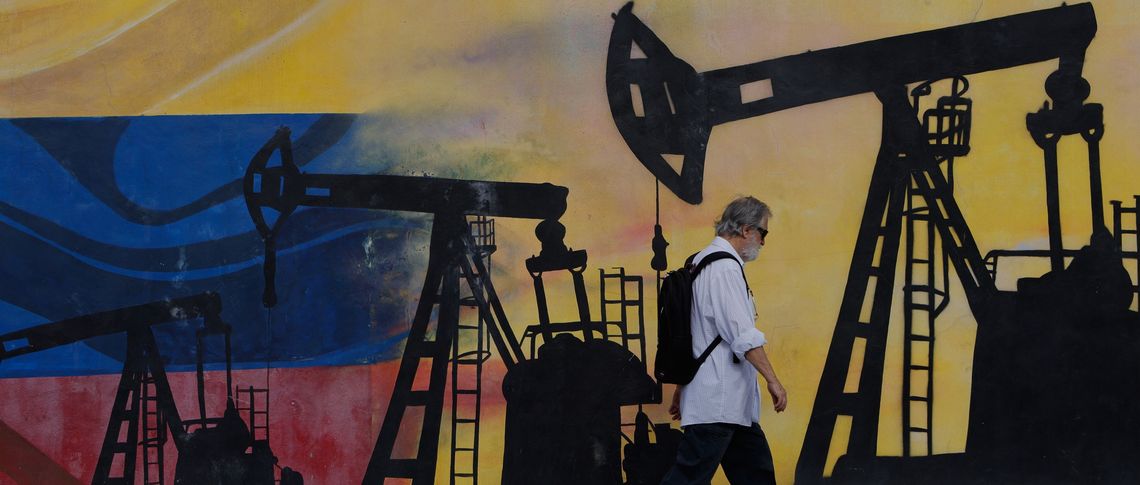
The US attack on Venezuela on 3 January marked the beginning of a new form of protectorate. The weakness of the Venezuelan government, its regional isolation and its opportunism have meant that the United States now not only has a seat at the table when it comes to all strategic decisions, but also has the final say. Formally, Venezuela remains sovereign; in practice, the country has entered a new state of dependency.
How smoothly this cooperation is working is demonstrated not least by the perfectly coordinated public messaging surrounding the latest energy agreement, which Venezuela and the United States concluded on 28 August: US President Donald Trump speaks to the American public and promises low petrol prices, Secretary of State Marco Rubio translates the measure into private investment and jobs for Venezuela, while interim President Delcy Rodríguez reassures the public that the agreement does not infringe on Venezuela’s sovereignty and that close diplomatic relations with the United States are a good way to move the country’s economy forward.
That the current government in Venezuela is essentially responsible for the country’s economic and institutional crisis goes unmentioned — another point on which the two sides agree. There are short news updates, presidential announcements and, frequently, deliberately planted rumours serving as trial balloons to gauge reactions to a possible ‘dollarisation’, as happened recently — followed by denials and reprimands. Disinformation and deliberate confusion have always been part of the Venezuelan government’s modus operandi. This, too, is something the government has in common with the current US administration.
Who calls the shots?
Given this communications strategy, few details of the energy agreement are known. According to the government, up to $100 billion is to be invested in oil production and infrastructure. The United States is to take control of 17 oil fields, representing around one-fifth of Venezuela’s total oil reserves. In this form, the deal would be unconstitutional, as the country’s natural resources are inalienable under Article 12 of the constitution. The government is working on the assumption of an oil price of $65 per barrel, of which around $19 would flow to the Venezuelan state in the form of taxes and other charges. Given the scale of the deal, the question is therefore less one of Venezuela’s formal sovereignty than of how much of it remains in practice.
Since the US intervention, Venezuelan oil exports have risen by 30 per cent. The reasons lie less in investment than in higher utilisation of existing production facilities and increased sales — to the United States. This business has already been under way since January: Venezuela sells its oil to the United States, which resells it with a ‘processing fee’. The profit flows into international accounts held in trust and administered by the United States, from where it is distributed to Venezuelan banks according to national needs, always subject to approval by the United States and the trust fund. The extent of the new dependency is therefore evident not only in oil production itself, but also in control over the revenues it generates. So far, there has been no sign of the promised transparency regarding public revenues and expenditure: the oil business remains the same black box it was before 3 January.
The hope that at least some of this money will eventually find its way into the pockets of the Venezuelan population remains as strong as it is unfounded. Workers in the oil sector have indeed received pay rises in some cases, and on 1 May the government introduced the usual increase in the state-mandated minimum bonus. But inflation continues to rise daily: since January, the bolivar has lost a further 175 per cent of its value against the dollar. Minimum wages, decent salaries and pensions, and sustainable jobs are on neither country’s agenda.
There is only one party guaranteed not to have a seat at the table: the population.
Yet Washington’s new influence now extends far beyond the economy. What was not yet apparent in January is an emerging, however it may ultimately be structured, political transition process. While the US intervention bore more of the stamp of Trump and Defence Secretary Pete Hegseth, Rubio has prevailed in recent months. The US calculation of relying on the existing government rather than bringing the elected 2024 president, Edmundo González, or opposition leader María Corina Machado into the picture is paying off. For one thing, the incumbent government keeps the country’s formal and informal armed groups under control. For another, the incumbent’s determination to cling to power is strong enough to ensure that she offers little meaningful resistance in negotiations. This functioning machinery led to an initial round of talks on a political transition in early August.
Here, the United States is not merely sitting at the table; it is also deciding who else gets a seat. Washington regards the parliament elected in 2015 as the last legitimate representative body and has appointed Dinorah Figuera, the parliament’s former president, as the opposition’s lead negotiator. Figuera has lived in exile since 2018 and has been politically insignificant in recent years — as have all the other members of the negotiating group. They are flown in once a month for the talks and stay in a hotel designated by the United States. All of them come from the conservative parties Primero Justicia and Voluntad Popular.
The fact that no politically representative selection was made from the 2015-elected parliament, but rather that conservative to staunchly Christian members were appointed, shows the conservative right-wing agenda Rubio is pursuing with regard to Venezuela and Latin America more broadly. Unlike Trump, he is concerned with more than oil.
Whatever assessment one makes of the talks, they will not give the Venezuelan regime a free pass. Whether they merely serve as a fig leaf to legitimise the political agenda of the current US administration or, as announced, whether more fundamental issues such as civil rights and the rule of law will also be addressed in the next round remains to be seen. A wave of releases of political prisoners following the first round of talks suggests the latter may be the case.
By popular demand
There is only one party guaranteed not to have a seat at the table: the population. There are no representatives of civil society organisations or trade unions, nor of Venezuela’s diverse democratic party landscape. No consultation process, no hearings, no opinion polls — why would there be? Critical engagement with what is currently happening in Venezuela is confined to a few individuals and circles who at most voice moderate criticism of ‘sovereignty’ or ‘participation’. Trust in the current government is so thoroughly destroyed that, according to the prevailing view, US involvement can only improve things. Or, as one student puts it: ‘We lost our sovereignty a long time ago — to our own people.’
This goes so far that some trade unions have demonstrated for higher wages not outside the Labour Ministry, but outside the US embassy. The United States’ significant involvement in rebuilding Maiquetía International Airport is also welcomed — in the hope that at least it will be done properly. People are aware that this gives the United States access to one of the country’s most important strategic facilities and, as critics argue, effectively puts a military base in its pocket, something the constitution prohibits. But for many, this is secondary. Blind obedience to Big Brother? Rather, it is a pragmatic and realistic assessment of the situation: in a Bloomberg/AtlasIntel poll, 40 per cent of Venezuelans said in July that nothing had changed in their country since Maduro was abducted, while 24 per cent each saw changes for the better and for the worse.
The Venezuelan paradox is that many do not experience this new dependency on Washington as a loss of sovereignty. After years of authoritarian rule and institutional decay, they instead hope that American control will allow them to regain political and economic room for manoeuvre. That is precisely what makes this new protectorate so stable — and so problematic.