


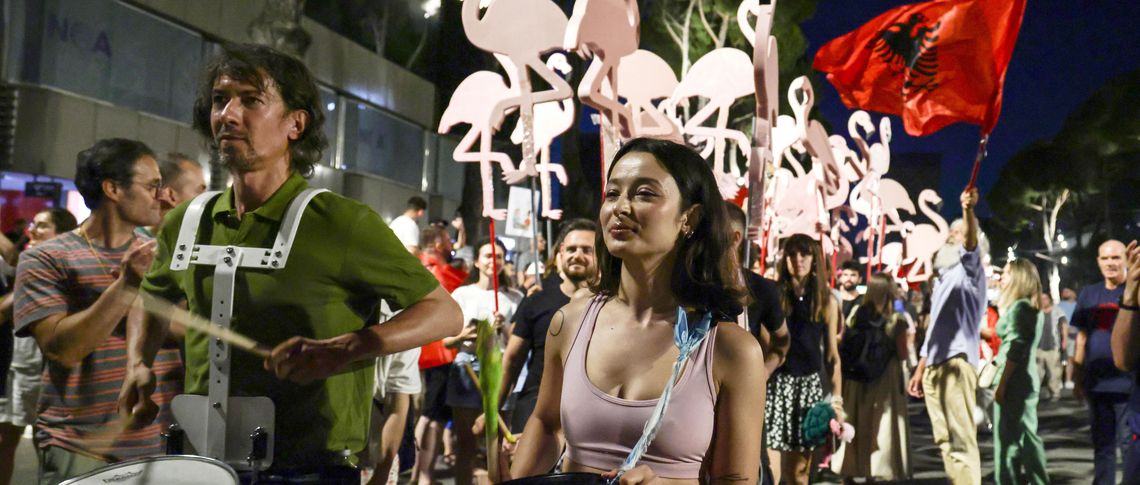
Like many of Eastern Europe’s revolutions, the recent protests in Albania did not begin with a political speech or a plan. They began with an image. In May, a peaceful protester in the southern seaside village of Zvërnec was dragged away by private security guards while police officers stood by. At the same time, construction vehicles started work on a luxury resort project backed by Trump’s daughter and son-in-law, Ivanka and Jared Kushner, and strongly supported by the Albanian government.
The project seeks to turn a revered, environmentally sensitive stretch of coast – a nesting ground for flamingos – into a playground for the world’s wealthy. Every part of it rankles in a country where incomes are stagnant while a select few prosper.
The property titles to the land in question are disputed. This is nothing new in Albania, where competing claims frequently overlap. The ostensible owner stands accused of forging title deeds and has been placed under investigation by the Special Prosecution against Corruption and Organized Crime for money laundering and international cocaine trafficking.
For three months, through a punishing heat wave, thousands of Albanians have taken to the streets each day to demand greater accountability and an end to corruption.
A fence on the beach. The inability to reach the sea. Thugs as the symbol of organised crime’s ties to politics and to oligarchs. Concrete devouring the coastline. For many Albanians, that scene captured a feeling that had been building for years, driven above all by real estate development in Tirana and along the coast. None of this was abstract. People live with it every day.
What followed was a chain reaction that revealed how much public frustration had accumulated. For three months, through a punishing heat wave, thousands of Albanians have taken to the streets each day to demand greater accountability and an end to corruption. Albanians living abroad, who make up about a third of the population, have helped shoulder the protest.
A symbol for something bigger
The protest reflects a sentiment that has been building for years across many layers of society: opposition to a predatory model of capitalism built at the expense of past and future generations — consuming the contributions of the former and ruining the prospects of the latter. Seen this way, the Zvërnec project is the final straw, and a lens through which all Albanians can understand how they have been governed. The furies it has released have opened a national debate about the country’s future: how Albania should develop, how decisions should be made, and whether citizens believe those decisions are taken in their interest.
This may indeed prove a defining moment in Albania’s history, akin to the fall of communism and its vice-like grip on politics, culture and daily life in my country. The people leading these daily demonstrations were born after that fall. They were not raised on fear or on the reflexes of the communist era. They have grown up in an open Albania: they have travelled, studied, and built lives connected to Europe and the wider world. They do not measure today’s Albania against its past. They measure it against what they believe their country is capable of becoming.
Their demands are neither radical nor ideological. Albanians want a functioning democracy with leaders who see themselves as servants of the people. They want institutions they can trust, decisions that are transparent, laws that apply equally, and confidence that public resources are managed for the benefit of the many rather than a privileged few.
Albania remains, perhaps, the most pro-American society in Europe, shaped by decades of friendship and gratitude towards the United States, and firmly committed to the Euro-Atlantic alliance.
So far, the government’s response has neither addressed the protesters’ demands nor quelled them. It is tempting to describe that response as a retreat. It is equally tempting to dismiss it as theatre. In June, the government placed civic protesters in the categories of hybrid-war manipulation, of an ‘algorithmic proletariat’, or of simple hostility. In July, it reversed the June repertoire without fully repudiating it. Instead, it tried, unsuccessfully, to adopt the vocabulary of the protest without abandoning the project or revising the development logic that produced the grievance.
It is equally important to understand what these protests are not. Despite the focus on Trump’s family and the resort development, these demonstrations are not a rejection of foreign investment, or of a luxury resort as such. This is a leaderless civic revolt against the way power works, and a warning that public anger can no longer be ignored.
Albania remains, perhaps, the most pro-American society in Europe, shaped by decades of friendship and gratitude towards the United States, and firmly committed to the Euro-Atlantic alliance. Albanians know that foreign investment, tourism and private enterprise are essential to economic growth. The question is whether development can be accompanied by transparency, accountability and public confidence. Those principles are not obstacles to investment. In the long run, they are among its strongest guarantees.
It’s the first time Albanians feel they can shape the national conversation without waiting for political parties to take the lead.
The flamingo that has become associated with these protests is only a symbol. The movement itself is about something much larger: the belief that Albania’s natural heritage, its public institutions and its future deserve careful stewardship. It’s the first time Albanians feel they can shape the national conversation without waiting for political parties to take the lead. The experience teaches us that democracy depends not only on elections, but on active citizenship between them.
The events unfolding in Albania can also be linked more closely to the EU accession process. For years, discussions about the country’s path toward EU membership have focused on familiar concerns: the rule of law, corruption, oligarchic capture of the state, organised crime and institutional weakness. Albania’s protesters are calling for change in these same areas. They are doing what responsible citizens do in every democracy. The EU’s silence, adopted as an institutional posture, should give way to strict but fair oversight that supports Albanian society in meeting European standards.
Since the fall of communism in 1990, Albania has made remarkable progress. It joined NATO, strengthened its partnership with the United States, served as an anchor of stability in Southeastern Europe, and moved steadily closer to the EU. The next stage of Albania’s success will depend on something different. Economic growth must be matched by institutions that enjoy public trust, and by a political culture that welcomes accountability rather than fears it.


