
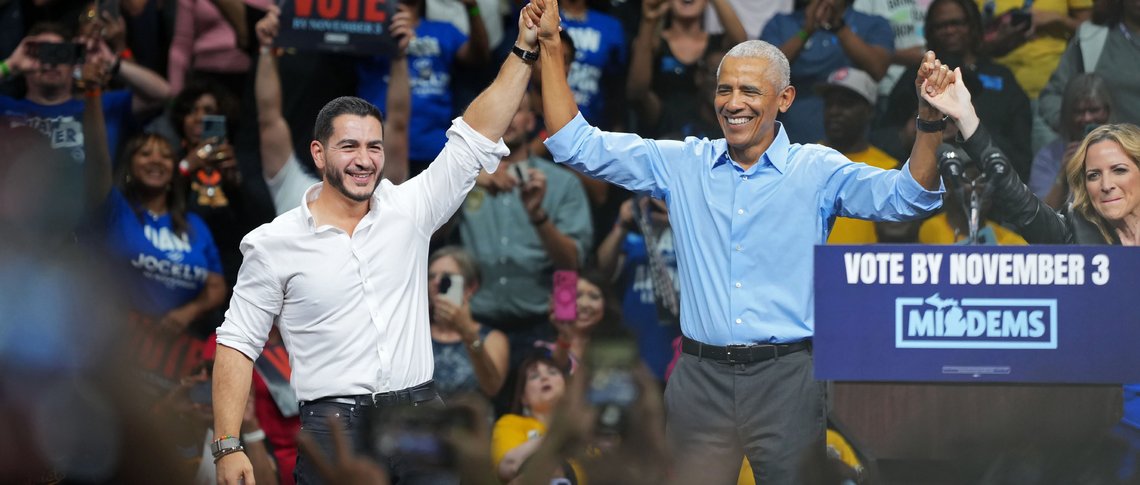
The Democrats have scored a resounding victory in the midterm elections, winning majorities in both the House of Representatives and the Senate. What explains their success?
I think the big takeaway from the midterm results is that this was a referendum on Donald Trump. Trump came into office just two years ago, riding a wave of frustration about the high cost of living and mass migration – a lot of the same issues Europe has been contending with in recent years. And he seemed to promptly squander it. He implemented tariffs that helped drive up the cost of living. Rather than simply trying to get control of the southern border, he launched a very aggressive campaign using ICE that ended up sweeping up a lot of American citizens in the process. But I think what really broke his coalition was the war in Iran. One of his big pledges during the presidential campaign was no more new wars. And he broke that promise. That’s what turned what we call a blue wave, which would have been a good midterm result for the Democrats, into a blue tsunami.
What do these results tell us about the Democrats’ standing with American voters? Can the party claim a mandate for its political agenda?
If I were the Democrats, I would be very careful in this victory. This appeared to be more of a mandate against Trump than in favour of the Democrats and their agenda. Even among those who voted, a majority still does not have a favourable view of the Democratic Party. And if you look at voters more broadly, including those who didn’t turn out, Democrats are still not viewed very favourably. So, I think they were a vessel for people’s frustrations with Trump. In America’s two-party system, if you’re frustrated with Trump and want to express that frustration, your only real option is to vote for a Democrat.
So, Democrats won big, but there’s still a lot of work to do. Just two years ago, they were swept out of power in Washington, and they’ve had a hard time regaining voters’ trust. Now they need to show voters that they can be trusted again. That means doing the things they ran on that worked: focusing on the cost of living, putting guardrails around AI and tackling corruption, without getting carried away with an overly ambitious agenda after just one election.
With their new strength in Congress, Democrats now have an opportunity to challenge Trump more directly. What should their priorities be over the next two years? And what mistakes should they avoid?
What’s interesting is that President Trump indicated on election night that he is open to working with Democrats in a bipartisan way on some big issues, including immigration and potentially election reform. And I think Democrats would be wise to take him up on that.
Having won back the House and Senate, their next goal is to win back the presidency. But the electorate in 2028 is going to look very different from this midterm election. Different voters will turn out, and they’ll be looking for different things. So, Democrats need to show voters who aren’t staunch Democrats what it would look like if they had full power.
Since the COVID pandemic, the biggest issues on people’s minds have been the cost of living and the economy. People feel it in their pockets, at grocery stores and gas stations, and they’re concerned about what AI is doing to the job market. Healthcare is another big issue. Democrats should focus on these everyday concerns and show voters what their plans are for the next two years. And if Trump is willing to work with them to pass laws that make a tangible difference in people’s lives, they should take those opportunities. If voters feel an improvement in their lives, Democrats should reap the rewards moving forward.
A new generation of progressive politicians is gaining influence within the Democratic Party. Is a major ideological showdown between the progressive and moderate wings inevitable?
I think so. And I think we’ll see that as soon as the first presidential candidates start announcing their campaigns, potentially before the end of this year, but certainly early next year. This is a long-overdue debate. Back in 2020, the moderates won. Joe Biden ran the most moderate campaign in the Democratic primary, and he won. But that was partly because Democratic voters wanted somebody they thought could beat Trump. Now Trump is out of the picture. He’s not running for re-election in 2028. So, this is really the first time since 2016, with Bernie Sanders and Hillary Clinton, that the party will face a reckoning over this internal struggle.
Looking at the results, I think it’s clear that moderate candidates overperformed relative to expectations and the partisan baselines of their states compared to progressive candidates. Abdul El-Sayed, Peggy Flanagan in Minnesota and Troy Jackson in Maine all underperformed some of the more moderate candidates who ran in even more conservative states. That should be a lesson for Democrats.
However, this is also the first time we’ve seen truly progressive candidates winning in battleground states. That’s not something that has really happened before in America. So, progressives will certainly try to claim that as a victory. Alexandria Ocasio-Cortez famously said before the election that if Abdul El-Sayed can win in Michigan, progressives can win anywhere. And I think we’ll see those battles play out over the next couple of years.
Looking ahead to the 2028 presidential election, what kind of political platform should Democrats run on? Would a more progressive agenda help them win, or should they move closer to the political centre?
I think there’s a lot of evidence that America is a centre-right country. Even as Democrats were winning big across the country, voters in many states, including very Democratic ones, were rejecting ballot measures – referendums on individual issues – that were seen as liberal, while supporting more conservative measures. For example, in Colorado and Washington State, voters approved measures that are more restrictive on transgender issues. In California, voters decisively rejected the introduction of a billionaire tax. This reinforces what we’ve known for a while: Americans are more moderate overall and even lean a little to the right on specific issues.
If you look at the three successful Democratic presidential candidates in recent decades – Joe Biden in 2020, Barack Obama in 2008 and Bill Clinton in 1992 – all three were viewed by voters as more moderate than the Democratic Party as a whole and more moderate than their Republican opponents. So, Democrats don’t want to be seen as too culturally out of step with the median voter. Academic research has reinforced this idea that when parties, especially those of what Thomas Piketty called the Brahmin left, get too far out of step with voters on cultural matters, they tend to face a backlash.
Democrats should focus on how to fix the cost-of-living and affordability issues and make what feels like a very unstable time – whether because of costs, migration or war – feel more settled. They need to show voters how they can make life more stable. That should be their focus moving forward.
Centre-left parties across Europe are struggling with similar questions about their political direction and how to reconnect with voters. What lessons can European Social Democrats draw from the Democrats’ experience in the United States?
As far as lessons from the midterms go, unfortunately, I don’t know that there are many so far. Trump overreached. It’s the story of a right-wing populist who came to power riding a wave of outrage over mass migration and the cost of living, then overreached. And the Democrats were the beneficiaries of that.
Right now, people around the world feel that things are very unstable and that the pace of change is simply too fast. Right-wing populists are capitalizing on that, claiming to have easy answers. So, if you’re a centre-left party, you have to get ahead of these issues. First and foremost, you have to treat voters’ concerns as legitimate rather than dismissing them. And you have to do something about them. Parties hoping to avoid their own Trumps or Le Pens need to anticipate the problems that might arise and address them before they get there.
This interview was conducted by Nikolaos Gavalakis.